
The Cable That Whispered Too Slowly
Two Minutes a Letter
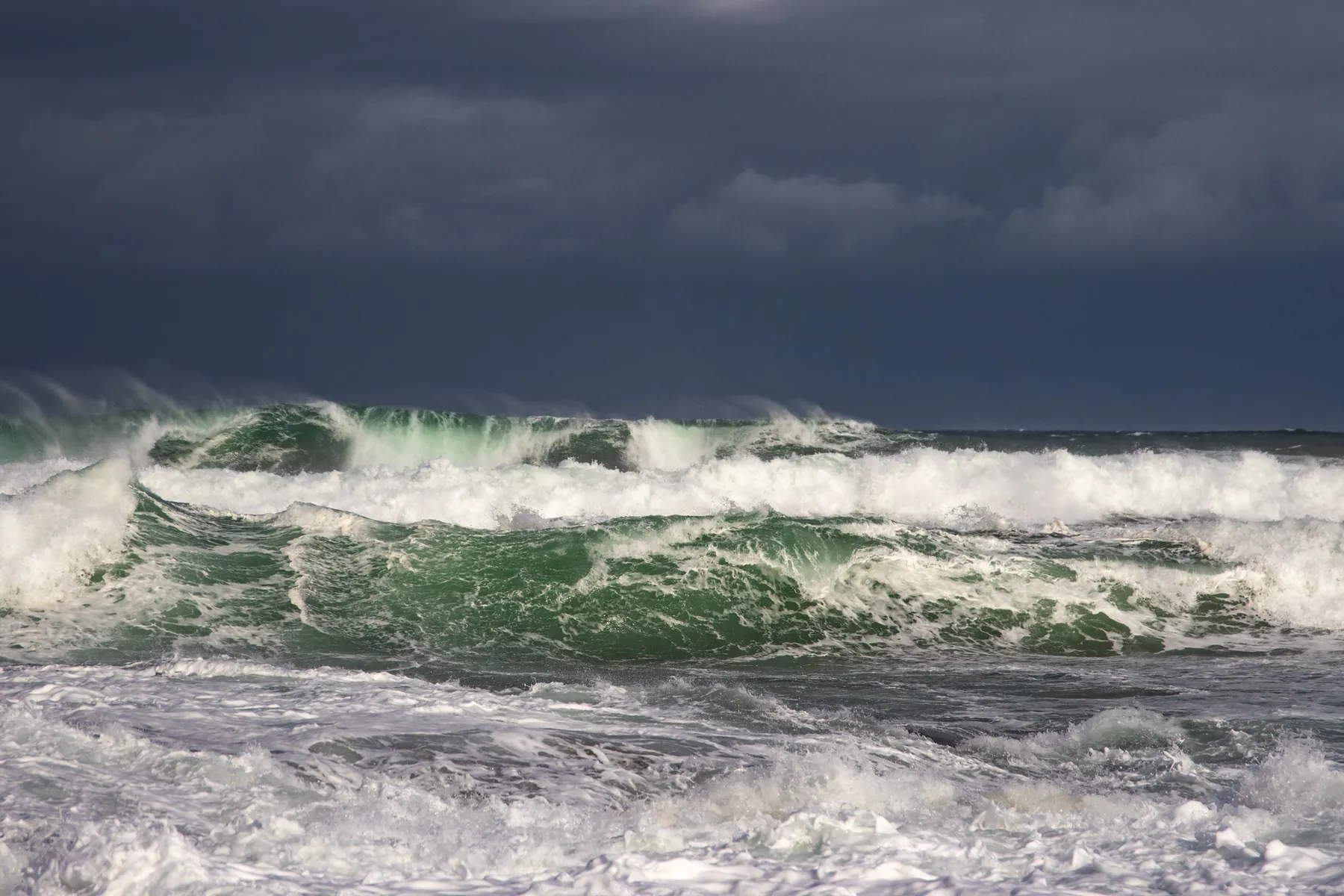
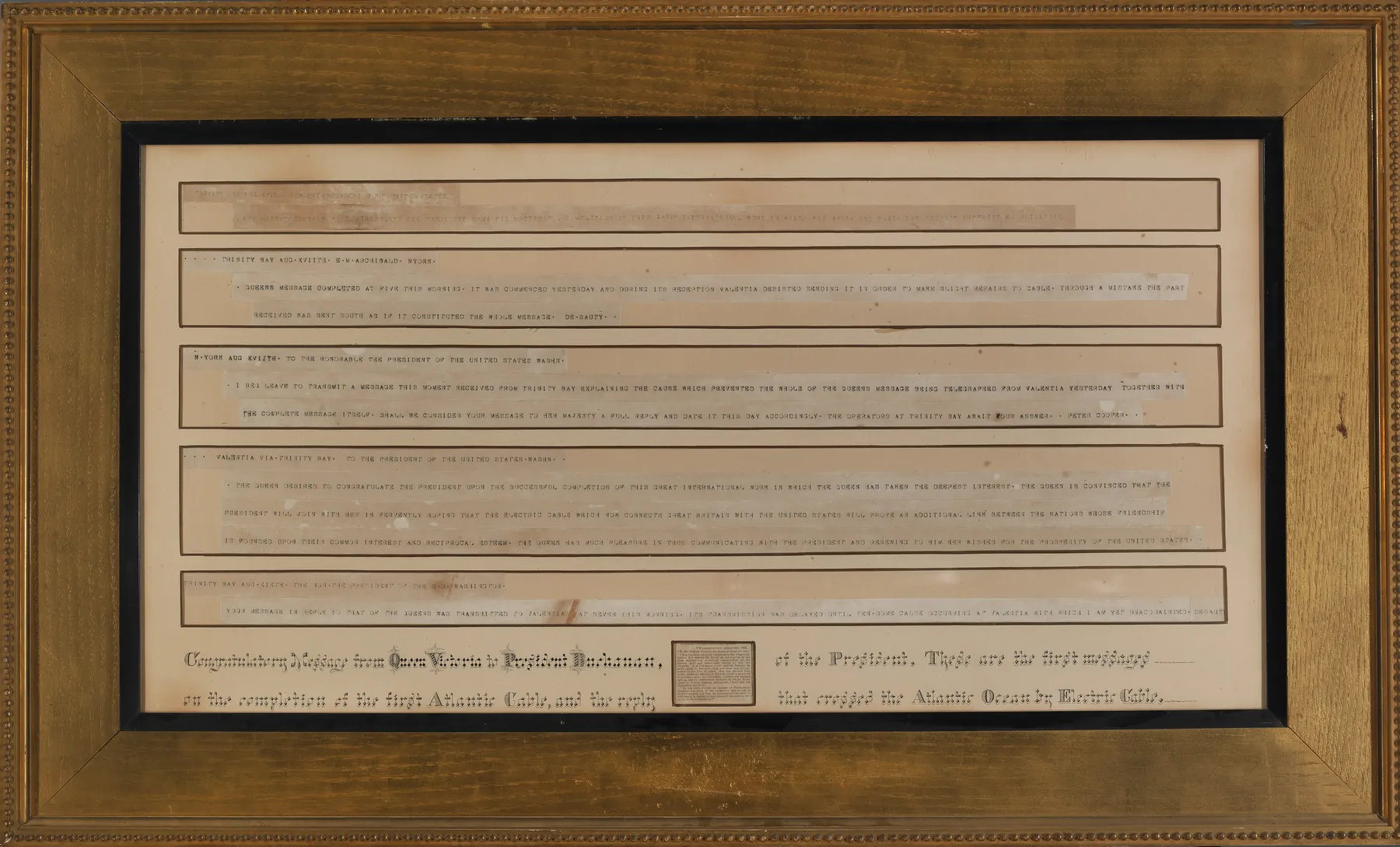
In August 1858, after a failed expedition in 1857 and another in June 1858, two warships finished laying a telegraph cable across the floor of the Atlantic, from Valentia Island in Ireland to Trinity Bay in Newfoundland. On 16 August the first official message went through: “Europe and America are united by telegraph.” Queen Victoria’s greeting to President Buchanan followed, 98 words. Valentia began sending it at 4.15 that afternoon; after 25 words the operator broke off with “Wait repairs to cable”, and the last word went through at 6.48 the next morning, fourteen and a half hours after the first. In ordinary working the cable carried about a tenth of a word a minute, two minutes for every letter. By September, after days of failing insulation, it was dead.
Nothing was wrong with the idea. Something was wrong with the length, and three years before the cable was laid a young professor in Glasgow, William Thomson, had worked out exactly what.
A Cable Is a Bar of Heat
A submarine cable is a copper wire inside a sleeve of insulation, lying in salt water. The copper resists the current, and the wire, its insulation and the sea around it make a long, thin capacitor that has to fill with charge before the far end feels anything. In 1855 Thomson saw that this is Fourier’s problem of heat in a bar. If $R$ and $C$ are the resistance and the capacitance of the cable per mile, the voltage $V$ along it obeys
which is the heat equation. Its consequence is the law of squares. Every time in the problem is a multiple of one time scale,
for a cable of length $\ell$. Make the cable twice as long and both its resistance and its capacitance double, so everything happens four times more slowly.
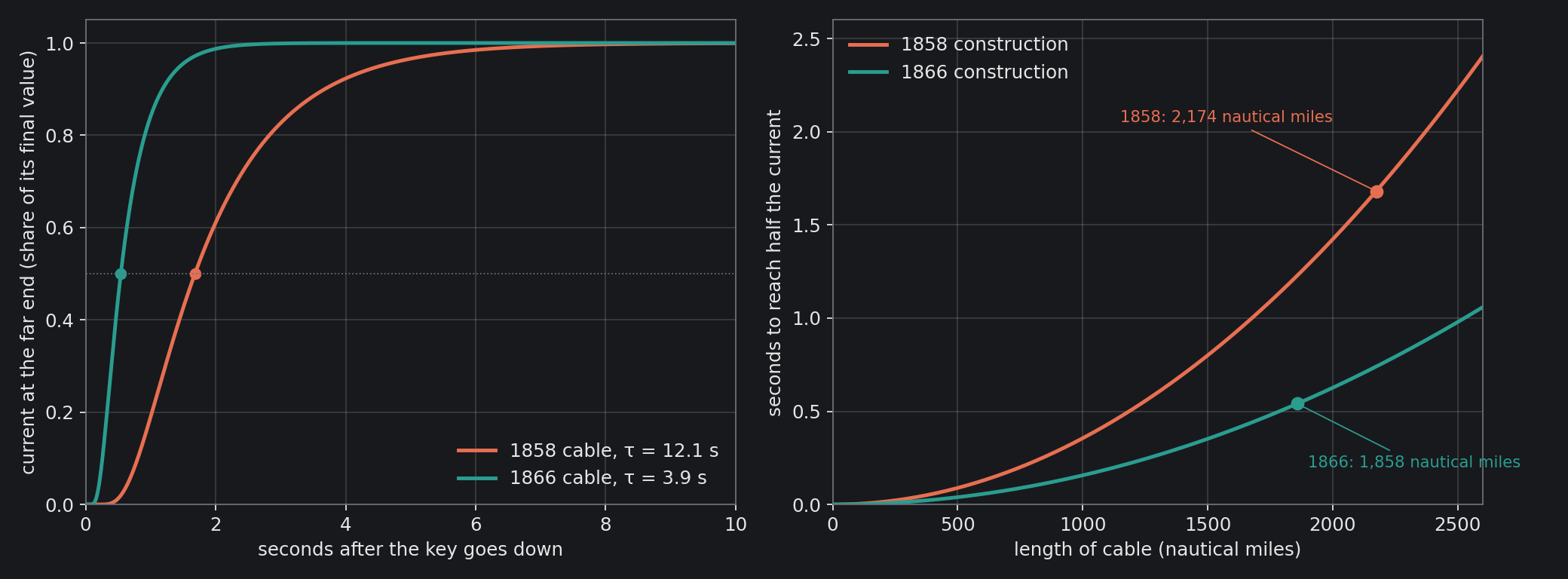
I could not find $R$ and $C$ of the 1858 cable in print, but its construction is on record: a strand of seven copper wires weighing 107 pounds per nautical mile, inside 261 pounds of gutta-percha, 2,174 nautical miles of it. Copper’s weight gives the wire’s cross-section and so its resistance; the gutta-percha’s weight gives the thickness of the sleeve, and a coaxial sleeve’s capacitance follows from its two radii. I checked the method on the 1865 cable, for which Fleeming Jenkin published both the weights and the measurements. From its 300 pounds of copper per mile it gives wires 0.0483 inches across in a strand 0.1448 inches across; Jenkin measured 0.048 and 0.144. Calibrated on his figures, the 1858 cable comes out at 12.0 ohms and 0.21 microfarads per nautical mile, 26,000 ohms and 465 microfarads in all. (That assumes copper as pure as 1865’s; the 1858 copper was worse, which would only slow the cable further.) Its time scale:
somewhere between 10 and 17 seconds, depending on what the gutta-percha’s dielectric constant really was (dried gutta-percha measures 2.6 to 3.0; I used 3).
What Arrives at the Far End
Close the key at Valentia, and at Trinity Bay, where the cable runs to earth through the receiving instrument, the current does not jump. It creeps in. The heat equation gives its exact shape, a sum of decaying exponentials:
where $I_\infty$ is the steady current the battery will eventually push through. On the 1858 cable, for the first half second almost nothing arrives. A tenth of the current has arrived after 0.8 seconds, half after 1.7 seconds and nine tenths after 3.7 seconds. When the key opens again, the current drains away just as slowly.
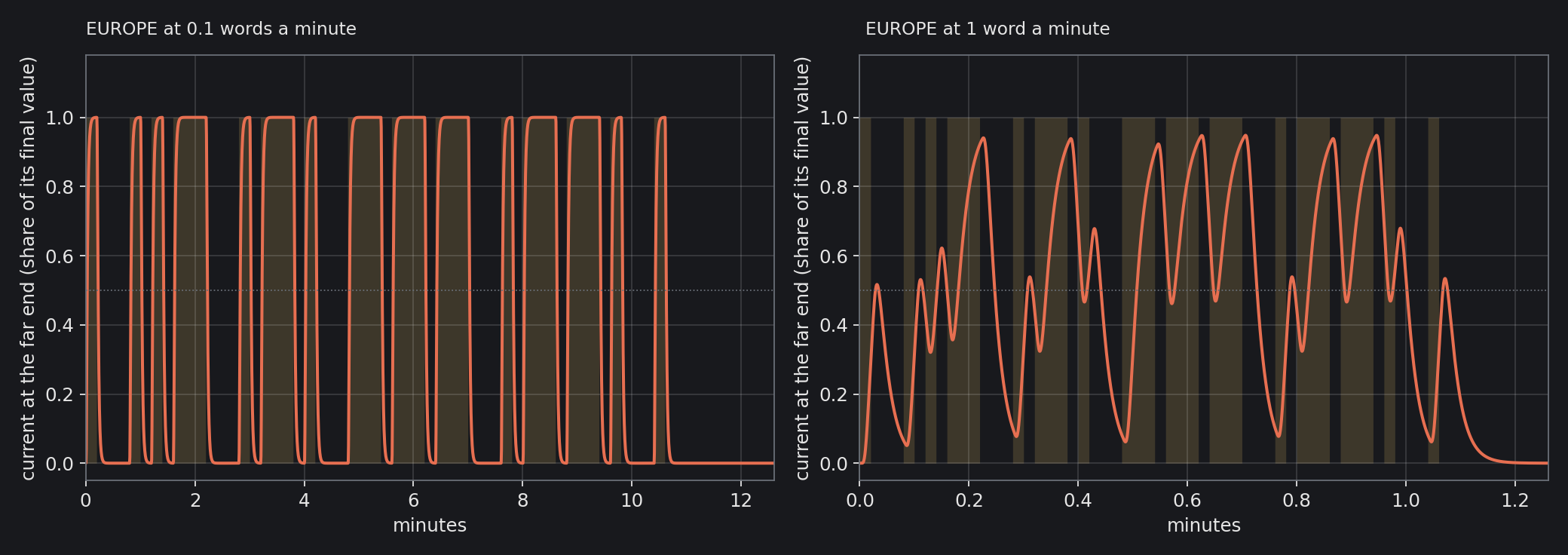
That is what limits the speed. A dot that is shorter than a couple of seconds never rises to its full height, and the gap after it never falls back to zero, so the next dot starts on top of the last one’s tail. Send slowly and every dot and dash arrives cleanly. Send faster and they smear into one another until the marks can no longer be told from the gaps.
To put a number on “can no longer be told apart”, I used a simple reading rule: look at the current once in the middle of every unit of the Morse code, at the best delay, and require every mark to read higher than every gap. By that rule the 1858 cable could carry the first official message at up to 1.2 words a minute in ordinary on-and-off Morse, and 1.4 words a minute in the cable code that submarine telegraphy used, in which dots and dashes are pulses of the same length and opposite polarity. The operators’ log of the Queen’s message shows how far below that the cable worked: its first 25 words took 2 hours 14 minutes, 0.19 words a minute, and all 98 took fourteen and a half hours, with the insulation already failing, stray earth currents in the line and every doubtful word repeated.
A Fiction of the Schools
The Atlantic Telegraph Company’s chief electrician, Wildman Whitehouse, was a doctor who had taught himself electricity. He did not believe the law of squares. In 1856 he told the British Association that his own experiments showed the delay growing hardly faster than the length, and called Thomson’s law “a fiction of the schools”. To work the cable he wanted currents strong enough to drive the printing telegraphs used on land, from induction coils of thousands of volts, and when the 1858 cable was landed he drove up to 2,000 volts through it.
Here is what the equation says about that. It is linear. Double the voltage and every current in it doubles, at every moment; no time changes at all. The arrival curve keeps its shape, the half-current time stays at 1.7 seconds, and two dots that blur together at 50 volts blur together exactly as much at 2,000. More voltage could not make the cable faster. It could only stress the gutta-percha, and the cable was already badly made: in its first hundred miles from Ireland, samples later showed the copper sitting badly off-centre in its insulation. The cable failed in September, and Whitehouse was held responsible and dismissed.
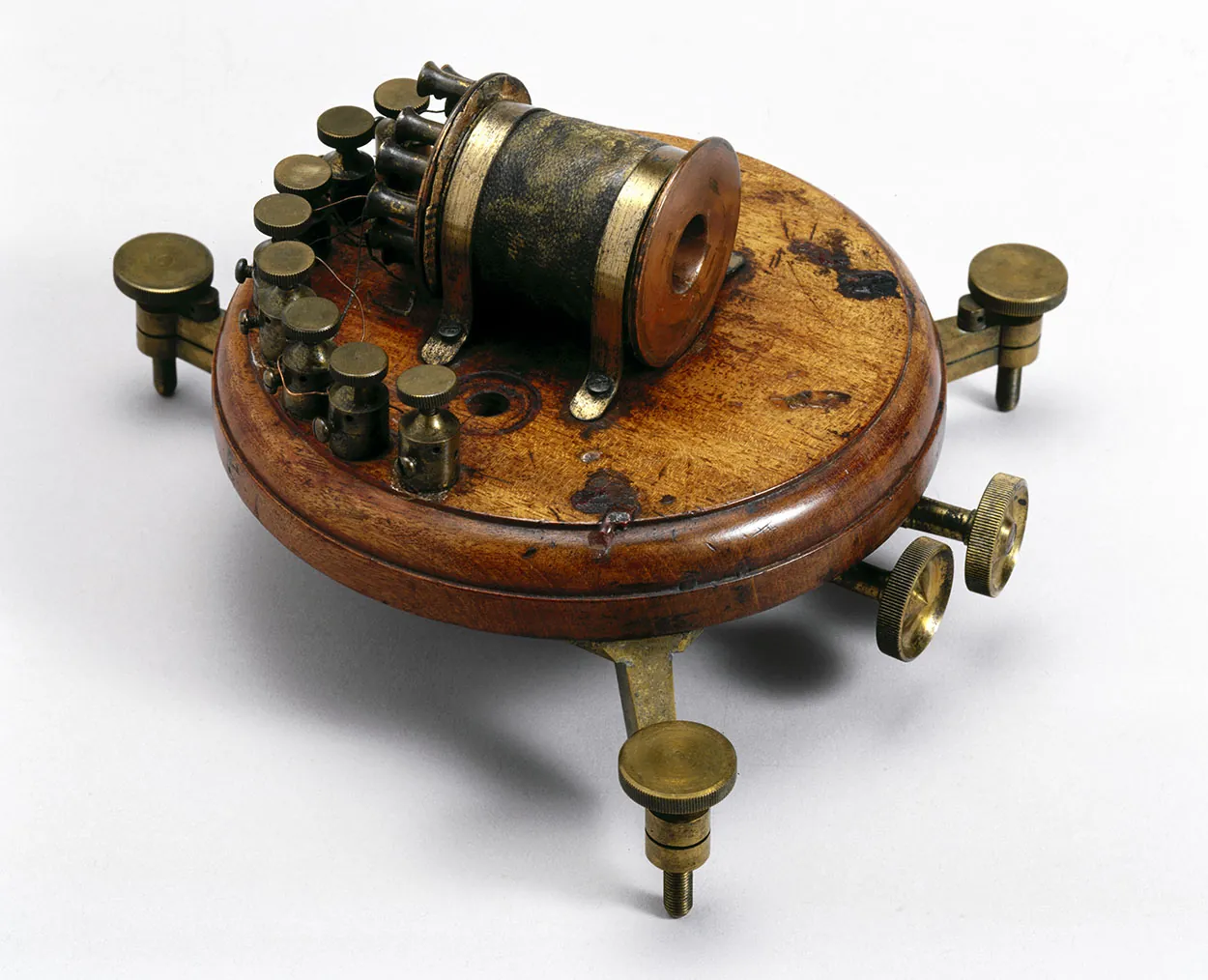
Thomson’s answer had been the opposite: weak currents, read by an instrument sensitive enough to see them. His mirror galvanometer hung a tiny magnet and mirror on a silk thread inside a coil; the faintest current turned it, and a spot of light reflected from the mirror swung left or right across a scale. During the laying voyage of 1858 he had received clear signals with it all the way across.
To compute what arrives for a whole message, the equation’s linearity does all the work: every time the key moves, the cable answers with one more copy of the arrival curve, shifted to that moment and with the sign of the move.
Algorithm — The Current at the Far End of a Cable, for a Morse Message
input:  R, C per mile; length ℓ; battery V
        the message as Morse units, each +1, −1 or 0
        unit: the length of one unit in seconds
τ ← R·C·ℓ²;  I∞ ← V / (R·ℓ)
A(s) ← 1 + 2 Σ (−1)ⁿ exp(−n²π² s)     the arrival curve
        (for small s the same function as
         2 √(1/(π s)) Σ exp(−(k + ½)² / s), which converges faster)
edges ← every unit k where the key changes, with the size
        of the change, Δₖ
I(t) ← I∞ · Σ over edges  Δₖ · A((t − k·unit) / τ)
return I(t)
I checked the formula against a direct solution of the heat equation on a grid of 400 points, stepped in time by the Crank–Nicolson method, with the far end earthed: for a single step they agree to $\textstyle 10^{-5}$ of the final current, and for the Morse message SOS to $\textstyle 6 \times 10^{-4}$.
The cable of 1866 was laid by the Great Eastern with 300 pounds of much purer copper per mile and 400 pounds of insulation, over 1,858 nautical miles. Its time scale is 3.9 seconds, three times shorter than 1858’s. It carried 8 words a minute, eighty times more. The law of squares and the heavier copper bought the first factor of three; the rest came from better instruments and from clerks who could read a swinging spot of light far better than my simple rule, which stops at 3.6 to 4.5 words a minute on that cable.
Make It Worse to Make It Better
Thomson’s equation leaves two things out: the inductance of the cable, which makes a current reluctant to change, and the slow leakage of current through the insulation. In the 1870s and 1880s Oliver Heaviside, a self-taught former telegraph clerk, put both back. With $L$ and $G$ the inductance and the leakage per mile, his telegrapher’s equations carry a signal undistorted, at a speed of $\textstyle 1/\sqrt{LC}$ and only growing weaker, when
Every working cable had far too little inductance to meet this, so Heaviside’s advice in 1887 was to add more of it: coils along the line. That sounded like madness. William Preece of the Post Office had just declared self-inductance the great enemy of clear transmission, and he blocked the paper.
For a long submarine cable the cure is also nearly impossible to apply. The 1866 cable, laid in cold deep water with superb insulation, leaked so little that meeting Heaviside’s condition would have taken about 2,500 henries per nautical mile, an impossible amount. Land lines needed far less, and from about 1900 loading coils, patented in America by Michael Pupin and developed by George Campbell at AT&T, carried telephone calls much farther. Under the sea the inductance came in 1924, as a tape of permalloy wound round the copper of a cable from New York to the Azores, which then worked about four times faster than an ordinary cable of its length.
Send Your Own Telegram
The board below sends a message of your choice through either cable, at any speed, with any battery, in on-and-off Morse or in the cable code, and shows the current that arrives. Raise the battery to Whitehouse’s 2,000 volts and watch the milliamps climb while the second chart, which shows the same current as a share of its steady value, does not move at all; neither does the verdict. Lengthen the cable and watch the law of squares take the speed away. I checked the board against the Python code: its arrival curve and its currents agree to $\textstyle 3 \times 10^{-16}$, its fastest readable speeds to six significant figures, and its readability cards are identical at 50 and 2,000 volts.
Twice the Equation Won
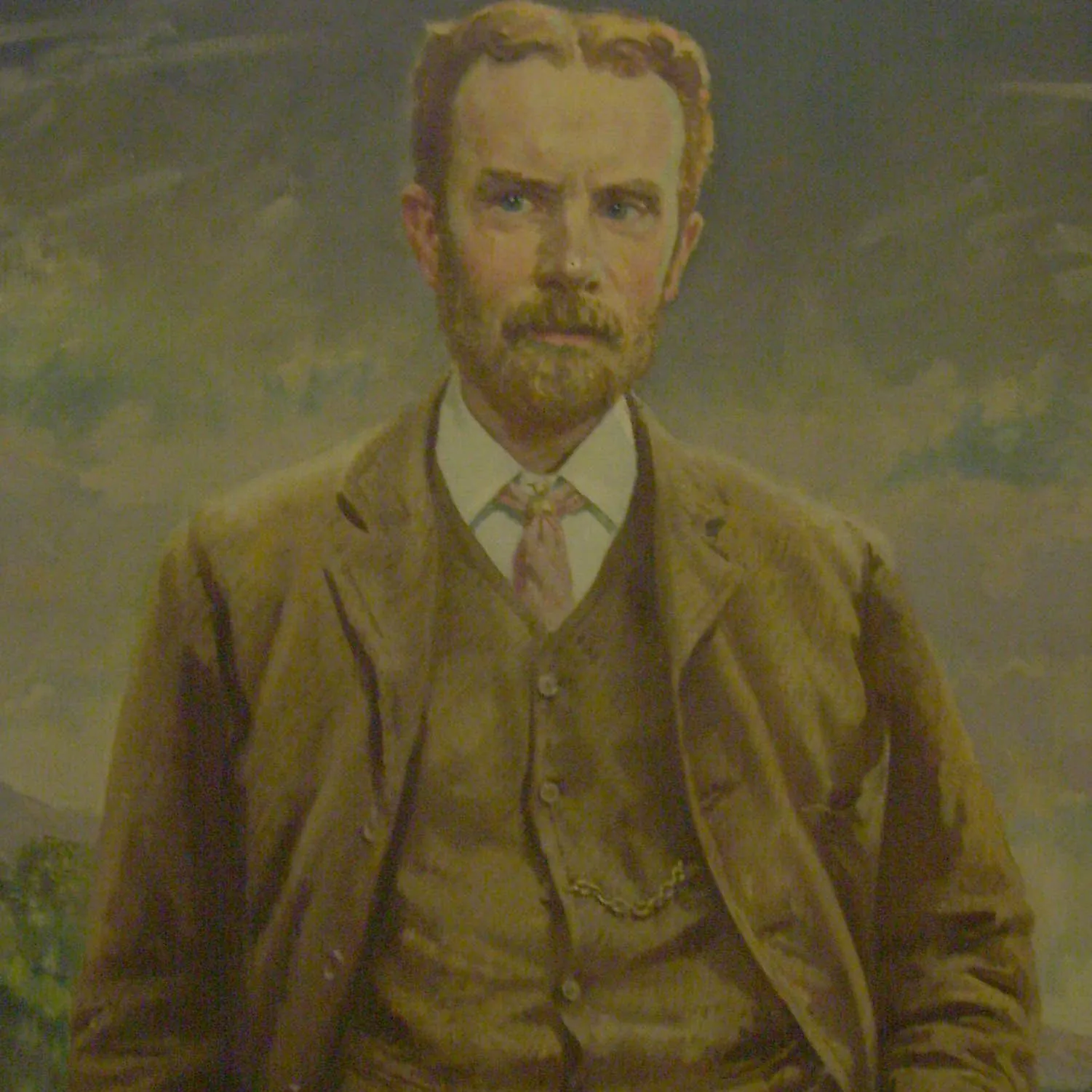
Twice, a practical man looked at a theorist’s equation for a cable and called it wrong, and twice the equation won. Thomson was knighted in November 1866, after the second cable worked. Heaviside never was. When AT&T offered him money for his rights in the loading coil, he refused it unless the company gave him full recognition, and he died poor in 1925.
Sources
- W. Thomson, “On the theory of the electric telegraph”, Proceedings of the Royal Society of London 7 (1855) 382–399.
- “The three Atlantic cables”, Mechanics’ Magazine (1866), and F. Jenkin, “On the two Atlantic telegraph cables”, Scientific Review (1866), both reprinted in “Engineering facts and figures for 1866”, atlantic-cable.com.
- B. J. Hunt, “Wildman Whitehouse, William Thomson, and the first Atlantic cable”, in Imperial Science: Cable Telegraphy and Electrical Physics in the Victorian British Empire, Cambridge University Press, 2021, chapter 2.
- O. Heaviside, “Electromagnetic induction and its propagation”, The Electrician (1885–1887).
- P. J. Nahin, Oliver Heaviside: The Life, Work, and Times of an Electrical Genius of the Victorian Age, Johns Hopkins University Press, 2002.
- “Transatlantic telegraph cable”, “Oliver Heaviside” and “Heaviside condition”, Wikipedia: the dates, the speeds of 1858 and 1866, Whitehouse’s voltages and dismissal, Preece and AT&T.
- “1924 New York – Azores cable”, atlantic-cable.com: the permalloy loading.
- “Messages carried by the 1858 cable”, atlantic-cable.com: the operators’ log of 16–17 August 1858, with the times of the Queen’s message.
- Library of Congress, “First transatlantic telegraph cable sent”, This Month in Business History.
Every number in the text, the two charts and the board are computed by the scripts archived with this post: the cable constants derived from the published construction, the arrival curve in closed form checked against a Crank–Nicolson solution of the heat equation, and the reading rule, its results saved once; the board was checked against the same Python code in a browser.
Interested in applying these ideas to your work? Get in touch.