
The Lease That Was as Good as Forever
As Good as Forever
On 9 June 1898, in Peking, Britain and Qing China signed a convention that leased the New Territories, the land north of Kowloon, to Britain for 99 years, rent-free. The British negotiator, Sir Claude MacDonald, settled for a lease of 99 years because, as he saw it, that was “as good as forever”.
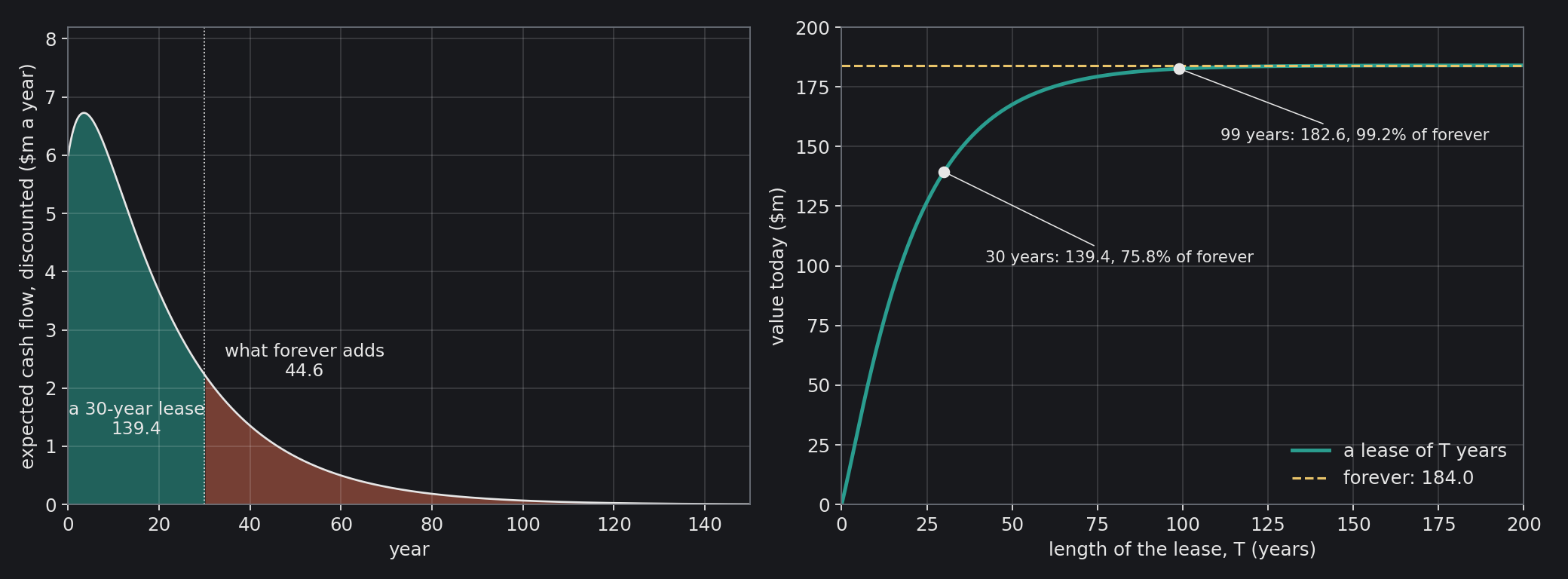
In money, he was nearly right. At a discount rate of 5% a year, a steady income for 99 years is worth 99.3% of the same income forever. The last 0.7% is all that forever adds after the first century. A 30-year concession is a different matter: the same income for 30 years is worth only 78% of forever.
This post is about that gap, and about a habit of the people who value projects. Many of the classic models of investment, Dixit and Pindyck’s book among them, and Boyarchenko and Levendorskii’s, work with projects that last forever. Forever is much easier to handle. But real projects end: licences expire, leases run out, plants wear down. How do you get from the easy answer, forever, to the true one, T years? We will take it slowly, in four steps, and the last step will turn out to be a question about interest that Jacob Bernoulli asked in 1683.

A Cash Flow That Wanders Home
Let us value something concrete: a concession that pays a cash flow $X_t$, in millions of dollars a year. Most years it pays about 10. It has had a bad year and pays 6 today, and bad years do not last: the cash flow is pulled back towards its normal level, with some random wobble on the way. The standard model of a quantity like that is the Ornstein–Uhlenbeck process:
Here $\theta = 10$ is the normal level, $\kappa = 0.2$ is how hard it is pulled back (half of any gap is gone in $\ln 2/\kappa = 3.5$ years), and $\sigma$ sets the size of the wobble. On average, the gap between today’s cash flow and the normal level simply fades away:
where $x = 6$ is today’s cash flow. There is no option anywhere in this post: the concession pays whatever it pays, every year, until it ends. That keeps everything about averages. The wobble $\sigma$ makes each possible future look different, but it never changes a value, because the value of a cash flow that is paid in full only depends on what it pays on average.
What Forever Is Worth
The value of the concession forever is the expected sum of all its future cash flows, each discounted to today at $r = 5\%$:
Swapping the average and the integral is allowed here, and it leaves two simple integrals: the normal level $\theta$ paid forever, and today’s gap $(x – \theta)$, which fades at rate $\kappa$ while it is being discounted at rate $r$:
The first piece is an ordinary perpetuity: 10 a year forever at 5% is worth 200. The second piece says that a gap which fades is worth the same as a gap that lasts forever but is discounted faster, at $r + \kappa = 25\%$ instead of 5%: mean reversion works like extra discounting. Today’s gap of $-4$ is worth $-4/0.25 = -16$, so the concession is worth $\textstyle 200 – 16 = 184$ million, forever.
Here is why the classic models love forever. A claim that never ends looks exactly the same tomorrow as it does today, so its value depends only on the state of the world, not on the date. It satisfies an equation with no time in it at all:
Mathematicians call the solution the resolvent of the process, and write it $\mathscr{R}_r f$: the value forever, at the rate $r$, of a cash flow $f(X_t)$. Here $f(x) = x$, so $V_\infty = \mathscr{R}_r f$. For our concession it is the straight line above (I checked it by finite differences: the equation holds to $\textstyle 2 \times 10^{-11}$). A project with an end date has a value that also depends on how much time is left, and its equation gains a time derivative. That one extra term is the reason so much of the literature prefers forever.
Forever Minus Forever
Here is the first way back from forever, and it needs nothing new. A lease of $T$ years is a claim that starts today and runs forever, minus a claim that starts in $T$ years and runs forever. The second claim is worth $V_\infty$ at whatever the cash flow is doing at time $T$, discounted back to today:
For our concession, every piece is known, and the answer is
Each piece of forever loses its tail at its own speed. Today’s gap is discounted at 25% a year, so after a couple of decades it no longer matters. The normal level is discounted at only 5%, so its tail is long. A 30-year lease is worth 139.4 million, 75.8% of forever; a 50-year lease 167.6 million, 91.1%; a 99-year lease 182.6 million, 99.2%. The lease reaches 99% of forever after 93.8 years, so MacDonald’s 99 years sit just past that line.
The line moves with the discount rate. At 3%, it takes 155 years to reach 99% of forever; at 2%, 232 years. And if the income grows, what matters is the discount rate minus the growth rate: a rent that grows by 3% a year, discounted at 5%, keeps 13.8% of its value beyond the 99th year. Whether forever is a harmless shortcut depends on the numbers. For a 30-year project it almost never is.
When Forever Is All You Have
Forever minus forever needs one thing: the distribution of the cash flow at a fixed date $T$, to compute $\mathbb{E}[V_\infty(X_T)]$. For our concession that is easy. For many models it is not: add jumps, or a cash flow that switches between regimes, and the value forever, with no time in it, can still be easy to find while the distribution at a fixed date is hard. In 1998 Peter Carr found a way to get the finite answer from forever problems alone. The trick is to make the end of the lease random.
Start with the crudest version. Suppose the lease does not end on a fixed date, but at a random moment that is equally likely to come in any year, with an average wait of $T$ years: an exponential clock with rate $\lambda = 1/T$. Such a clock has no memory. However long the lease has already run, its expected remaining life is still $T$, so the problem looks the same every year again, and there is no time in it. Ending at rate $\lambda$ works exactly like discounting $\lambda$ faster, so the value is the forever formula with $r$ replaced by $r + \lambda$:
For a lease of 30 years this gives 105.9 million, against the true 139.4. Far too low. Look at the normal level to see why: the exact lease keeps the fraction $\left(1 – e^{-rT}\right)$ of the perpetuity, 0.777 for 30 years, but the random end keeps $\left(1 – \tfrac{1}{1 + rT}\right) = 0.600$. The random end has quietly replaced $e^{-rT}$ by $\tfrac{1}{1 + rT}$, and that is simple interest. An exponential clock with an average of 30 years ends within 5 years 15% of the time, and those early ends cost more than the late ones give back.
Many Small Random Ends
The cure is to cut the lease into $N$ stages, each ending at an exponential random time with an average of $T/N$ years. The lease ends when the last stage does. The total length still averages $T$ years, but it is much less spread out: the more stages, the more tightly the end gathers around $T$. With 64 stages it falls between 22 and 38 years 97% of the time.
Each stage is again a problem with no time in it, because each stage’s clock has no memory. While a stage lasts, the lease pays its cash flow; at rate $\lambda = N/T$ the stage ends, and the owner holds what is left of the lease, which is worth the value with one stage fewer. So each stage is a forever problem at the rate $r + \lambda$, fed by the stage after it, $V_n = \mathscr{R}_{r+\lambda}\big(f + \lambda V_{n-1}\big)$:
Algorithm — A Finite Lease From Forever Problems Alone
input:  ℛ[q] f: the value forever of a cash flow f,
                  discounted at rate q (the resolvent)
        T: the length of the lease;  N: the number of stages
λ ← N / T                    each stage ends at rate λ
V[0] ← 0                     when the last stage ends,
                             nothing more is paid
repeat for n = 1 … N:
    V[n] ← ℛ[r+λ]( f + λ·V[n−1] )
                             earn f during the stage; at rate λ
                             move on to the rest of the lease
return V[N]                  → the T-year value as N grows
better:  2·V[2N] − V[N]      (Richardson extrapolation)
For our concession every stage is a straight line in $x$, and the whole recursion collapses to a formula. Every $e^{-cT}$ in the exact answer turns into $(1 + cT/N)^{-N}$:
That is compound interest: the discount factor of a lender who adds interest $N$ times over the life of the lease. With one stage it is simple interest. As $N$ grows it becomes continuous compounding, $e^{-rT}$, and the value becomes the true one. For the 30-year lease, 1 stage gives 105.9 million, 4 give 128.3, 16 give 136.4 and 64 give 138.6, against 139.4 exactly. The error halves every time $N$ doubles, which is what makes the shortcut on the last line of the algorithm work: $\textstyle 2V^{(16)} – V^{(8)} = 139.2$, off by 0.18, and $\textstyle 2V^{(64)} – V^{(32)}$ is off by 0.012.
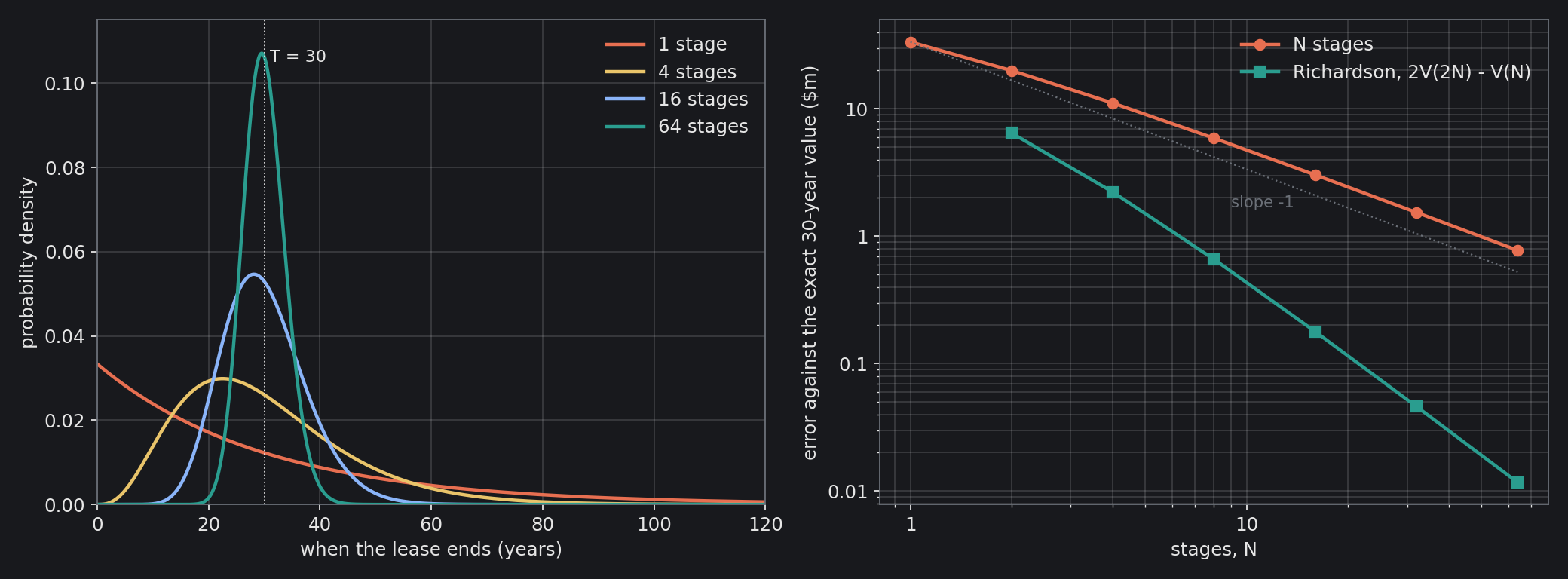
To check all of this without trusting the formulas, I simulated 200,000 possible futures of the cash flow, in steps of a week, added up each one’s discounted cash flow, and averaged. For 30 years the simulation gives 139.30 million against 139.38 from the formula (1.3 standard errors apart). With a random end in one stage it gives 105.89 against 105.88; in four stages, 128.28 against 128.28.
Bernoulli’s Question, Run Backwards
In 1683 Jacob Bernoulli asked a question about money, and published it in 1690: if a lender’s interest were added to the loan “at every moment”, how much would he be owed at the end of the year? With interest added once, a loan at 100% doubles. Twice, it grows to 2.25 times; monthly, 2.61; daily, 2.71. Bernoulli showed it would be “more than 2½ and less than 3” times the loan. The number it settles on, $(1 + 1/n)^n$ as $n$ grows, is $e = 2.71828\ldots$, the number that every continuous discount factor in this post is built from.
The random stages run his question backwards. Discounting continuously over the life of a lease is the limit of discounting in $N$ steps, and a lease that ends after $N$ random stages is exactly a lease discounted in $N$ steps. Each step is a problem that lasts forever, so each step only needs the easy, timeless answer. For readers who like the general statement: the operator that values a cash flow for exactly $T$ years is the limit of $N$-th powers of the resolvent, $\big(\tfrac{N}{T}\, \mathscr{R}_{r + N/T}\big)^N$, which is Euler’s formula for the exponential applied to a whole process. This is the idea that lets Boyarchenko and Levendorskii, among others, bring fixed deadlines into models where only forever is easy.

Play With Forever
The board below values the concession for any lease length, from 1 to 300 years, against the value forever, and shows where the random end falls for $N$ stages. Move the length to 300 years and the lease is forever in all but name; lower the discount rate and forever moves further away; pull the cash flow back harder and today’s bad year stops mattering sooner. The wobble changes the six sample futures but never the values. I checked the board against the Python code at 300 random settings of every slider: forever, the lease, the $N$-stage value and the years to 99% of forever all agree exactly.
Forever Ended at Midnight
MacDonald was right about the money. At 5%, 99 years are worth 99.3% of forever, and anyone valuing the New Territories in 1898 would hardly have noticed the difference.
The lease ran out at midnight on 30 June 1997. Hong Kong Island and Kowloon had not been leased: they had been ceded in perpetuity, in 1842 and 1860. But by the 1980s it was judged impractical to hand back only the leased land, and under the Joint Declaration of 1984 the whole colony was transferred at the same moment. The land that was Britain’s forever lasted exactly as long as the land that was leased for 99 years.
Sources
- Convention between the United Kingdom and China respecting an extension of Hong Kong territory, Peking, 9 June 1898.
- J. Bernoulli, “Quæstiones nonnullæ de usuris, cum solutione problematis de sorte alearum, propositi in Ephem. Gall. A. 1685”, Acta Eruditorum (1690) 219–223.
- G. E. Uhlenbeck and L. S. Ornstein, “On the theory of the Brownian motion”, Physical Review 36 (1930) 823–841.
- Joint Declaration of the Government of the United Kingdom of Great Britain and Northern Ireland and the Government of the People’s Republic of China on the Question of Hong Kong, Beijing, 19 December 1984.
- A. K. Dixit and R. S. Pindyck, Investment under Uncertainty, Princeton University Press, 1994.
- P. Carr, “Randomization and the American put”, Review of Financial Studies 11 (1998) 597–626.
- S. Boyarchenko and S. Levendorskiĭ, Irreversible Decisions under Uncertainty: Optimal Stopping Made Easy, Springer, 2007.
- “Claude MacDonald” and “Convention for the Extension of Hong Kong Territory”, Wikipedia: the “as good as forever” remark, the lease’s terms and the transfer of 1997.
Every number in the text, the two charts and the board are computed by the scripts archived with this post, from the closed-form values, with the forever equation checked by finite differences and the lease values checked against 200,000 simulated futures saved once; the board was checked against the same Python code in a browser.
Interested in applying these ideas to your work? Get in touch.