
The Woman Who Outlived Her Buyer
A Flat in Arles, Paid For by the Month
In 1965 Jeanne Calment was 90. She had outlived her husband, her daughter and her grandson, and she had no direct descendants. Her apartment was on the second floor of an old Provençal building in the centre of Arles, and a local lawyer, André-François Raffray, made her an offer for it. He would pay her 2,500 francs a month for as long as she lived. When she died, the apartment would be his.

The French call this a sale en viager. In the words of the French justice ministry’s guide, “le viager consiste à vendre à un acheteur un bien immobilier en échange d’une rente viagère”: the seller hands over her home in exchange for a life annuity, a sum paid at regular intervals until she dies. The buyer may also pay a lump sum at signing, the bouquet, but it is not compulsory, and the reports of this deal mention only the monthly payments. The same guide states the catch in one line: “La valeur totale de la rente est incertaine, car elle dépend de la durée de vie du vendeur.” The total cost depends on how long the seller lives.
So it was a bet, and for a buyer in his forties against a woman of 90 it looked like a safe one. Raffray died at Christmas 1995, aged 77, thirty years into the contract. By then, the Associated Press reported, he had paid “more than twice the apartment’s current market value”, and “his widow is obligated to keep sending that monthly check.” Calment died in a nursing home in Arles on 4 August 1997, at 122 years and 164 days: by the account of the researchers who checked her records, “the most thoroughly validated age claim”. Raffray never lived in the apartment.
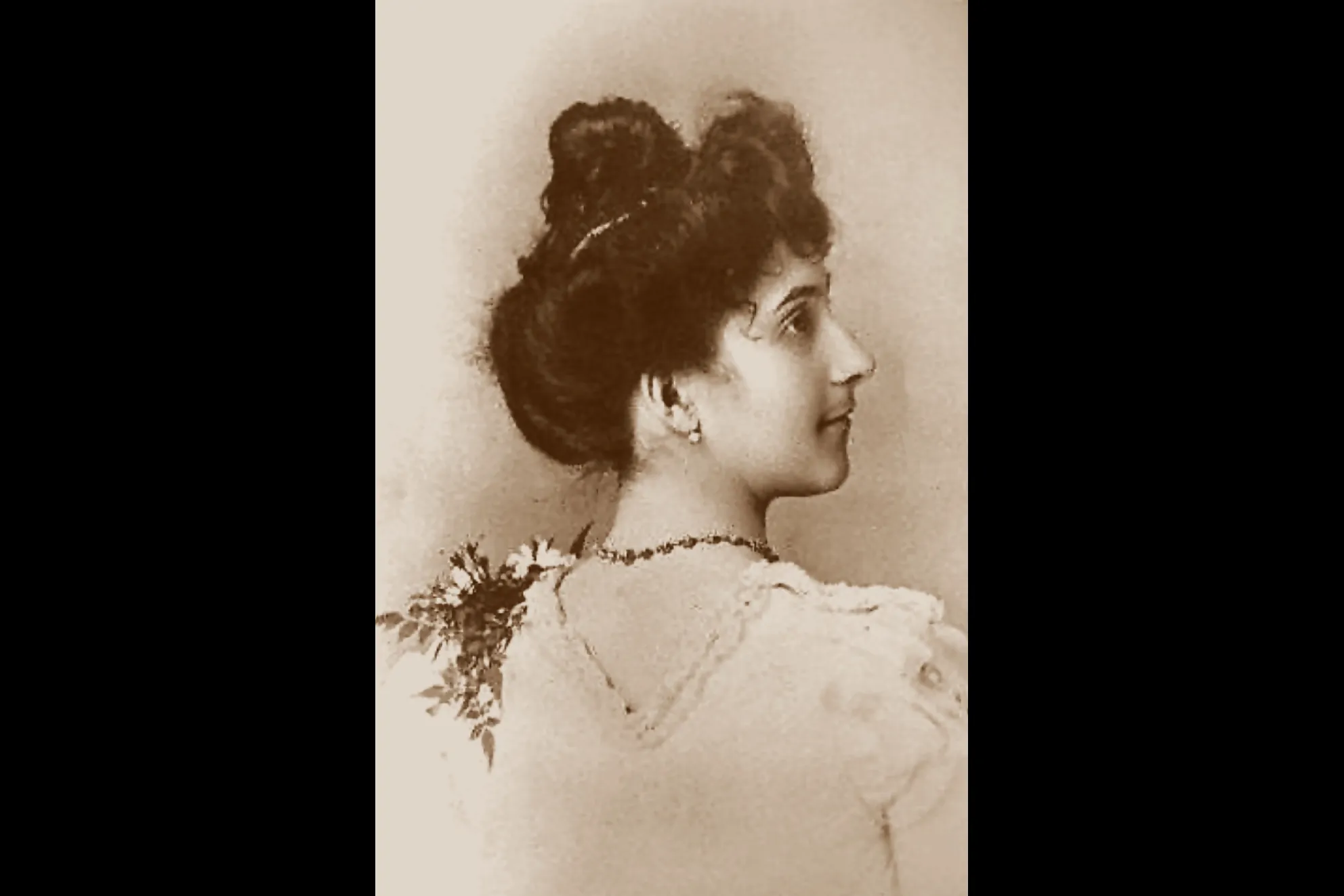
On her 120th birthday she gave her own verdict: “In life, one sometimes makes bad deals.”
How bad was it, in numbers? And how unlikely was she?
What the Table Said
Raffray’s question in 1965 was the one every annuity seller asks: how long does a woman of 90 live? A life table answers it. For each age $x$ it gives $q_x$, the chance of dying before the next birthday, and from those chances the expected remaining life $e_x$.
France’s own table for 1965 is not free to republish, so the numbers in this post come from the most recent American table for women, the 2023 table of the National Center for Health Statistics. Read every number below as “on today’s American table”.
It gives a woman of 90 a chance of 0.129 of dying within the year, and an expected remaining life of 4.82 years. At 30,000 francs a year, the bill Raffray could expect at signing was
He paid for thirty years: about 900,000 francs, 6.2 times what the table expected.
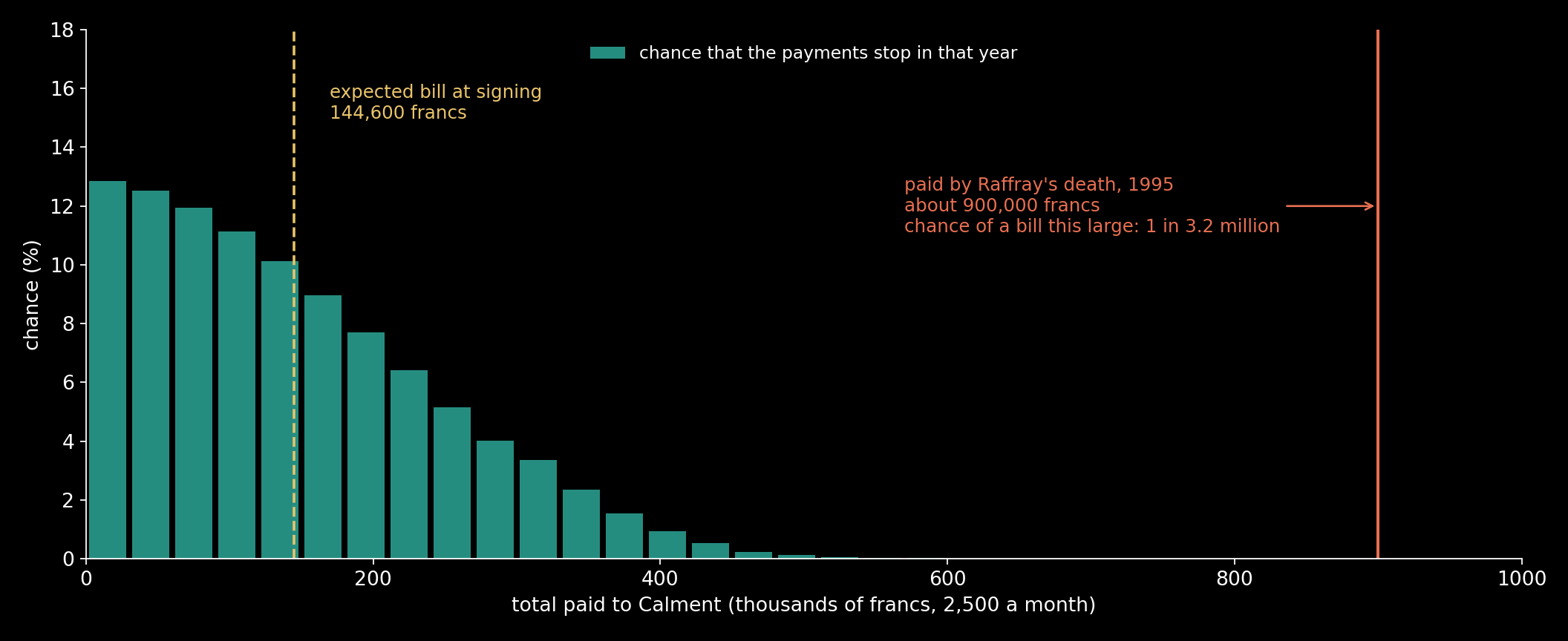
Most of the probability sits on the left. The chance that the payments stopped within five years, under 150,000 francs, is 58.5%. The chance she reached 100 and pushed the bill past 300,000 is 9.2%. A bill of 900,000 francs needed her to live to 120. To put a number on that, the table is not enough: it stops at 100, with every woman who gets there lumped into one last line. Beyond 100 we need a law.
A Law From 1825
Benjamin Gompertz taught himself mathematics, “learning mathematics by reading Newton and Maclaurin”, because, as his biography at St Andrews puts it, “he was denied admission to universities since he was Jewish.” In 1824 he became actuary of the Alliance Assurance Company, and in 1825 the Philosophical Transactions of the Royal Society printed a paper of his with a long title: On the nature of the function expressive of the law of human mortality, and on a new mode of determining the value of life contingencies. The second half of that title is Raffray’s problem. A life contingency is a payment that depends on someone being alive, and a viager’s rente is exactly that.
Gompertz’s law says that the force of mortality, the instantaneous death rate $\mu(x)$ at age $x$, grows exponentially with age:
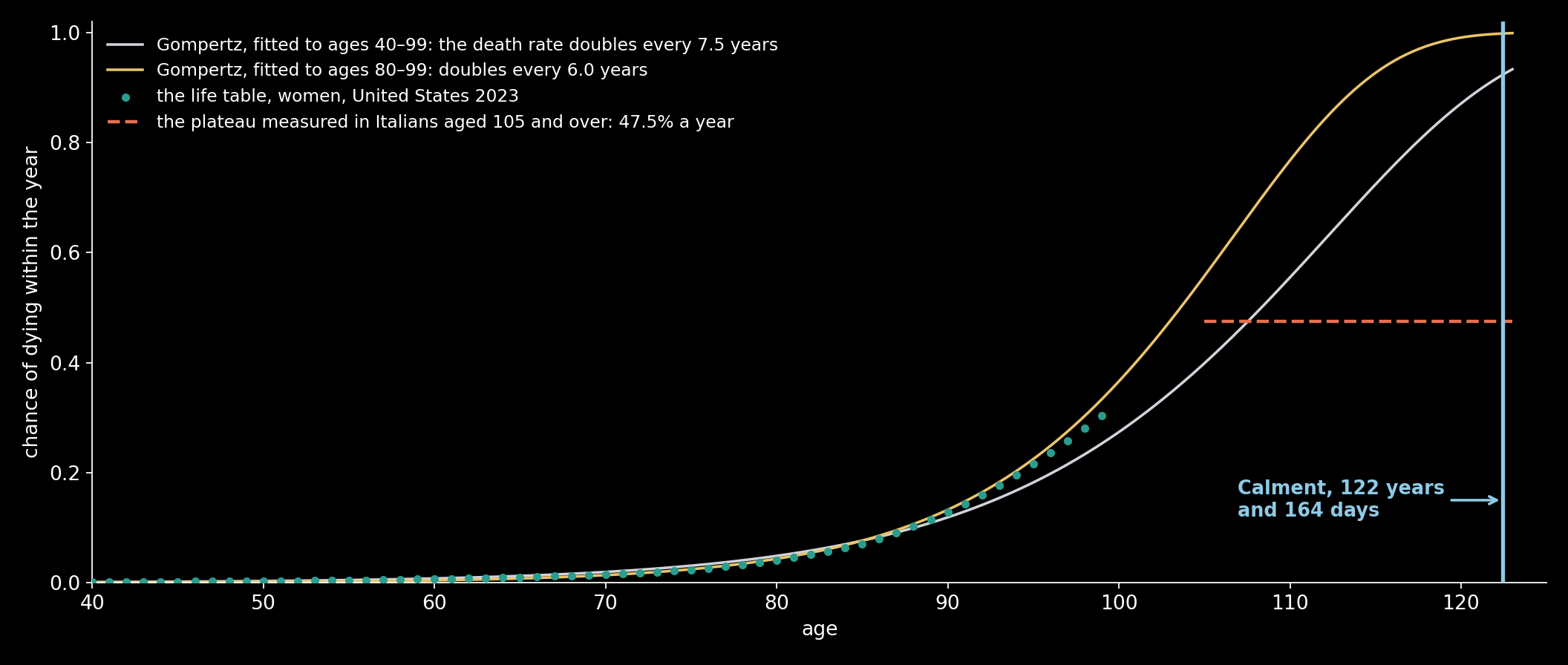
A life table gives one rate for each year of age, $\mu_x = -\ln(1 – q_x)$: the constant rate that kills the fraction $q_x$ in one year. On a log scale Gompertz’s law is a straight line, so a straight line through $\ln \mu_x$ against age is the fit. On the American women’s table for ages 40 to 99 it gives $b$ = 0.0928 a year, a death rate that doubles every 7.47 years; on ages 80 to 99 alone it gives $b$ = 0.1164, doubling every 5.96 years. The oldest ages on the table climb faster than the long line.
Survival follows from the rate in one line. If $S(x)$ is the chance of being alive at age $x$, the fraction dying in a short time $dx$ is $\mu(x)\,dx$, so
The exponential inside an exponential is what makes Gompertz’s law so hard on the very old. The 40-to-99 line gives a woman of 90 a chance of 0.1368 of reaching 100, where the table itself says 0.0921; the 80-to-99 line follows the table’s last decade more closely, and run on past 100 it leaves almost nobody. By 110 it puts the chance of dying within the year at 76.7%, by 115 at 92.6%, by 120 at 99.1%.
The Rente Is a Life Annuity
What was the rente worth on the day it was signed? A payment of 30,000 francs a year, paid while the seller is alive and discounted at a rate $r$, is worth
This is the integral of The Lease That Was as Good as Forever, a stream of payments with a random end. There the end was an exponential clock with no memory. Here the clock is a human life, and it has a memory: the older it gets, the faster it runs.
Under Gompertz’s law the integral has a closed form. Write the survival from age $x$ as $S(x \to x+t) = \exp\big(-\eta\,(e^{bt} – 1)\big)$ with $\eta = (a/b)\,e^{bx}$, and substitute $u = \eta\,e^{bt}$, so that $dt = du/(b\,u)$ and $e^{-rt} = (u/\eta)^{-r/b}$:
where $\Gamma(s, \eta)$ is the upper incomplete gamma function. With no discounting, $r = 0$, it becomes $e^{\eta} E_1(\eta)/b$, the exponential integral, and that is the expected remaining life under the law.
At 90, on the 40-to-99 fit, $\eta$ = 1.301. Without discounting the rente was worth 160,600 francs, 5.35 years of payments. Discounted at 3% a year it was worth 142,600 francs, and at 6% a year 127,800; the two rates are illustrations, not the French rates of 1965. The closed form and a direct numerical integration agree to a relative difference of $5.3 \times 10^{-15}$ at 90, and to within $1.9 \times 10^{-12}$ at every age from 60 to 100. The same integral run on the life table itself, with the tail beyond 100 described below, gives 143,100, 128,800 and 116,800 francs.
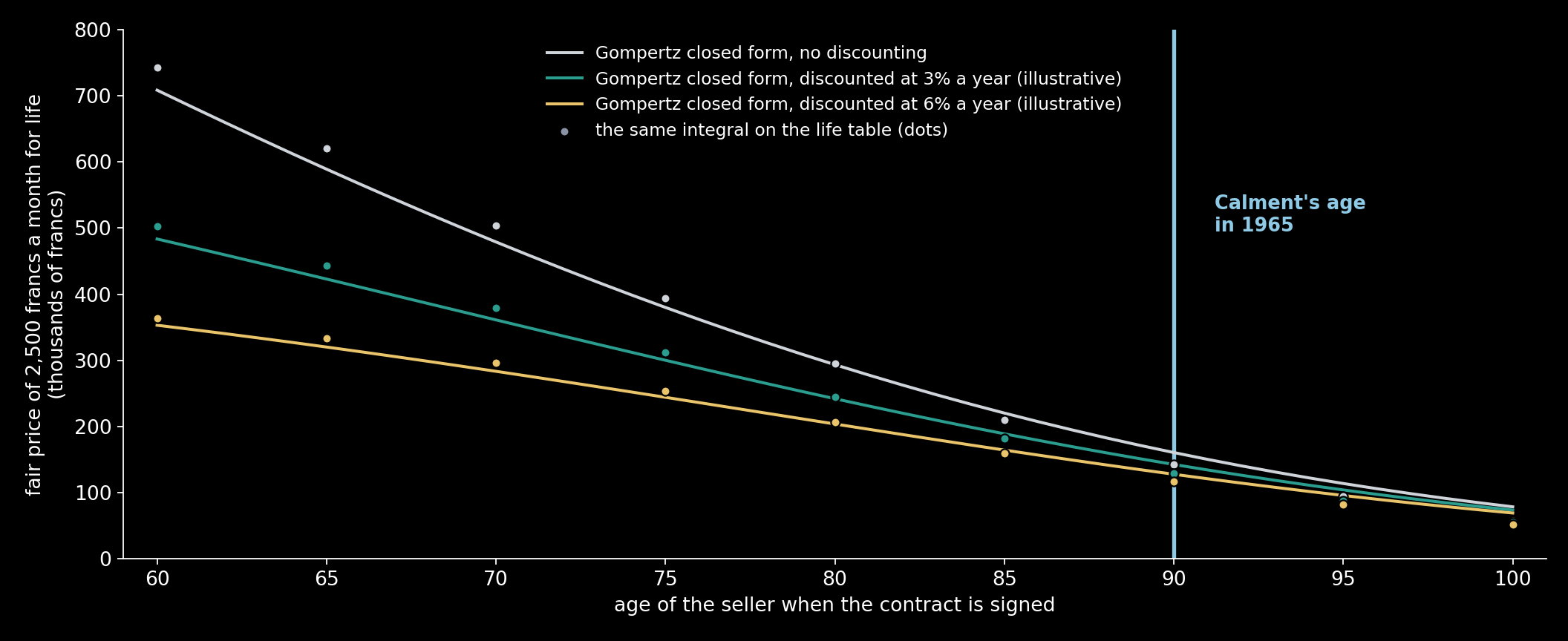
Every version agrees on the order of magnitude: the table priced the rente at roughly 150,000 francs, and Raffray paid about six times that. Each of those prices is an average over every woman of 90, and an average is only a fair price for the buyer who holds many contracts. A buyer who holds one is betting on one life.
The opposite worry, the money running out before the life does, is the one The 1966 Retiree measured. A viager seller has handed that worry to her buyer. Her income cannot run out; only his patience can.
The Woman the Law Could Not Hold
How likely was a woman of 90 to reach 122 years and 164 days? Gompertz’s law has an answer, and the answer depends on which line you draw. One law fitted to ages 40 to 99 and run all the way gives $1.2 \times 10^{-11}$, one chance in 81 billion. The table up to 100 followed by the steeper 80-to-99 line gives $5.2 \times 10^{-22}$, one chance in $1.9 \times 10^{21}$. Ten orders of magnitude separate two reasonable fits, because under a law where the death rate keeps doubling the answer hangs on the slope. Every version, though, says the same thing: impossible.
In 2018 Elisabetta Barbi, Francesco Lagona, Marco Marsili, James Vaupel and Kenneth Wachter looked at the people who are supposed not to exist: every Italian aged 105 and over between 2009 and 2015, born between 1896 and 1910, “a total of 3836 documented cases”. They “observed level hazard curves, which were essentially constant beyond age 105.” Past 105, the death rate stops doubling. It stops rising at all. For their baseline cohort, born in 1904, the plateau is a hazard of 0.645 a year, which, in their words, “corresponds to an annual probability of dying of 1 — exp(−0.645) = 0.475, and an expectation of further life of 1/0.645 = 1.55 years.” They also drew the line this post drew: “A straight-line fit based on ages 65 to 80, where the Gompertz model does appear to hold, fails at later ages and far overshoots our estimated plateau beyond age 105.”
Put their number in. The table to 100, the 80-to-99 line from 100 to 105, and then a flat 47.5% chance of dying each year, taken as they published it: the chance that a woman of 90 reaches Calment’s age becomes $6.5 \times 10^{-8}$, one in 15 million. From 105 alone, the plateau gives $1.3 \times 10^{-5}$ where the Gompertz line gives $1 \times 10^{-19}$.
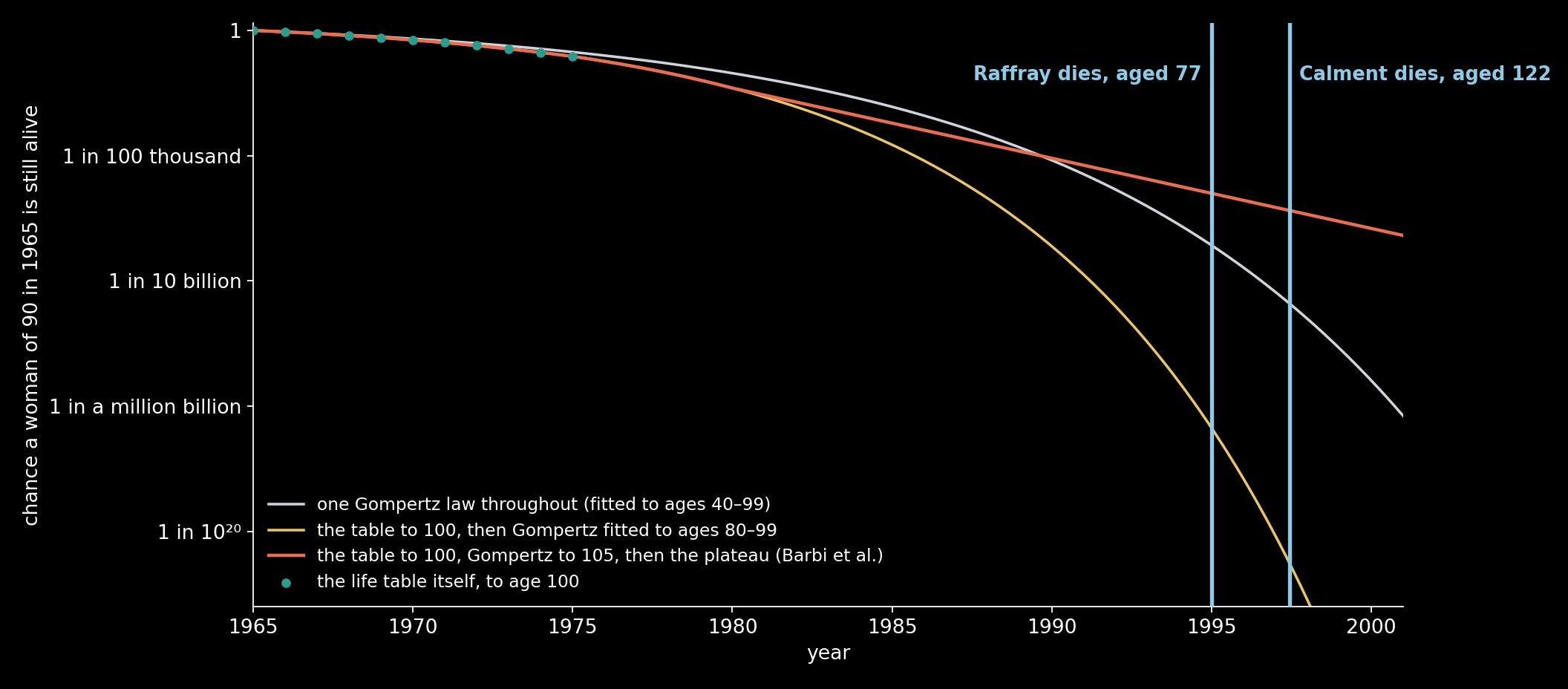
That is the reversal. Gompertz’s law, the law written to price life annuities, says Calment could not have lived. The plateau measured in the oldest people anyone has counted says she was rare, roughly one woman of 90 in 15 million, and very bad luck for her buyer.
The question is not closed. In 2016 Xiao Dong, Brandon Milholland and Jan Vijg analysed global demographic data in Nature and found “that improvements in survival with age tend to decline after age 100, and that the age at death of the world’s oldest person has not increased since the 1990s,” concluding that their “results strongly suggest that the maximum lifespan of humans is fixed and subject to natural constraints.” Barbi and her colleagues read their Italian cohorts the other way: the plateau is slowly falling from one cohort to the next, which they say suggests “that a limit, if any, has not been reached.”
Calment’s record has been questioned too. In a paper in Rejuvenation Research in 2019, Nikolay Zak argued for reconsidering “the previously rejected hypothesis that Jeanne’s daughter Yvonne acquired her mother’s identity after her death to avoid financial problems and that Jeanne Calment’s death was reported as Yvonne’s death in 1934.” The same year Jean-Marie Robine, Michel Allard, François Herrmann and Bernard Jeune answered in The Journals of Gerontology, setting out the documents behind the validation and presenting mathematical models which, they wrote, support “the hypothesis that though extremely rare, as would be expected for the oldest person ever, Jeanne Calment’s age claim is plausible.” Extremely rare, not impossible: the same line that separates the two curves in the last figure.
Algorithm — Pricing a Viager From a Life Table and a Tail
input:  q_x for ages 0..99 from a life table (age 100+ is one open line)
        the seller's age x0; the payment per year m; a discount rate r
mu_x ← −ln(1 − q_x)                          one rate per year of age
(a, b) ← straight line through ln mu_x against age, on a chosen window
S(x0 → x):
    up to 100:   exp( − Σ mu over the whole years − the part of a year )
    100 to 105:  S(x0 → 100) · exp( −(a/b)(e^{bx} − e^{100b}) )
    beyond 105:  S(x0 → 105) · exp( −0.645 (x − 105) )      the plateau, as published
P(x0) ← m · ∫ e^{−rt} S(x0 → x0 + t) dt      numerical quadrature
check, one Gompertz law throughout: η ← (a/b) e^{b x0}
    P(x0) = m · e^η η^{r/b} Γ(−r/b, η) / b      must equal the quadrature
expected bill ← m · e_{x0};  chance of surviving T years ← S(x0 → x0 + T)
Who Holds the Tail
The table priced the average woman of 90, and it priced her well. What it could not price was this woman. A seller en viager is selling the tail of her own survival curve: if she dies early the buyer has a bargain, if she lives long the whole tail of that last figure is his to pay. An insurer selling thousands of life annuities holds the average and can sleep. Raffray held one life, and so, after him, did his family. In 1995 the Associated Press spelled out who came next: “If Mrs. Calment outlives her, too, then the Raffray children and grandchildren will have to pay.”
On the same birthday, at 120, Calment was asked for her vision of the future. “Very brief,” she said. The plateau gives anyone past 105 an expected 1.55 more years, whatever her age. She had 2.45.

When she died, Raffray’s widow, Huguette, spoke to French radio: “She was a personality. My husband had very good relations with Mrs. Calment.”
Sources
- Associated Press, “A 120-Year Lease on Life Outlasts Apartment Heir”, The New York Times, 29 December 1995.
- Ministère de la Justice, “Achat ou vente en viager : quelles sont les règles ?”, justice.fr, updated 18 August 2025 (content from Service Public).
- C. R. Whitney, “Jeanne Calment, World’s Elder, Dies at 122”, The New York Times, 5 August 1997.
- J.-M. Robine, M. Allard, F. R. Herrmann and B. Jeune, “The Real Facts Supporting Jeanne Calment as the Oldest Ever Human”, The Journals of Gerontology: Series A 74 (Supplement 1) (2019) S13–S20, doi:10.1093/gerona/glz198.
- National Center for Health Statistics, United States Life Tables, 2023, National Vital Statistics Reports 74(6), Table 3: life table for females (US federal work, public domain).
- J. J. O’Connor and E. F. Robertson, “Benjamin Gompertz”, MacTutor History of Mathematics Archive, University of St Andrews.
- B. Gompertz, “On the nature of the function expressive of the law of human mortality, and on a new mode of determining the value of life contingencies”, Philosophical Transactions of the Royal Society of London 115 (1825) 513–583, doi:10.1098/rstl.1825.0026.
- E. Barbi, F. Lagona, M. Marsili, J. W. Vaupel and K. W. Wachter, “The plateau of human mortality: Demography of longevity pioneers”, Science 360 (2018) 1459–1461, doi:10.1126/science.aat3119.
- X. Dong, B. Milholland and J. Vijg, “Evidence for a limit to human lifespan”, Nature 538 (2016) 257–259, doi:10.1038/nature19793.
- N. Zak, “Evidence That Jeanne Calment Died in 1934—Not 1997”, Rejuvenation Research 22 (2019) 3–12, doi:10.1089/rej.2018.2167.
Every number in the text and the charts is computed by the script archived with this post, from the 2023 life table and the published plateau above, once, into a saved results file.
Interested in applying these ideas to your work? Get in touch.