
The Road That Made Everyone Late
A Thing You Can Do To A City
Here is a thing you can do to a city.
Find a road. A real one — busy, useful, the sort people complain about being stuck on. Close it. Not widen it, not resurface it, not add a lane. Close it, dig it up, plant something on it and walk away.
Now go back and measure the traffic.
It got faster.
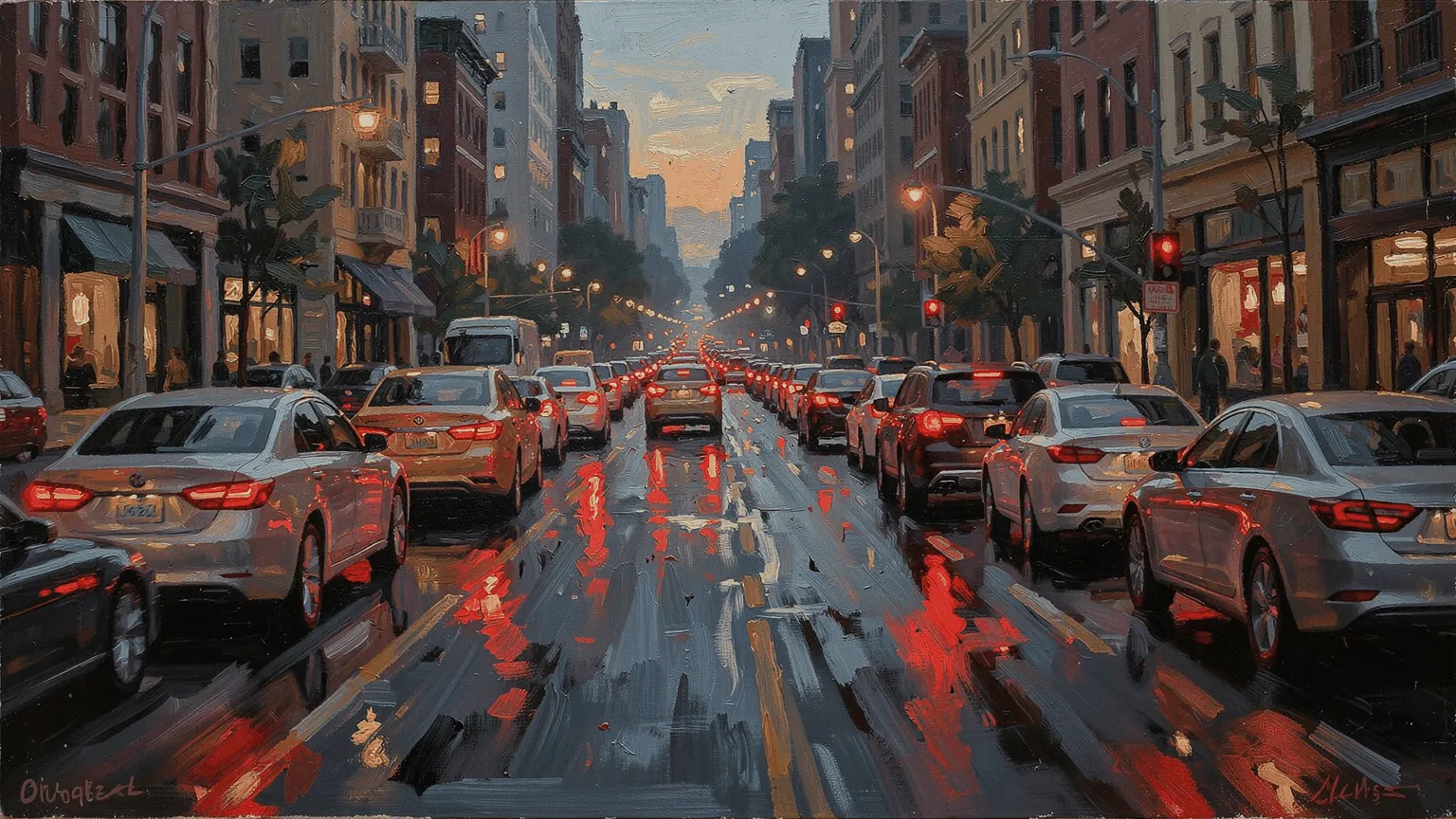
This is not a thought experiment, and it is not a trick of accounting. Cities have done it — sometimes on purpose, sometimes by accident — and been surprised by the result. Seoul pulled down a six-lane elevated motorway in 2003 and put a stream back where it had been, and the traffic it carried did not turn up anywhere else. New York closed 42nd Street for Earth Day in 1990 braced for gridlock, and the gridlock declined to appear. Stuttgart has a version of the story running the other way: a new stretch of road opened, the traffic got worse, and closing it again fixed it.
The reason was found in 1968 by a German mathematician named Dietrich Braess, and it is pure arithmetic. There is no psychology in it, no traffic engineering, no assumption that drivers are irrational or badly informed. Quite the opposite. It only works if every single driver is perfectly selfish and perfectly well informed. Put one confused person in the model and the effect gets weaker.
The Smallest City In Which This Happens
Four thousand drivers all want to get from START to END. There are two ways round, and they are mirror images.
The top route goes START → A → END. The first leg is congested: it takes one minute for every hundred cars on it. The second leg is a wide open motorway that takes 45 minutes whatever happens. The bottom route, START → B → END, is the same thing backwards: 45 fixed minutes, then a congested leg.
Everybody picks whichever looks quicker, and they keep switching until neither is. That is an equilibrium, and here it is the obvious one: two thousand cars each way, which is twenty minutes of crawling plus forty-five of motorway, for 65 minutes each.
Now build a short new road from A to B. It is a wonderful road. It is so short and so clear that crossing it takes no time at all — call it zero minutes, to be generous to it.
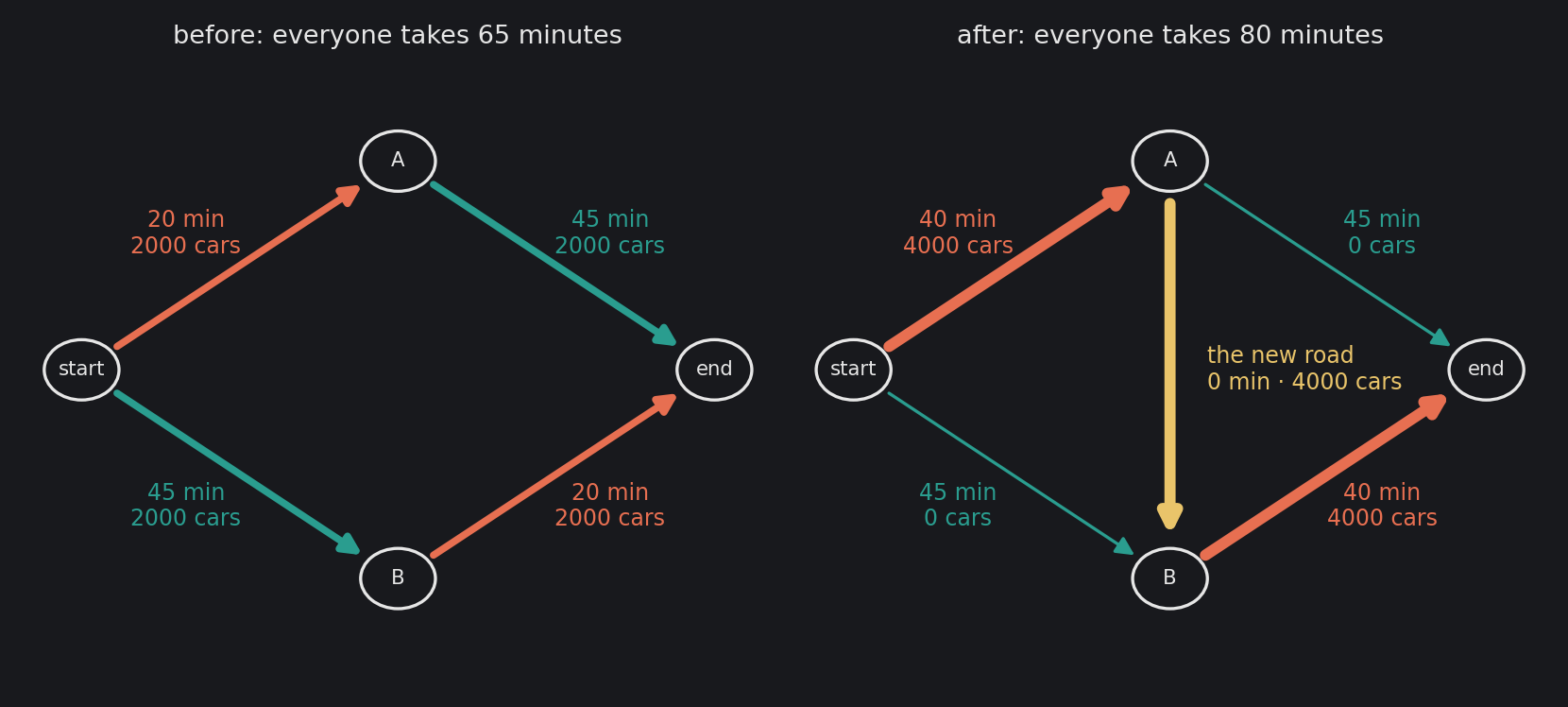
Watch what a single driver now sees. From START they can go to A — and if they are quick, A is not very congested yet, so that leg is cheap. From A, instead of committing to the 45-minute motorway, they can nip across to B for free and take the other congested leg into END, which is also cheap. Two cheap legs instead of one cheap leg and one 45-minute slog. It is obviously better, so they do it.
So does everybody else. And now both congested legs carry all four thousand cars, at forty minutes apiece:
Everyone is fifteen minutes worse off than before the road existed.
Nobody Made A Mistake
The natural response is that the drivers are being stupid, and that if they would only coordinate they could go back to 65. The first half of that is wrong and the second half is the entire problem.
Check whether anyone wants to change their mind. A driver on the new route is taking 80 minutes. If they abandon it and take the old top route instead, they face 40 minutes of congestion — the other 3,999 are still there — plus the 45-minute motorway, which is 85 minutes. Worse. The bottom route is 85 minutes too, by symmetry. So nobody moves. Eighty minutes is a genuine equilibrium, held in place by four thousand individually correct decisions.
And here is the part that ought to be better known. The selfish equilibrium is not disorder. It is not a failure to optimise. It is the exact minimiser of a function — just not the function anybody wanted minimised. Write $\ell_e(x)$ for the time on road $e$ when $x$ cars are on it. The equilibrium minimises
while the outcome that is actually best for everybody minimises the total time spent,
Those are different functions, so they have different minima, and the gap between them is the whole subject. The reason they differ is one sentence: a driver counts the delay they suffer, and not the delay they cause. Joining a queue costs you the time you wait in it; it also costs everybody behind you, and nothing in your decision sees that.
Solve the second one for this network and it puts 1,750 cars on each old route and 500 across the new road, for an average of 64.7 minutes — very slightly better than the 65 you got before the road was built. The road is not a bad road. It is a marginally useful road that a crowd is incapable of using.
It Depends How Busy You Are
Here is where the story gets more interesting than the version usually told, because the same road with the same drivers is not always a disaster.
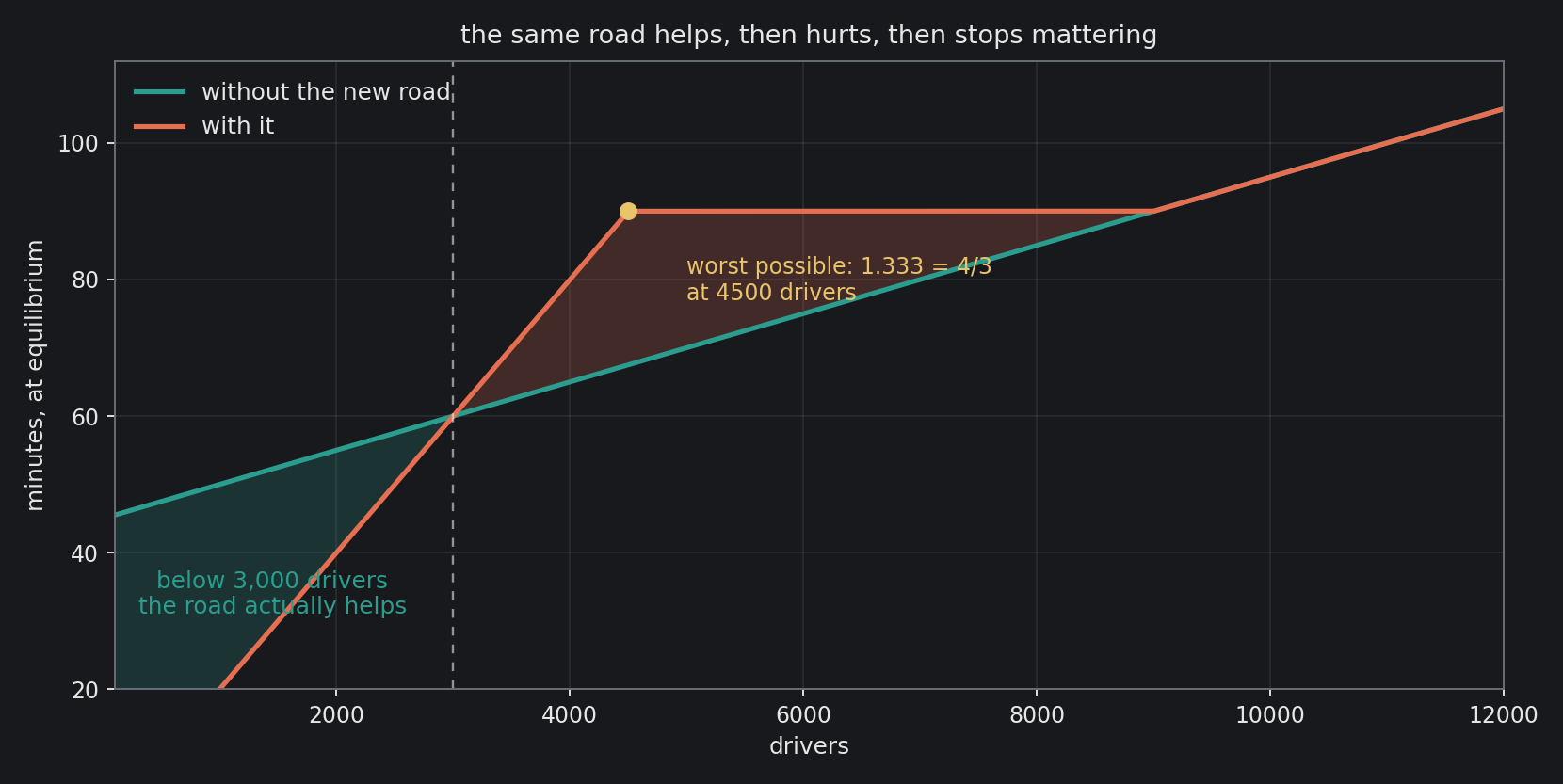
With very few drivers, congestion barely exists, the two cheap legs really are cheap, and the new road is a genuine improvement — at a thousand drivers it more than halves the journey. The crossover is at exactly 3,000 drivers, where the road makes no difference at all. Above that it starts doing harm, and the harm peaks at 4,500 drivers, where the journey goes from 67.5 minutes to 90.
Ninety against sixty-seven and a half is exactly $4/3$, and it is not a coincidence that it is a round number. For any road network whose delays grow linearly with traffic — however large, however tangled — it is a theorem that selfishness can never cost more than 4/3 of the best achievable. This little four-road town, at exactly 4,500 drivers, is as bad as such a network is mathematically permitted to be.
Then the damage shrinks again, and by 9,000 drivers it is gone: the shortcut is so congested that nobody takes it, and the road might as well not be there. A road can be harmless because it is empty and harmless because it is full, and vicious in between.
The Worst Road Is Not The Free One
One more turn, and it is my favourite.
We assumed the new road takes no time at all. Suppose it takes a little time — a minute or two of slow going. The harm ought to shrink: a road that costs something is less tempting, so fewer people should pile onto it.
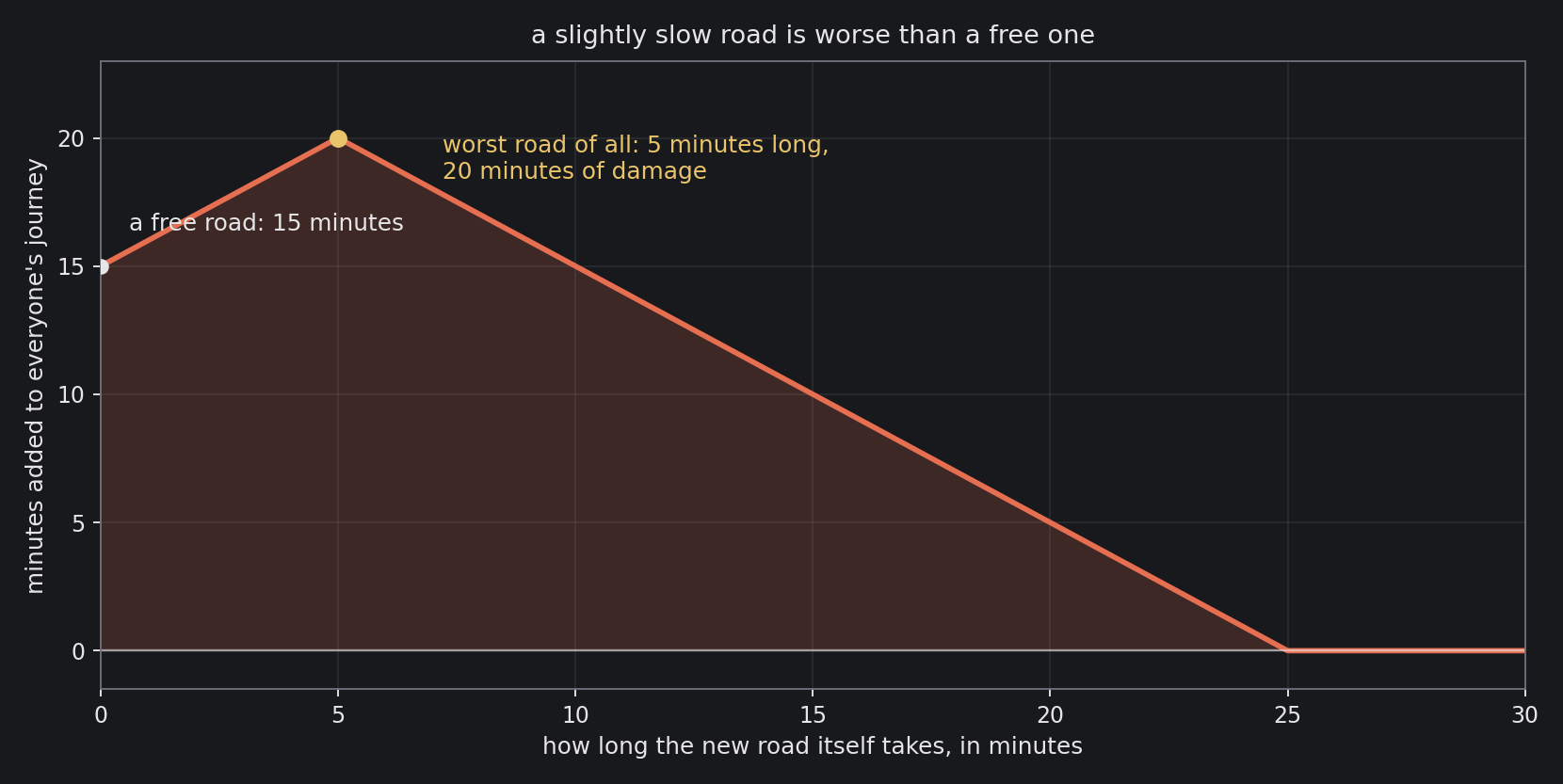
It does shrink, eventually. It grows first. The damage climbs from 15 minutes at zero, peaks at 20 minutes for a road that takes five minutes to cross, and then falls away, reaching nothing at 25 minutes, after which the road is long enough that no one bothers with it.
So the most destructive thing you can build here is not a magic teleporter. It is a slightly slow road. Fast enough that everybody piles onto it, slow enough that it charges them for the privilege.
Algorithm — Finding Out What A Road Will Do
input:  the network, a latency l_e(x) per road, N drivers

# ---- what the crowd does: minimise the WRONG thing ---------
the selfish equilibrium is the minimiser of

    PHI(x) = sum over roads e of
               integral from 0 to x_e of l_e(t) dt

  Beckmann's potential. It is convex, so there is exactly one
  answer and any descent finds it. Nobody in the model is
  minimising PHI. It is simply what a crowd of individually
  correct choices adds up to.

# ---- what you WANTED: minimise the right thing -------------
the best outcome is the minimiser of

    C(x) = sum over roads e of  x_e * l_e(x_e)

  Same network, same constraints, different objective. The gap
  between the two minima is what the crowd costs itself.

# ---- check it with something that is not an optimiser ------
put every driver somewhere. repeat:
    work out the time on each route at the current flows
    move a batch from the slowest used route to the fastest
    stop when no used route is slower than the fastest
report the common travel time

  This is the only one of the three that could disagree, which
  is exactly why it is worth running. It uses no formula and no
  solver, and its drivers do not know what a potential is.

# ---- the sweep that tells you whether to build -------------
for N across the range you actually expect:
    compare the equilibrium WITH the road to the one WITHOUT
a road that helps at today's traffic can hurt at next year's,
and hurt most at a level in between the two

return equilibrium time, best possible time, and the ratio
What Is Checked, and Against What
Three routes to every number, sharing no code.
The closed form is the case analysis done by hand. The Beckmann potential is minimised numerically over the whole space of route flows, with no symmetry assumed and no algebra used — it finds 2,000 / 2,000 / 0 before the road and 0 / 0 / 4,000 after, on its own. And the drivers actually move: batches switching to whichever route is currently quickest, no optimiser anywhere, converging to the same 65 and the same 80.
The equilibrium claim is then checked directly rather than asserted — deviating from the all-cross flow costs 85 minutes against 80, in both directions, which is what makes it an equilibrium rather than merely a bad outcome.
What To Take Away
Cities are not really four roads and four thousand cars, and I would not use this to argue about a specific junction. Real networks have many origins and destinations, delays that are not linear, drivers who have habits and no information, and roads that do other things than carry traffic.
What survives is the shape, and the shape is not about traffic at all.
Whenever a system is made of individuals each doing the locally best thing, and each one’s choice makes things slightly worse for everybody else, the crowd will settle at the minimum of a function nobody chose. Adding an option to such a system can move that minimum in the wrong direction — and because every individual is still choosing correctly, there is nobody to blame and no amount of good behaviour that fixes it.
Which is why the remedy is so often the thing that sounds like vandalism. You do not persuade the drivers. You take away the road.
Interested in applying these ideas to your work? Get in touch.