
The Man Who Could Have Won the Nobel Twice
A Thesis Nobody Read
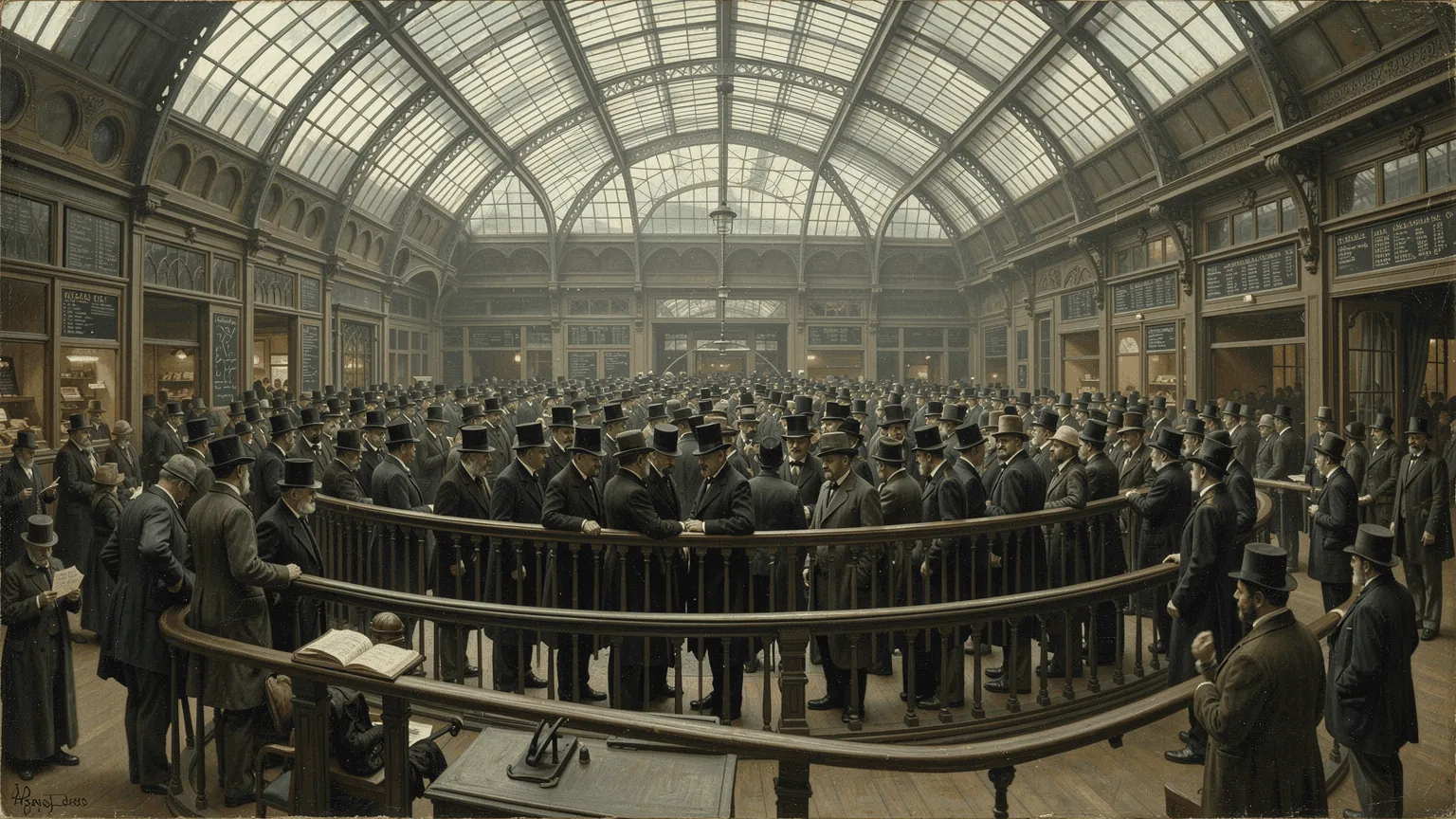
On 29 March 1900 a young Frenchman named Louis Bachelier defended a doctoral thesis at the Sorbonne called Théorie de la spéculation. It modelled the prices of the Paris Bourse as a random walk, and in doing so it worked out the mathematics of Brownian motion five years before Einstein. His advisor, Henri Poincaré, called the approach very original. The examiners gave it a respectable but unremarkable grade, and the thesis sank almost without trace for half a century.
A Postcard from Yale
In the early 1950s the statistician Jimmie Savage sent a dozen or so postcards from Yale to economists he knew, asking whether any of them had heard of a French book on the theory of speculation by someone called Bachelier.
One of the postcards reached Paul Samuelson at MIT at exactly the right moment. He had been puzzling for years over how to price warrants, long-dated options to buy a company’s stock. He had the thesis found, arranged for it to be translated into English, and started building on it.

Samuelson was not an obscure figure looking for a subject. He was already one of the best-known economists in America, author of a textbook that sold more than four million copies, and within a few years he would be the first American to win the new Nobel prize in economics, in 1970. What he did next with Bachelier’s thesis is the part of his career that tends to be left out.
The Flaw He Fixed
In 1965 Samuelson published Rational Theory of Warrant Pricing, and it opens with Bachelier. The Frenchman, he wrote, “discovered the mathematical theory of Brownian motion five years before Einstein’s classic 1905 paper”. Then he put his finger on the flaw. Bachelier’s prices moved by normal amounts, so they could drift below zero, and “Bachelier had forgotten that stocks possess limited liability and thus cannot become negative… To correct this, I introduced the ‘geometric’ or ‘economic Brownian motion’.”
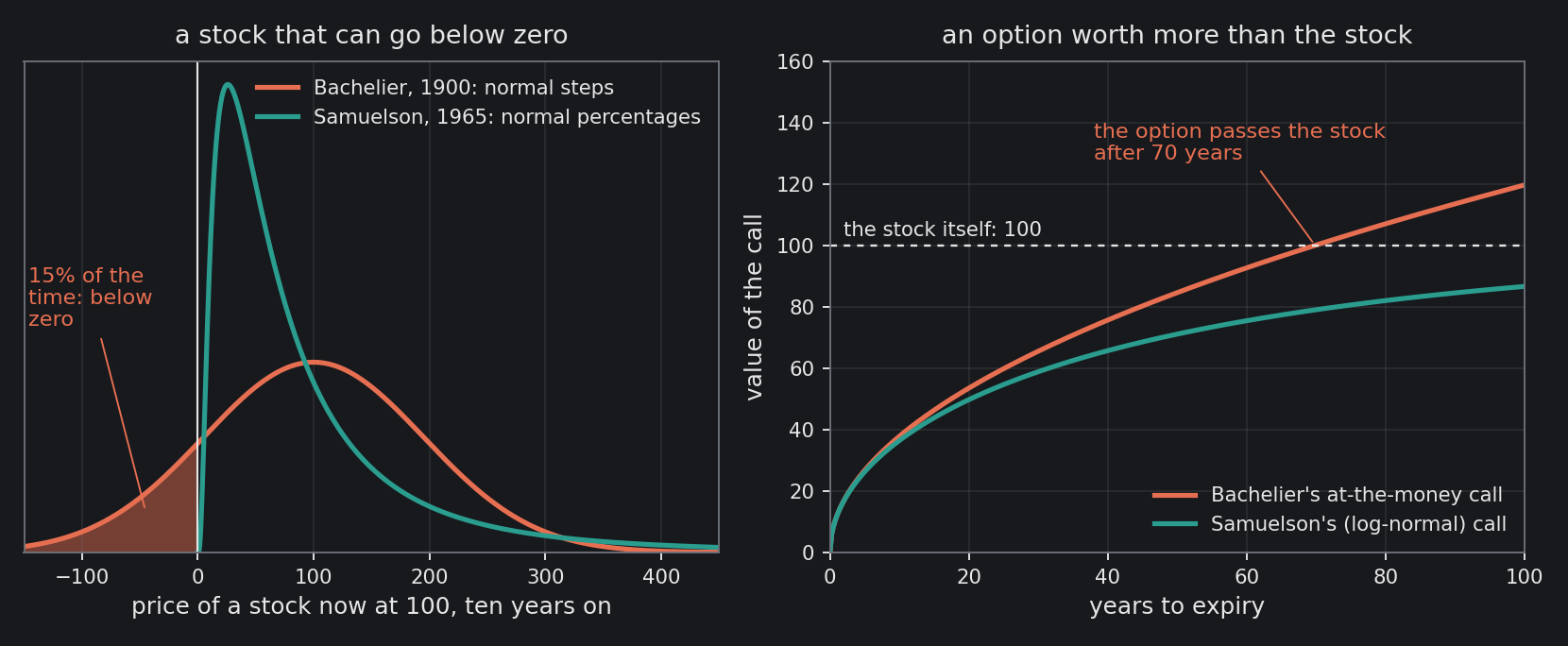
The difference is one word: Bachelier’s price moves by normal amounts, Samuelson’s by normal percentages,
where $\alpha$ is the rate the stock is expected to earn and $\sigma$ its volatility. The results of Bachelier’s version are not subtle. A stock at 100 whose price moves by 30 a year has, after ten years, a 15% chance of being worth less than nothing. And an option on it keeps growing with the square root of time until, after about seventy years, it is worth more than the stock itself, which Samuelson pointed out is absurd, since the stock is simply an option with a strike of zero.
Geometric Brownian motion is exactly the model of a stock that Black, Scholes and Merton would use in 1973. It is still the first model most students of the subject meet.
Two Unknowns
Then Samuelson priced the warrant. His recipe was natural: take the expected payoff at expiry, above the strike $K$, under the log-normal distribution the model implies, and discount it back to today at the rate $\beta$ that the warrant itself is expected to earn:
It has two unknowns, $\alpha$ and $\beta$, and he knew it. “I do not pretend to give a theory from which one can deduce the relative values of β and α,” he wrote. “Here, I merely postulate that they are constants.” His MIT colleague, the mathematician Henry McKean, added an appendix solving the harder case of a warrant that can be exercised early, as a free-boundary problem.
Now set both unknowns equal to the riskless interest rate, $\alpha = \beta = r$:
That is the Black–Scholes–Merton formula, term for term. It was sitting inside Samuelson’s 1965 paper, one assumption away, eight years before it was published.
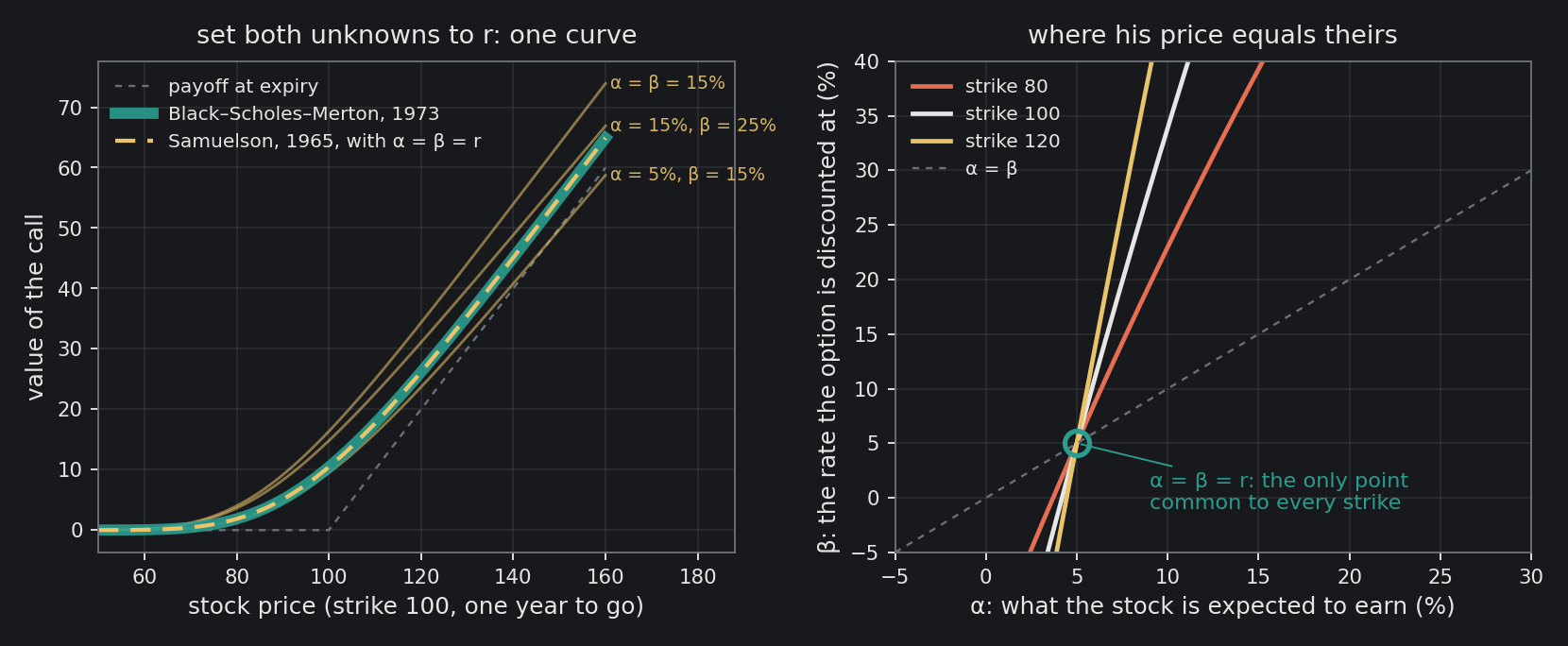
The right-hand panel shows why “one assumption away” is the honest way to say it. For any single option there is a whole line of $(\alpha, \beta)$ pairs that happen to give the right price, so a trader could have tuned Samuelson’s formula to match any one quote. But each strike gives a different line, and those lines cross at a single point, $\alpha = \beta = r$. Only there are the two formulas the same formula rather than the same number.
The Argument He Did Not Have
So why did it take until 1973? Because nothing in Samuelson’s framework said the unknowns should equal $r$. A stock is risky and ought to be expected to earn more than a bond; a warrant is riskier still. Setting both to the riskless rate looks like a mistake, not an insight.
Black and Scholes say exactly this in their paper, and they name him. “Samuelson (1965) has unknown parameters α and β,” they write, and he discounts the expected payoff “at the rate β. Unfortunately, there seems to be no model of equilibrium that would make this an appropriate procedure for determining the value of a warrant.” The next step was his and his student’s: “In a subsequent paper, Samuelson and Merton (1969)… advance the theory by treating the option price as a function of the stock price.”
The missing piece turned out to be the idea from the last post: the hedge. Hold the right number of shares against the option, adjust it continuously, and the pair carries no risk at all, so it can only earn the riskless rate. The expected return of the stock drops out of the problem entirely. Samuelson could not pin down $\alpha$ because it does not matter.
That is a strong claim, and it can be tested. We sold a one-year call on a stock at 100 with 20% volatility and a 5% interest rate, and hedged it, forty thousand times, in four different worlds where the stock is expected to earn −5%, 5%, 15% and 30% a year. Samuelson’s formula, with $\beta = \alpha$, would price that call anywhere from 5.86 to 26.42 depending on the world. The hedge does not care. Rebalanced four times a day, it costs between 10.450 and 10.457 in every one of them, against a Black–Scholes–Merton price of 10.4506.
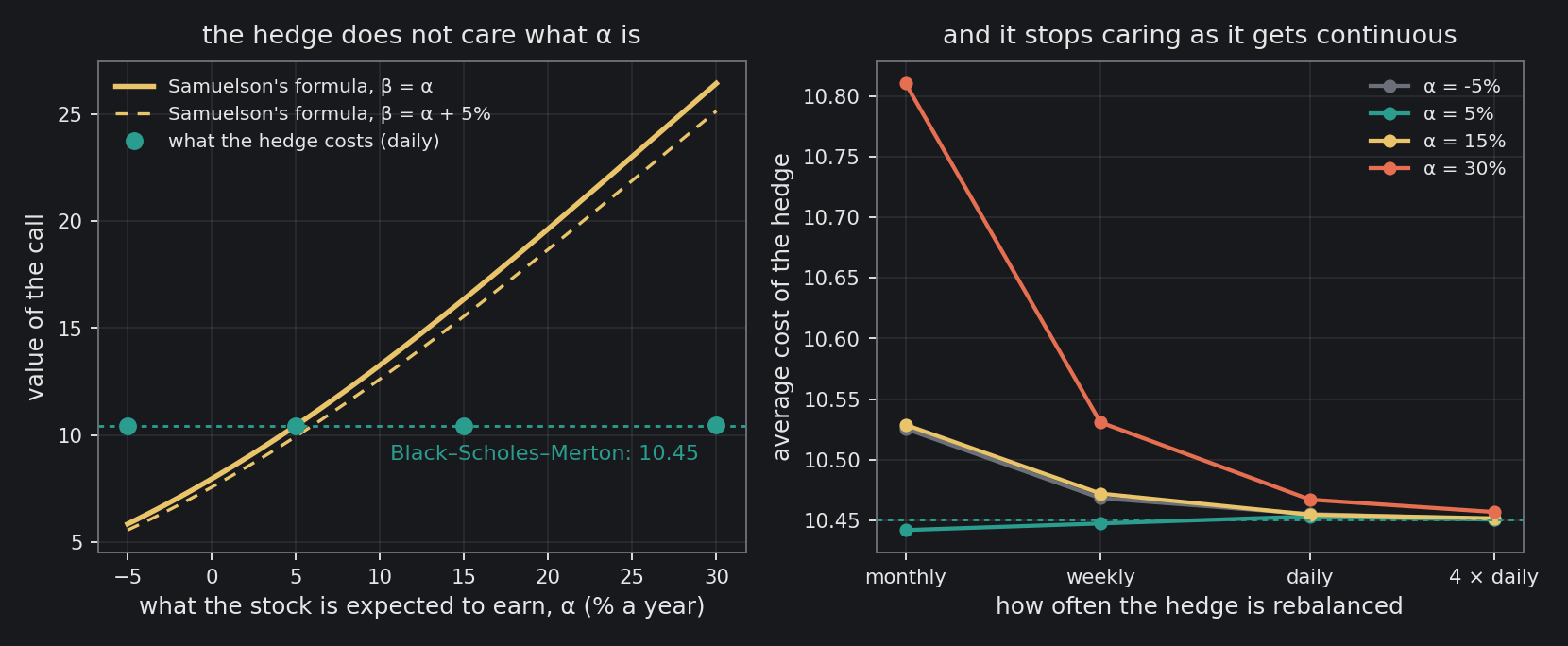
The convergence is not instant. Hedged only once a month, the call on the stock expected to earn 30% costs 10.81 to hedge, because a stock that drifts fast between adjustments runs away from the hedge. Weekly it costs 10.53, daily 10.47, and four times a day 10.457. In the limit of continuous hedging, which is the world Merton’s mathematics describes, the dependence on $\alpha$ disappears.
Algorithm — What the Hedge Costs, in a World of Your Choosing
input:  S = 100, strike K = 100, T = 1 year, volatility 20%, rate r = 5%
        alpha, what the stock is REALLY expected to earn
        n, how many times the hedge is rebalanced

# ---- sell the call, then hedge it ---------------------------
for 40,000 paths:
    cash <- 0,  shares <- 0
    repeat n times:
        delta  <- N(d1)                   # Black-Scholes delta, at rate r
        cash   <- cash grown at r  +  (delta - shares) * S
        shares <- delta
        S      <- S * exp((alpha - sigma^2/2) dt + sigma sqrt(dt) Z)
    owed at expiry <- max(S - K, 0)
    cost of this path <- e^{-rT} * (cash grown at r - shares * S + owed)

# ---- the claim ------------------------------------------------
report the average cost for alpha = -5%, 5%, 15%, 30%

  With n large they agree with each other and with the
  Black-Scholes-Merton price. alpha never entered the formula,
  and in the limit it does not enter the cost either.

return the average cost, and Samuelson's price with beta = alpha
Twice
The Chicago Board Options Exchange opened on 26 April 1973. The Black–Scholes paper appeared in print the same spring. In 1997 the Nobel prize in economics went to Myron Scholes and Robert Merton for their method of valuing options and other derivatives. Fischer Black had died of cancer in August 1995, and the prize is never awarded after death; the Academy made a point of naming him anyway.
Merton had written his doctoral thesis at MIT under Samuelson, and was his co-author on the 1969 paper that Black and Scholes cite. The model of the stock was Samuelson’s. The shape of the formula was Samuelson’s. The idea of pricing the option as a function of the stock was Samuelson’s and Merton’s. What Black, Scholes and Merton added was the argument that removed his two unknowns, and it was a genuinely new idea: the one that made the formula worth a prize.

Nobody has ever won the economics prize twice. Samuelson won it in 1970 for the breadth of his work across the whole of economic theory; option pricing was not part of the citation. Whether he should have shared the second one is a matter of opinion. That he laid most of the road it travelled is a matter of record: it is in his 1965 paper, in the paper he wrote with Merton, and in the pages of the 1973 paper that cite them both.

He died in December 2009, at ninety-four, having lived to see the formula he nearly wrote become one of the most used equations in finance.
Sources
- P. A. Samuelson, “Rational Theory of Warrant Pricing”, Industrial Management Review 6 (1965) 13–31, with an appendix by H. P. McKean.
- P. A. Samuelson and R. C. Merton, “A Complete Model of Warrant Pricing that Maximizes Utility”, Industrial Management Review 10 (1969) 17–46.
- F. Black and M. Scholes, “The Pricing of Options and Corporate Liabilities”, Journal of Political Economy 81 (1973) 637–654.
- R. C. Merton, “Theory of Rational Option Pricing”, Bell Journal of Economics and Management Science 4 (1973) 141–183.
- M. Davis and A. Etheridge, Louis Bachelier’s Theory of Speculation (2006), for the rediscovery.
Every number here is computed by the script archived with this post.
Interested in applying these ideas to your work? Get in touch.