
Two Worlds, One Price: Entropy and the Risk-Neutral Measure
Two Probabilities for One Asset
In classical physics, probability is a statement about a single world — a particle’s position has one distribution, determined by the Hamiltonian. Finance operates differently. Every option pricing model requires two probability measures: the physical measure $\mathbb{P}$, which describes how asset prices actually evolve, and the risk-neutral measure $\mathbb{Q}$, under which every discounted asset price is a martingale.
Under $\mathbb{P}$, equities earn a risk premium. Under $\mathbb{Q}$, they grow at the risk-free rate. One asset, two worlds. The question that connects thermodynamics to derivative pricing is: how different are these two worlds, and what does that difference cost?
The answer is relative entropy.
Relative Entropy — Distance Between Measures
The Kullback-Leibler divergence from $\mathbb{Q}$ to $\mathbb{P}$ is defined as
$(1)$
It measures how much information is gained — or how much surprise is introduced — when one replaces $\mathbb{P}$ with $\mathbb{Q}$. It is always non-negative, and equals zero if and only if the two measures are identical. It is not symmetric: $D_{KL}(\mathbb{Q}\|\mathbb{P}) \neq D_{KL}(\mathbb{P}\|\mathbb{Q})$ in general.
Physicists encountered this object long before information theorists named it. The Gibbs free energy of a distribution $\mathbb{Q}$ relative to a reference measure $\mathbb{P}$ is
$(2)$
where $U$ is potential energy, $T$ is temperature, and $H(\mathbb{Q}) = -\mathbb{E}^{\mathbb{Q}}[\log \mathbb{Q}]$ is the Gibbs entropy. Minimising $F$ over all $\mathbb{Q}$ subject to a fixed energy constraint produces the Boltzmann distribution $\mathbb{Q}^* \propto e^{-\beta U}$ — an exponential tilt of the reference measure. This minimisation is equivalent to minimising $D_{KL}(\mathbb{Q}\|\mathbb{P})$ subject to the same constraint.
The mathematical structure is identical in both fields: find the distribution closest to a reference, subject to a constraint.
From Girsanov to Gibbs
In continuous-time finance, the change of measure is governed by the Girsanov theorem. In a diffusion model with physical drift $\mu_t$ and volatility $\sigma_t$, the Radon-Nikodym derivative is
$(3)$
where $\lambda_t = (\mu_t – r)/\sigma_t$ is the market price of risk — the instantaneous Sharpe ratio of the risky asset. The measure $\mathbb{Q}$ is equivalent to $\mathbb{P}$ precisely when the Novikov condition $\mathbb{E}^{\mathbb{P}}[\exp(\frac{1}{2}\int_0^T \lambda_t^2 \, dt)] < \infty$ holds.
Substituting equation (3) into the definition (1) and simplifying:
$(4)$
The entropy cost of the risk-neutral measure is one-half the expected integrated squared Sharpe ratio. In a constant-parameter Black-Scholes model with $\lambda = (\mu – r)/\sigma$ constant, this reduces to
$(5)$
A market with no risk premium ($\mu = r$) has $\lambda = 0$ and $D_{KL} = 0$ — the two measures coincide and derivative prices equal their actuarial expectations under $\mathbb{P}$. The further the market departs from this benchmark, the higher the information cost of repricing under $\mathbb{Q}$.
The connection to Gibbs is now explicit. Equation (3) has the form $d\mathbb{Q}/d\mathbb{P} \propto \exp(-\theta \cdot X)$ — an exponential tilt of the reference measure, identical in structure to the Boltzmann factor $e^{-\beta U}$. The “energy” in the financial case is the stochastic integral $\int_0^T \lambda_t \, dW_t$. The “temperature” controls how far $\mathbb{Q}$ departs from $\mathbb{P}$. The Esscher transform used in actuarial science to price insurance risks has exactly the same form — this is not a coincidence.
Algorithm — Change of Measure — Entropy Cost of Risk-Neutral Repricing
Input:  mu (physical drift), r (risk-free rate), sigma (volatility), T (horizon)

1. Compute market price of risk:
      lambda = (mu - r) / sigma

2. Write the Radon-Nikodym derivative (Girsanov theorem):
      dQ/dP = exp( -lambda * W_T  -  (1/2) * lambda^2 * T )
   where W_T ~ N(0, T) under P.

3. Shift the Brownian motion to Q-world:
      W_T^Q = W_T + lambda * T       (W_T^Q is Brownian under Q)

4. Read off terminal densities in each world:
      log(S_T / S_0) ~ N( (mu - sigma^2/2)*T,  sigma^2*T )   under P
      log(S_T / S_0) ~ N( (r  - sigma^2/2)*T,  sigma^2*T )   under Q
   Same variance, different means — the densities are horizontal shifts of each other.

5. Compute entropy cost (equation 5):
      D_KL(Q || P) = (1/2) * lambda^2 * T

Output: lambda, D_KL, log-normal densities under P and Q
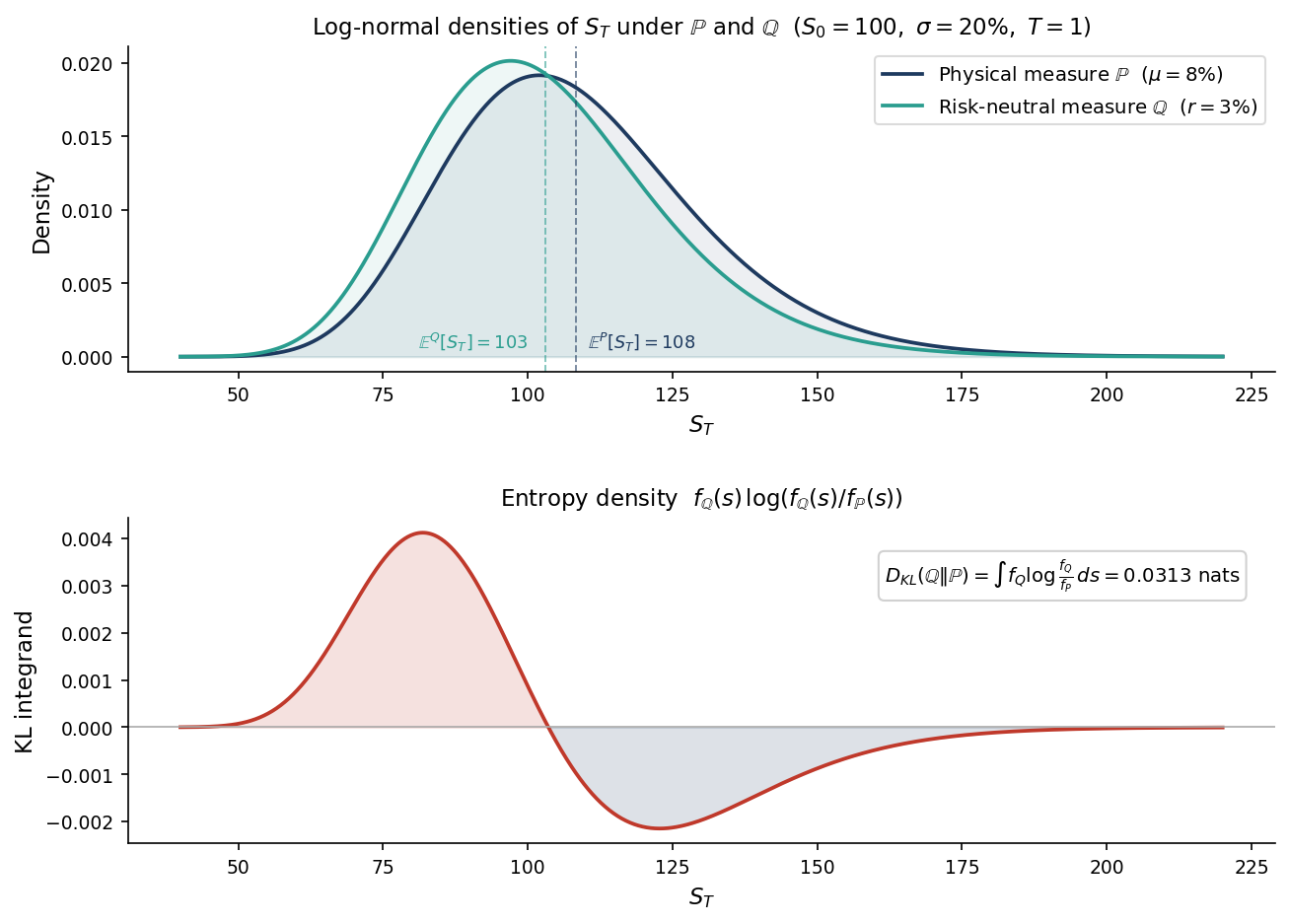
Figure 1 shows these two densities and the KL integrand $f_{\mathbb{Q}}(s)\log(f_{\mathbb{Q}}(s)/f_{\mathbb{P}}(s))$ whose integral equals $D_{KL}$. For $\lambda = 0.25$ and $T = 1$, the entropy cost is 0.0313 nats — small but non-zero, growing quadratically in $\lambda$ and linearly in horizon.
The lower panel goes negative in the right tail, and this is not an error. The KL integrand is negative wherever $f_{\mathbb{Q}}(s) < f_{\mathbb{P}}(s)$, that is, wherever $\mathbb{P}$ assigns more probability than $\mathbb{Q}$. Because $\mathbb{P}$ has a higher drift ($\mu = 8\%$ versus $r = 3\%$), it puts more weight on large values of $S_T$ — the right tail. In those regions, switching from $\mathbb{P}$ to $\mathbb{Q}$ actually reduces surprise: you are moving to a world that finds high prices less likely, so log$(f_\mathbb{Q}/f_\mathbb{P}) < 0$. The economic interpretation is direct: under $\mathbb{Q}$, the upside that $\mathbb{P}$ considers realistic is systematically discounted. Option sellers know this — they are being paid to price in a world that underweights the right tail relative to what history suggests. The positive region (low and mid prices, where $\mathbb{Q}$ has more mass than $\mathbb{P}$) dominates the negative region in the integral, and the total $D_{KL}$ is positive. The total entropy cost is the net information price of removing the risk premium.
The Minimal Entropy Martingale Measure
In the Black-Scholes model, $\mathbb{Q}$ is unique — the market is complete and $\lambda$ is pinned down by no-arbitrage. But in incomplete markets — models with jumps, stochastic volatility, or discrete trading — there are infinitely many measures equivalent to $\mathbb{P}$ under which discounted prices are martingales. No-arbitrage narrows the set but does not select a single element.
This is where entropy provides a canonical selection principle. The minimal entropy martingale measure (MEMM) is
$(6)$
where $\mathcal{M}$ is the set of all equivalent martingale measures. The MEMM selects the pricing measure that departs least from the physical dynamics — in the precise sense of relative information.
This is formally identical to the Gibbs variational principle: minimise free energy subject to a constraint. In physics, the constraint is a fixed energy expectation. In finance, it is the martingale condition $\mathbb{E}^{\mathbb{Q}}[e^{-rT} S_T] = S_0$. The solution in both cases has the exponential form in equation (3). For jump-diffusion models, the MEMM has been characterised explicitly by Frittelli (2000) and Fujiwara and Miyahara (2003). The resulting pricing measure damps the jump intensity in a way that minimises information loss relative to $\mathbb{P}$.
In stochastic volatility models (Heston, SABR), the MEMM imposes a specific relationship between the market prices of diffusion risk and volatility risk — one that can be tested against observed option surfaces.
What the Entropy Gap Tells You
Equation (4) has a direct empirical interpretation. The variance risk premium — the systematic gap between implied and realised volatility — is the entropy cost made observable.
If options are priced under a $\mathbb{Q}$ with $\lambda > 0$, implied variance $\sigma_{\mathbb{Q}}^2$ exceeds realised variance $\sigma_{\mathbb{P}}^2$ on average. The relationship is approximately
$$\sigma_{\mathbb{Q}}^2 – \sigma_{\mathbb{P}}^2 \approx \frac{2}{T} \cdot D_{KL}(\mathbb{Q} \| \mathbb{P})$$
This spread is observable in market data — it is the gap between VIX-squared and subsequent realised variance, one of the most robust and persistent anomalies in equity options markets. A large variance risk premium signals a large entropy gap: option sellers require compensation for operating in $\mathbb{Q}$-world rather than $\mathbb{P}$-world.
This framing also clarifies when Black-Scholes works well and when it breaks down. When the Sharpe ratio is small, $D_{KL}$ is small, the two measures are close, and pricing under $\mathbb{Q}$ is a minor perturbation of actuarial pricing. The formula degrades precisely as the entropy gap grows — in regimes with high risk premia, or in asset classes where jumps introduce a second source of risk that cannot be hedged.
Where This Shows Up in Practice
The entropy framework is not just a theoretical restatement of things already known. It has direct operational uses across quantitative finance.
Variance risk premium harvesting. The gap between implied variance (VIX-squared) and subsequent realised variance equals $\lambda^2$ — exactly twice the entropy cost per unit time. Systematic variance-selling strategies — short variance swaps, delta-hedged short straddles — are in effect harvesting this entropy gap. The entropy framing explains why the premium is persistent: it compensates for the information cost of operating under $\mathbb{Q}$ rather than $\mathbb{P}$.
Entropy pooling. Meucci (2008) introduced a portfolio construction technique in which an investor updates a prior distribution over returns to reflect views. The updated distribution is the one closest to the prior in KL sense subject to the views as equality constraints — formally identical to the MEMM problem. This is now standard practice at systematic asset managers and is implemented in most institutional risk systems.
Robust portfolio optimisation. Hansen and Sargent’s robust control framework models an investor who distrusts their reference measure $\mathbb{P}$. The investor optimises against the worst-case measure $\mathbb{Q}$ within a KL ball of radius $\delta$ around $\mathbb{P}$. The entropy radius $\delta$ is a direct, interpretable input: it parameterises how much model uncertainty the investor is willing to entertain. This framework is now used in central banking and macro policy research.
Pricing in incomplete markets. In jump-diffusion models (Kou, Merton), the risk-neutral measure is not unique. The MEMM gives the canonical pricing measure: it adjusts jump intensity and jump size distribution in the entropy-minimising direction. For exotic options — barriers, cliquets, variance swaps — the choice of $\mathbb{Q}$ can shift prices by 5–15%. The MEMM provides a principled, model-consistent default.
Stress testing and scenario severity. Regulatory stress scenarios (CCAR, FRTB) are implicitly alternative probability measures. The KL distance from the historical measure provides a natural severity metric — comparable across asset classes and scenarios, and consistent with the no-arbitrage structure of the model.
Takeaway
The change of measure at the heart of derivative pricing is not an accounting convention — it is an exponential tilt of the real-world probability measure, identical in structure to the Boltzmann distribution in statistical mechanics. The cost of that tilt is relative entropy: half the expected integrated squared Sharpe ratio. In complete markets this cost is uniquely fixed by no-arbitrage. In incomplete markets, minimising entropy provides a canonical and physically motivated selection principle. The variance risk premium — one of the most persistent empirical facts in options markets — is the directly observable signature of this entropy gap.
Interested in this line of work? Get in touch.