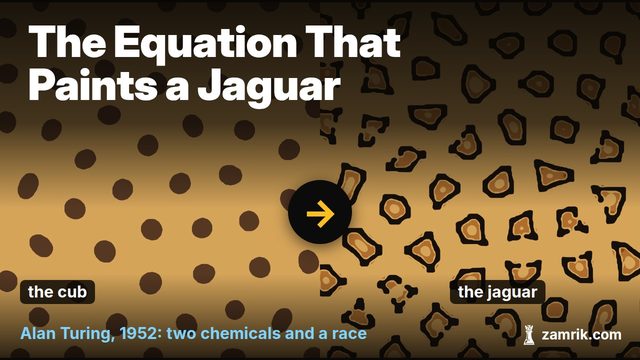
The Equation That Paints a Jaguar
For a change from our usual topics, this one picks up a neat gem of applied mathematics instead: the Alan Turing model, and what it can paint.
Five Fat Black Finger-Tips
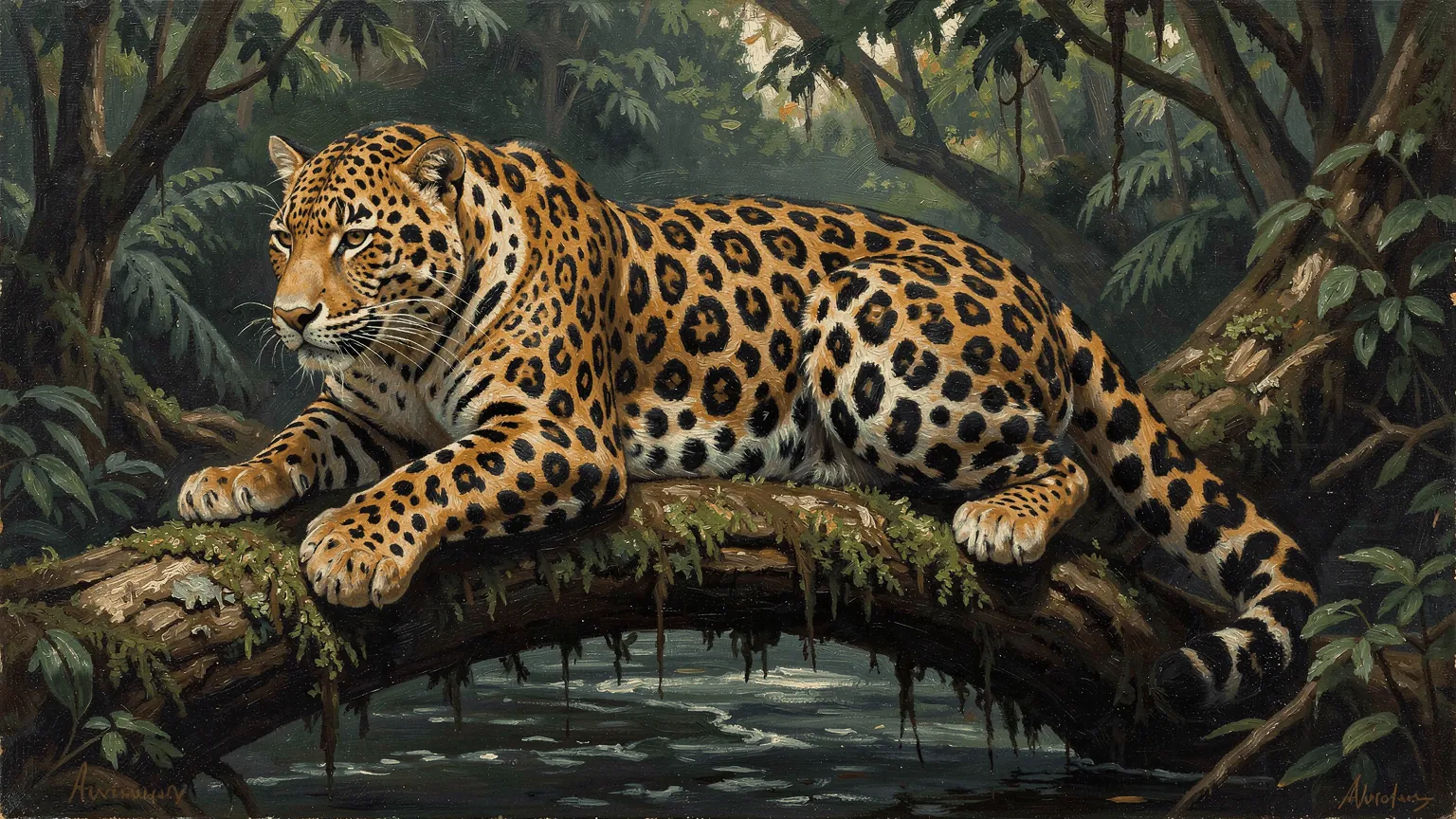
In 1902 Rudyard Kipling explained the leopard. In Just So Stories, an Ethiopian daubs the plain yellow cat with the black left on his own hands: “Then the Ethiopian put his five fingers close together … and pressed them all over the Leopard, and wherever the five fingers touched they left five little black marks, all close together.” That, said Kipling, is why a leopard’s spots come in clusters: “if you look closely at any Leopard now you will see that there are always five spots — off five fat black finger-tips.”
It is a better description than it sounds. Kipling had drawn the rosette: a ring of dark marks around a patch of coat. The jaguar wears bigger ones, broken rings around a darker centre, often with a spot or two inside. What nobody could say, for another fifty years, was what does the pressing.
Two Chemicals and a Race
In 1952 Alan Turing published The Chemical Basis of Morphogenesis, two years before his death. His idea was that a pattern could appear from nothing, in a skin of identical cells, if two chemicals were at work. One, the activator, makes more of itself and more of the other. The other, the inhibitor, shuts the activator down, and it spreads faster. A small excess of activator grows where it starts, while its inhibitor races ahead and stops anything similar growing nearby. The result is a patch of activity surrounded by a moat of quiet, repeated across the skin at a spacing the chemistry chooses: spots or stripes from a uniform start.
The version that paints a jaguar comes from Liu, Liaw and Maini (2006), built on a model of Barrio and colleagues. With $u$ the activator and $v$ the inhibitor, both measured as departures from a plain coat:
Here $\nabla^2 = \partial_x^2 + \partial_y^2$ spreads each chemical across the skin. $D < 1$ is the activator's diffusion as a fraction of the inhibitor's, so the inhibitor is the faster of the two. $\delta$ sets the size of the pattern against the size of the skin. The linear terms, with $\gamma = -\alpha$, are the chemistry near a plain coat; $r_2$ weights a quadratic reaction that favours spots, and $r_3$ a cubic one that favours stripes. For the cub, the paper's values are $D = 0.45$, $\delta = 6$, $\alpha = 0.899$, $\beta = -0.91$, $r_2 = 2$ and $r_3 = 3.5$.
Turing’s condition is what makes those values special. Without spreading, the plain coat is stable: any small disturbance dies away. With spreading, it is not. For this system both statements reduce to four inequalities, and the cub’s numbers pass all four. The first line says the plain coat is stable while nothing spreads; the second, that spreading at these rates breaks it:
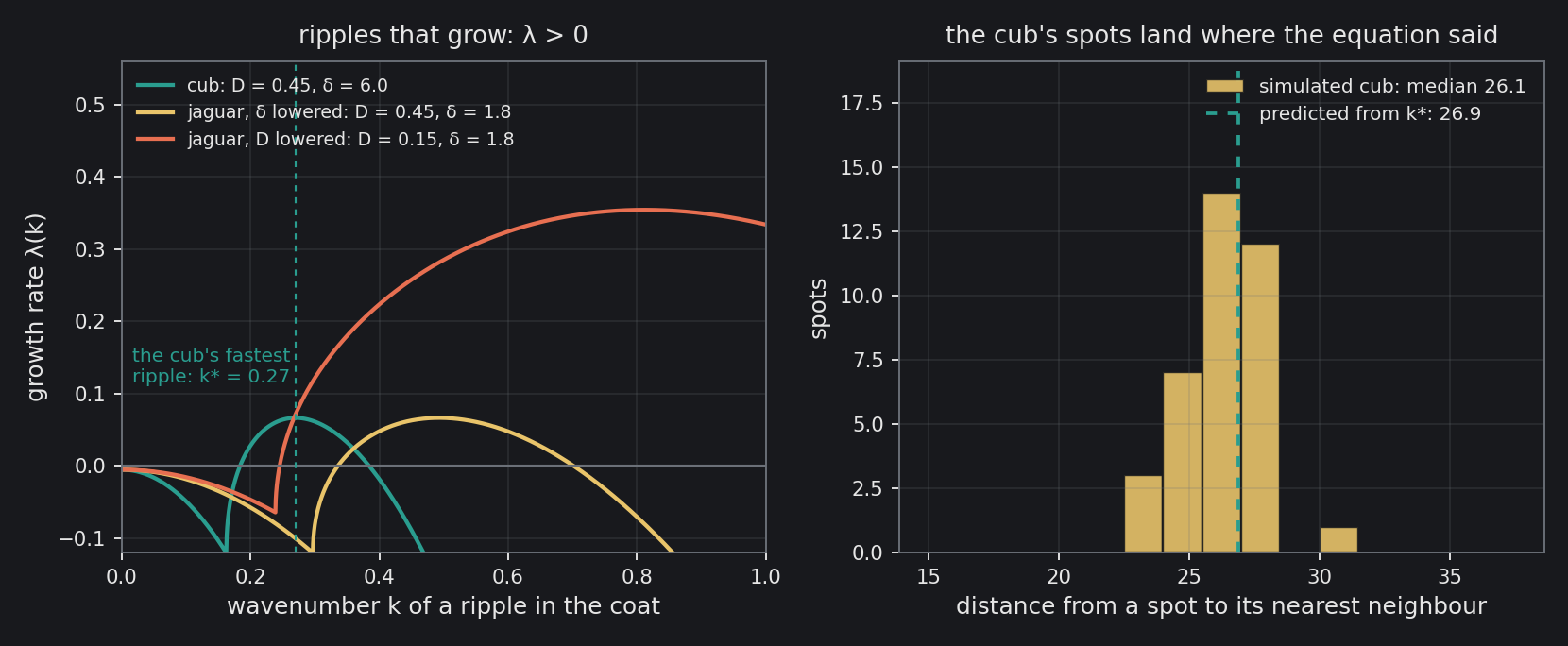
The linear algebra says more than whether. It says which ripples grow and how fast: a ripple with wavenumber $k$ grows at a rate $\lambda(k)$, positive only in a band. For the cub, the fastest is $k^{*} = 0.27$, the value the paper states. Before a single spot exists, the equation predicts where the spots will be: a honeycomb of spots made by that ripple puts neighbours $4\pi/(\sqrt{3}\,k^{*}) = 26.9$ units apart, on a skin 200 units across. Run it, and the simulated cub’s spots, away from the edges, sit a median of 26.1 units from their nearest neighbours. The paper reports about 25.
The Cub Comes First
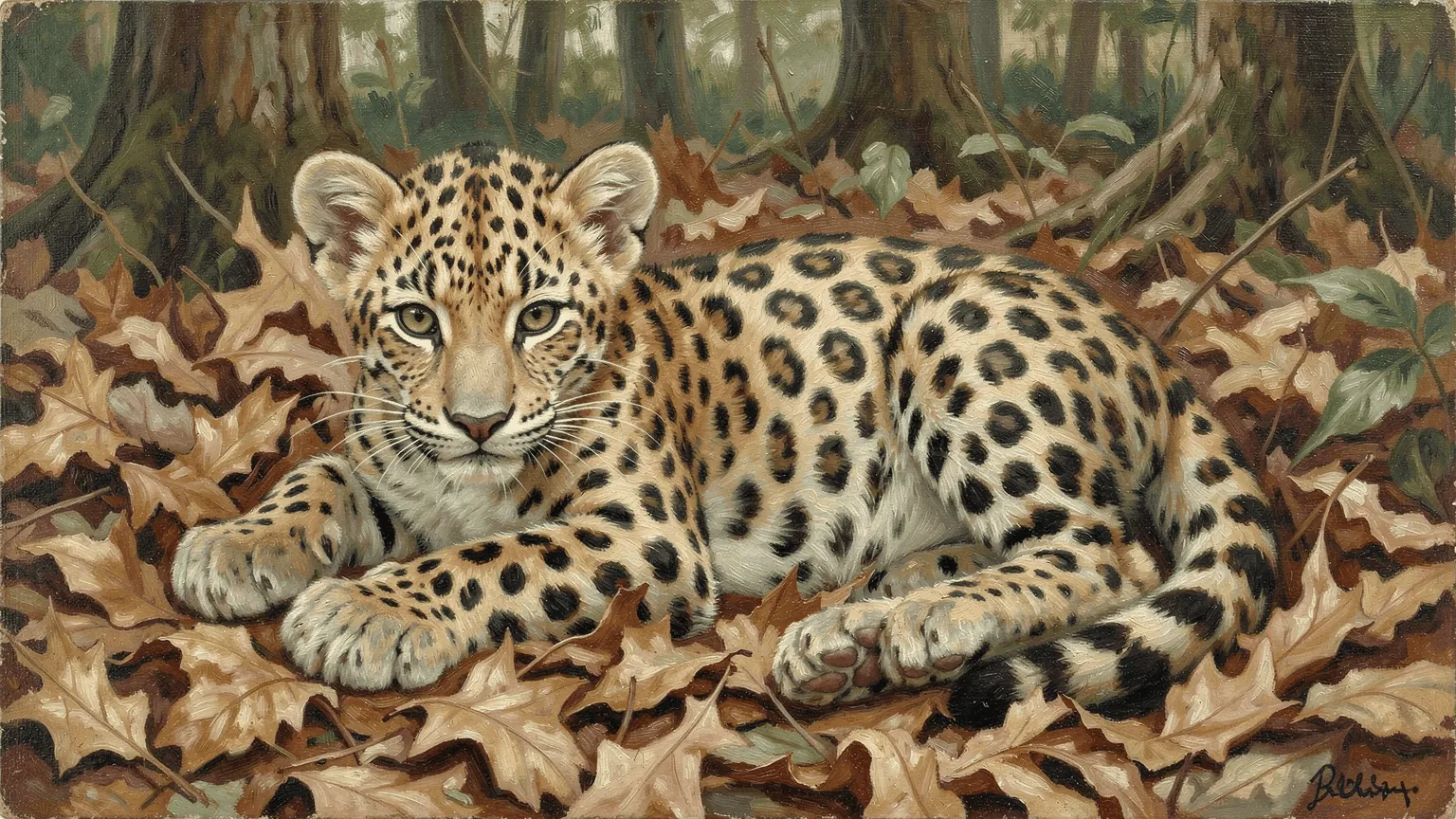
One equation with fixed numbers makes spots, and only spots: even, well spaced and dull. Liu, Liaw and Maini noticed that this is what a young cat looks like. Their photographs of a jaguar show plain spots at five weeks, irregular rings at three months and the broken rosettes of the adult. The family tree of the cats points the same way: small scattered spots are the ancestral coat, and rosettes and blotches came later.
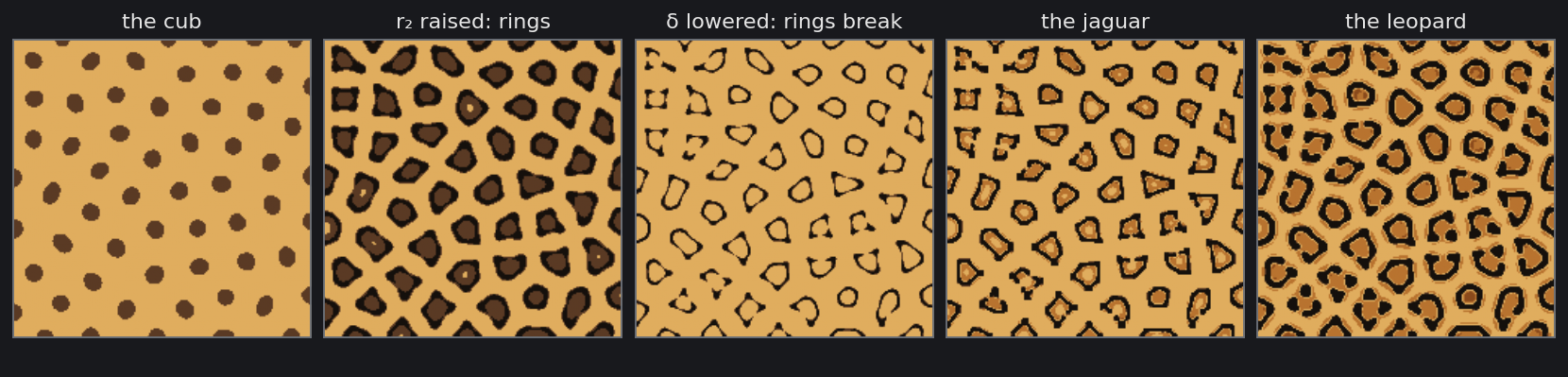
So they painted in two stages. The first makes the cub’s spots. The second changes three numbers, one after another, while the pattern is already on the skin:
- Raise $r_2$ from 2 to 7. In the paper’s words, the spots “grow darker and begin to change into rings”. Each of the cub’s 60 spots swells into one of 60 polygons, and the middle of each sinks while its rim rises; by the time the jaguar’s rings are deepest, the middle holds about a third of the rim’s activator.
- Lower $\delta$. For the jaguar it falls from 6 to 1.8, and the pattern’s natural size shrinks by $\sqrt{6/1.8} = 1.83$. The rings thin, and then, as the paper says, “a few rings begin to break.”
- Lower $D$ from 0.45 to 0.15. The broken rings set.
The leopard is the same cub taken through the same three changes with different numbers: $r_2$ is held for less time, and $\delta$ falls only to 3.8. Its rosettes come out smaller and more broken than the jaguar’s.
The model also marks where a rosette’s centre is. Inside a closed ring the activator runs lowest of all: a median of −6.8 against −3.4 on the open coat for the jaguar, −7.6 against −5.8 for the leopard. A jaguar’s centres are a deeper tawny than its ground, so that is the colour given to them here. The region is the model’s; the colour is a choice. And one thing does not come out: in the paper, the jaguar’s dots inside its rosettes come from a double ring whose inner ring breaks into spots. In these runs no double ring forms, and not one black piece sits inside a ring.
The paper gives the values and the order of the three changes, but not how long each lasts. So the script watches for the moments the paper describes and switches when it sees them. For the leopard it lowers $\delta$ as soon as the spots have turned into rings, after 6 units of time; for the jaguar, which the paper holds longer, when the rings are at their deepest, after 12. It lowers $D$ when the black pieces outnumber the cub’s spots by a tenth, which is when the rings begin to break. There is a clock: held at $r_2 = 7$ with nothing else changed, the whole pattern collapses within about 40 units of time, so the changes have to come quickly.
Two more checks keep the picture honest. The skin is solved on 400 by 400 points. On a grid half as fine, the leopard’s late spots came out as squares: the grid showing through, not the cat. And the adult has to hold still. After $D$ drops, both coats keep the same pieces in the same places, which move less than one unit in 20 units of time, while their outlines thicken by about a seventh. Left running for another hundred units, a finer pattern starts to take over, at any grid size. So the adult is read off that plateau. That turns out to be how real skin works too: as the next section shows, the pattern is laid down in a window before birth and then fixed.
Algorithm — One Cub, Two Cats, Solved
input:  the paper's rates: α = 0.899, β = −0.91, γ = −α, r₃ = 3.5
        a skin 200 units across, drawn with 400 × 400 points (h = 0.5)

u, v  <- random in [0, 1]           # a plain coat with noise, as in the paper

repeat until t = 300:               # stage 1: the cub
    step(D = 0.45, δ = 6, r₂ = 2)

r₂ <- 7                             # stage 2: the adult
repeat step() until the spots are rings
    leopard: a spot's middle falls to 0.70 of its rim
    jaguar:  the rings are at their deepest
δ <- 3.8 (leopard) or 1.8 (jaguar)
repeat step() until black pieces >= 1.1 × the cub's spots
                                    # the rings begin to break
D <- 0.15
repeat step() for 30 units of time
refuse the adult unless it keeps the same pieces
    and none of them moves by more than 2.5 units

step():  one explicit Euler step, dt = 0.005
    ∇²f  ≈ (f_east + f_west + f_north + f_south − 4 f) / h²
                                    # zero flux: an edge copies its neighbour
    u <- u + dt · (D δ ∇²u + α u + v − r₂ u v − α r₃ u v²)
    v <- v + dt · (δ ∇²v + γ u + β v + r₂ u v + α r₃ u v²)
Drag the slider to watch one cub become either cat:
What the Equation Does Not Know
None of this proves that a jaguar is painted this way. In the equation, $u$ and $v$ are placeholders: no molecule in a jaguar’s skin has been identified as either. The numbers were chosen so that the picture came out right, and the second stage is an assumption; the authors write that they “do not have precise evidence that parameters change in the system.” Other kinds of model, built from cell movement or mechanical forces, can draw rosettes too. A picture that matches is a picture that matches.
What would count as evidence is a real activator and a real inhibitor, found in real skin, drawing the pattern before the fur appears. For the jaguar, that evidence does not exist yet. For the house cat, it does.
Caught in a House Cat
In 2021 Christopher Kaelin, Kelly McGowan and Gregory Barsh published the molecular answer for the domestic cat in Nature Communications. Their material came from feral-cat spay-and-neuter clinics: more than two hundred litters of fetal tissue that would otherwise have been discarded.
What they found is Turing’s mechanism, at the level of molecules:
- The pattern is drawn before birth, and before the fur. Partway through the 63-day pregnancy, before any hair follicle has formed, the fetal skin is already divided into alternating thick and thin regions in the layout of the future stripes. Then the window closes: the molecular pattern fades as the first hair follicles form, and from then on each follicle keeps the light or dark identity it was given, through every hair it grows.
- A gene-expression pattern comes first. Before the skin thickens, the gene Dkk4, which makes a secreted inhibitor of the Wnt signal, is switched on in a periodic pattern. The cells that express it mark the skin that will later grow dark hair.
- The cast list is an activator and an inhibitor. The activators, Wnt10b and Wnt5a, act over a short range; the inhibitors, Dkk4, Dkk3 and Wif1, are secreted and reach further. In the authors’ words, this suggests “a reaction-diffusion model for the establishment of color patterns in which Wnt10b and Wnt5a serve as short-range activators, and Dkk4, Dkk3, and Wif1 serve as long-range inhibitors.” Short-range activation, long-range inhibition: the structure of the equations above.
- Break the inhibitor and the pattern changes. The Ticked pattern, the plain coat of the Abyssinian, is a tabby with its dark markings erased. Of 105 Ticked cats tested, 104 carry at least one broken copy of Dkk4; of 234 cats without the pattern, not one does. In spotted Savannah cats, the same broken alleles give dark spots that are more numerous and smaller. A second gene, Taqpep, changes the scale: when it fails, the fetal Dkk4 regions come out fewer and broader, and the cat’s narrow mackerel stripes open into the swirling blotches of the classic tabby. The same gene gives the rare king cheetah its blotched coat.
“Several of the molecules, including Dkk4, are known to function coordinately as activators and inhibitors,” Kaelin said, “exactly as Alan Turing predicted 70 years ago.”
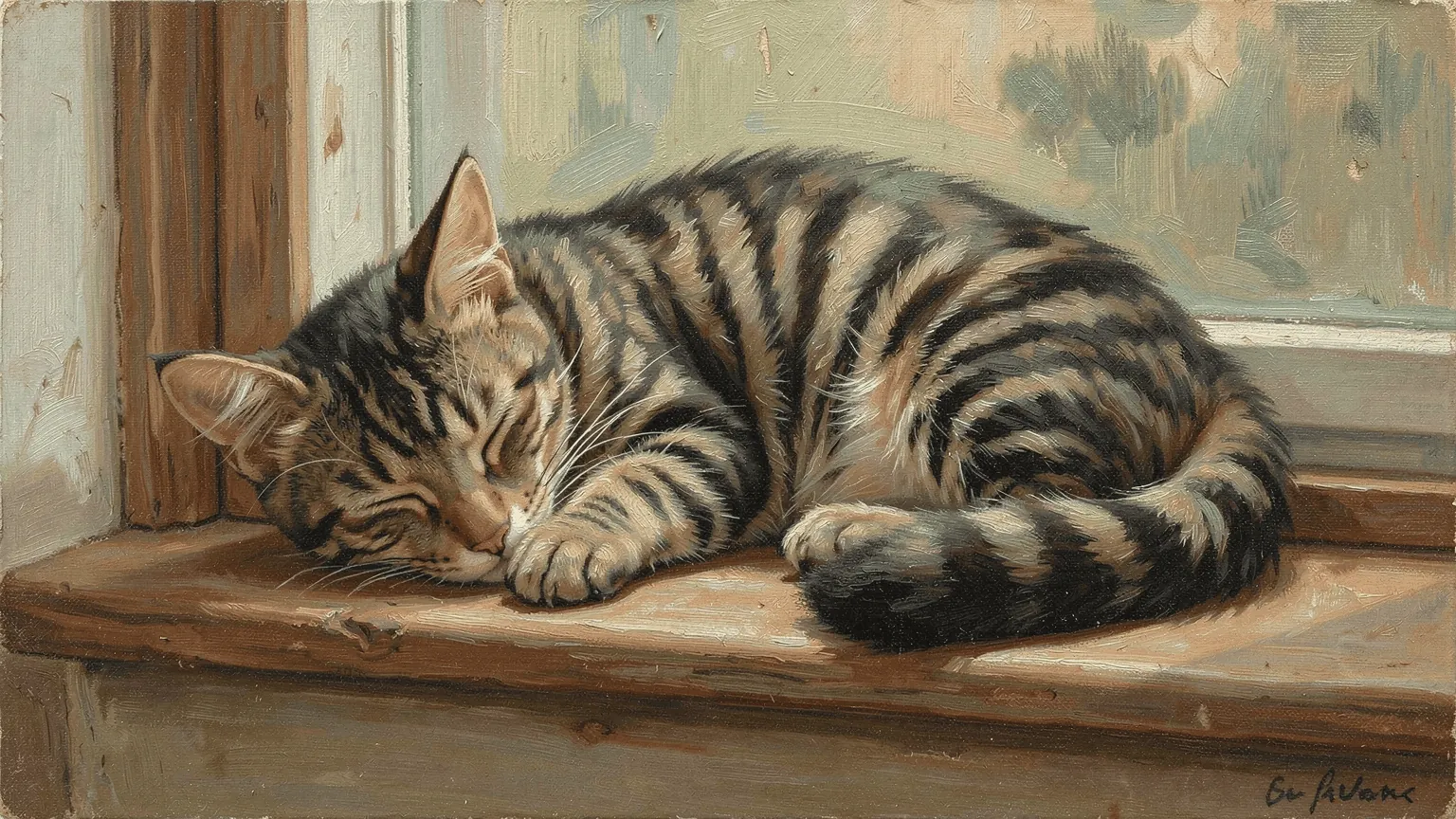
So the evidence is this. In the house cat, the kind of system that equation (1) describes has been caught at work, with named molecules, the right ranges, and mutations that change the pattern in the directions a reaction-diffusion model allows. It does not certify this particular equation, or its numbers, for the jaguar. And it raises the one question the jaguar model has to answer: in the house cat the pattern is fixed before birth and only grows with the animal, while the model’s second stage runs as the cub grows up. Whether a jaguar’s rosettes are finished in the womb or reshaped afterwards is not yet known.
Two Molecules and a Race
Turing never saw a cat embryo. He wrote down two chemicals and a race, showed that a flat coat could not stay flat, and died two years later. Seventy years on, in skin recovered at spay clinics, the activator and the inhibitor were there, drawing stripes before a single hair had grown.
Kipling needed five fat black finger-tips. The mathematics needs two molecules, one faster than the other, and three changes of pace.
Sources
- R. Kipling, Just So Stories (1902).
- A. M. Turing, “The chemical basis of morphogenesis”, Philosophical Transactions of the Royal Society B 237 (1952) 37–72.
- R. T. Liu, S. S. Liaw and P. K. Maini, “Two-stage Turing model for generating pigment patterns on the leopard and the jaguar”, Physical Review E 74 (2006) 011914.
- C. B. Kaelin, K. A. McGowan and G. S. Barsh, “Developmental genetics of color pattern establishment in cats”, Nature Communications 12 (2021) 5127.
- C. B. Kaelin et al., “Specifying and sustaining pigmentation patterns in domestic and wild cats”, Science 337 (2012) 1536–1541.
- HudsonAlpha Institute for Biotechnology, press release of 7 September 2021.
Every number here is computed by the script archived with this post.
Interested in applying these ideas to your work? Get in touch.