
De Rerum Electione: The Choice That Is Not a Swerve
I. The Question Left Open
- The first poem closed with atoms bending, and it made one passing claim — that without the swerve there is no choice, and the will would have no name.
- Lucretius said it plainly, and his Latin still is clear — the swerve “fati foedera rumpat”, breaks the bonds of fate, and so the will is here.
- “Fatis avolsa voluntas”, a will torn from the fates — the mind slips through the tiny gap the random tilt creates.
- So freedom was the swerve itself, a jolt without a cause — and every choice a little break in nature’s iron laws.
- But is a jolt a choice at all? That question waited there — and a Roman was the first to lay the whole objection bare.
II. Cicero’s Objection (45–44 BC)
- Marcus Tullius Cicero read the Epicurean line — and called the swerve “ficta pueriliter”: a child’s invention, not a sign.
- No greater shame, he wrote, for one who studies how things go — than saying that a thing can happen with no cause below.
- A year later, in De Fato, he came back to press the case — a twitch without a reason is not choosing, only chance in place.
- And there he gives the prize to Carneades, who saw the better way — “acutius”, more shrewdly: the mind can move by its own sway.
- No swerve was needed, Carneades taught, to set the will apart — a motion of the mind itself, and not a jolt inside the heart.
- So two thousand years ago the question found its hinge — that chance is not a choice, and choosing is no random twinge.
III. The Demon (1814)
- Then Laplace, in 1814, took the swerve away once more — he pictured a mind that knew each force, and where each atom was before.
- To such a mind “nothing would be uncertain”, past and future in plain view — the whole of time laid open, like a book it had read through.
- No swerve, no break, no gap in which a will could slip inside — the atoms of Democritus returned, and chance had died.
- And if the demon had it right, there was no room for choice — the chain of cause ran through us all, and no one had a voice.
IV. The Three Bodies (1890)
- Henri Poincaré, in 1890, took three bodies and their law — and found, inside the clockwork, a tangle and a flaw:
- two starts that almost touch will drift apart as time goes on — the law is kept, the forecast lost: determinism, with prophecy gone.
- The demon needs a precision that no finite mind can hold — an endless string of digits for each speck, exactly told.
- So chaos keeps the chain of cause, but hides it in the fine — the future is decided, and yet no one reads the line.
V. The Dice (1926)
- In 1926 Max Born read the quantum wave a newer way — its square, a probability: not where a thing is, but where it may.
- For the first time since the swerve, real chance lay in the ground — not ignorance, not averages, but chance itself, profound.
- And Einstein, who had shown the jitter was a way to count the grain — wrote Born the Old One “does not throw dice”, and made his feeling plain.
- The man who read the atoms in the trembling of a drop — would not let chance go to the bottom, where the laws of nature stop.
VI. Chance Is Not Choice
- But grant the dice. Let every atom roll at nature’s floor — does that make us free? It makes us lucky, nothing more.
- A choice that comes from nowhere has no author and no aim — a coin that lands on heads has not decided, all the same.
- If I am free because a particle has leapt without a cause — then no one wrote my choosing, and no one earns applause.
- So neither iron chain nor dice can hold the thing we mean — the swerve gives only luck, and the demon, a machine.
- Cicero was right, and Carneades had seen it long before — the choosing is a motion of its own, and something more.
VII. The Equation With a Hand on It
- The mathematics settled it, two thousand years along — and wrote the swerve and choosing in one line, where both belong:
$$dX_t = b\big(X_t,\,u_t\big)\,dt + \sigma\,dW_t$$
$(1)$
- The $\sigma\,dW_t$ is the swerve, the old clinamen, still — the kick that no one ordered, the jolt against the will.
- The $u_t$ is the hand upon the helm, a choice made at each time — from everything that has been, never from the future’s rhyme.
- The noise is what you suffer, and the drift is what you do — one line of mathematics holds the swerve, and the steerer too.
VIII. Choosing Well (1957, 1961)
- In 1957 Richard Bellman wrote the rule behind a plan — whatever step you take first, play the rest as well as the rest can.
- By 1961 the rule had met the noise: Florentin, then Kushner, wrote it with the swerve — a value for each state that weighs each kick, each future curve:
$$\partial_t V + \min_{u}\Big\{\, r(x,u) + b(x,u)\,\partial_x V \,\Big\} + \tfrac{1}{2}\sigma^{2}\,\partial_x^{2} V = 0$$
$(2)$
- The $\min$ is where the choosing lives, the one term with a hand — the $\tfrac{1}{2}\sigma^{2}$ is the swerve, which no one can command.
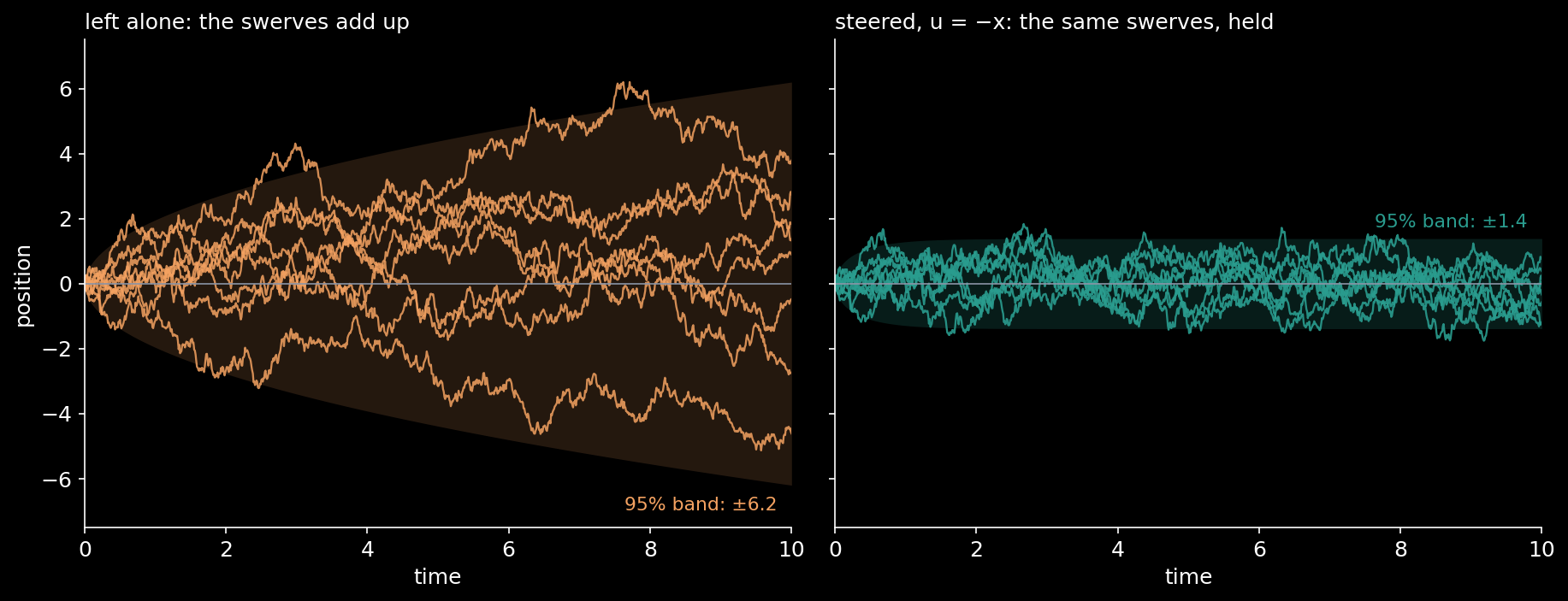
- Now steer a speck toward the centre, paying for the distance and the push — the answer is the simplest one: lean back against the rush.
$$dX_t = u_t\,dt + \sigma\,dW_t,\quad \text{cost } X_t^{2} + u_t^{2} \;\;\Longrightarrow\;\; u_t^{*} = -X_t,\quad \text{long-run cost } \sigma^{2}$$
$(3)$
- Steer perfectly, and still the cost is $\sigma^{2}$, the swerve’s own size — the noise is never beaten, only carried, and the carrying is wise.
- Steer twice as hard, or half as hard, and a quarter more is paid — the best hand on the helm is neither frantic nor afraid.
IX. The Reversal
- Lucretius put our freedom in the swerve, the twitch without a cause — the mathematics puts it in the drift: the steering, and its laws.
- The free one is not the atom that is jolted, blind, and tossed — but the one who, being jolted, steers, and counts the cost.
- The noise is not our freedom; it’s the weather and the gale — the freedom is the rudder, and the trimming of the sail.
- Carneades had seen it: the mind’s own motion, not the dice — and Bellman gave that motion rules, a value, and a price.
X. Coda
- The atoms swerve, the dice may roll, the chaos hides the thread — and none of that is choosing, whatever Lucretius said.
- The choosing is the hand that, knowing it will still be pushed, still leans — the answer to the swerve is not a swerve, but what the leaning means.

- The first poem ended on the swerve; this one can end as clear — the world still swerves, and still, we steer.
Sources
- Lucretius, De Rerum Natura, Book II, lines 216–293.
- Cicero, De Finibus Bonorum et Malorum, Book I, 19 (45 BC).
- Cicero, De Fato, 22–23 (44 BC).
- P.-S. Laplace, Essai philosophique sur les probabilités, Paris (1814).
- H. Poincaré, “Sur le problème des trois corps et les équations de la dynamique”, Acta Mathematica 13 (1890) 1–270.
- M. Born, “Zur Quantenmechanik der Stoßvorgänge”, Zeitschrift für Physik 37 (1926) 863–867.
- M. Born, The Born–Einstein Letters, Macmillan (1971): Einstein to Born, 4 December 1926.
- R. Bellman, Dynamic Programming, Princeton University Press (1957).
- J. J. Florentin, “Optimal control of continuous time, Markov, stochastic systems”, Journal of Electronics and Control 10 (1961) 473–488.
- H. J. Kushner, “Optimal stochastic control”, IRE Transactions on Automatic Control 7 (1962) 120–122.
The steering example and its chart are computed by the scripts archived with this post: the closed forms (best steering u = −x, long-run cost σ², a quarter more at half or twice the effort), each checked against a simulation of 20,000 paths driven by the same random kicks, saved once. The Latin is quoted from the texts themselves.
Interested in applying these ideas to your work? Get in touch.