
The Third Walker
Walking Home
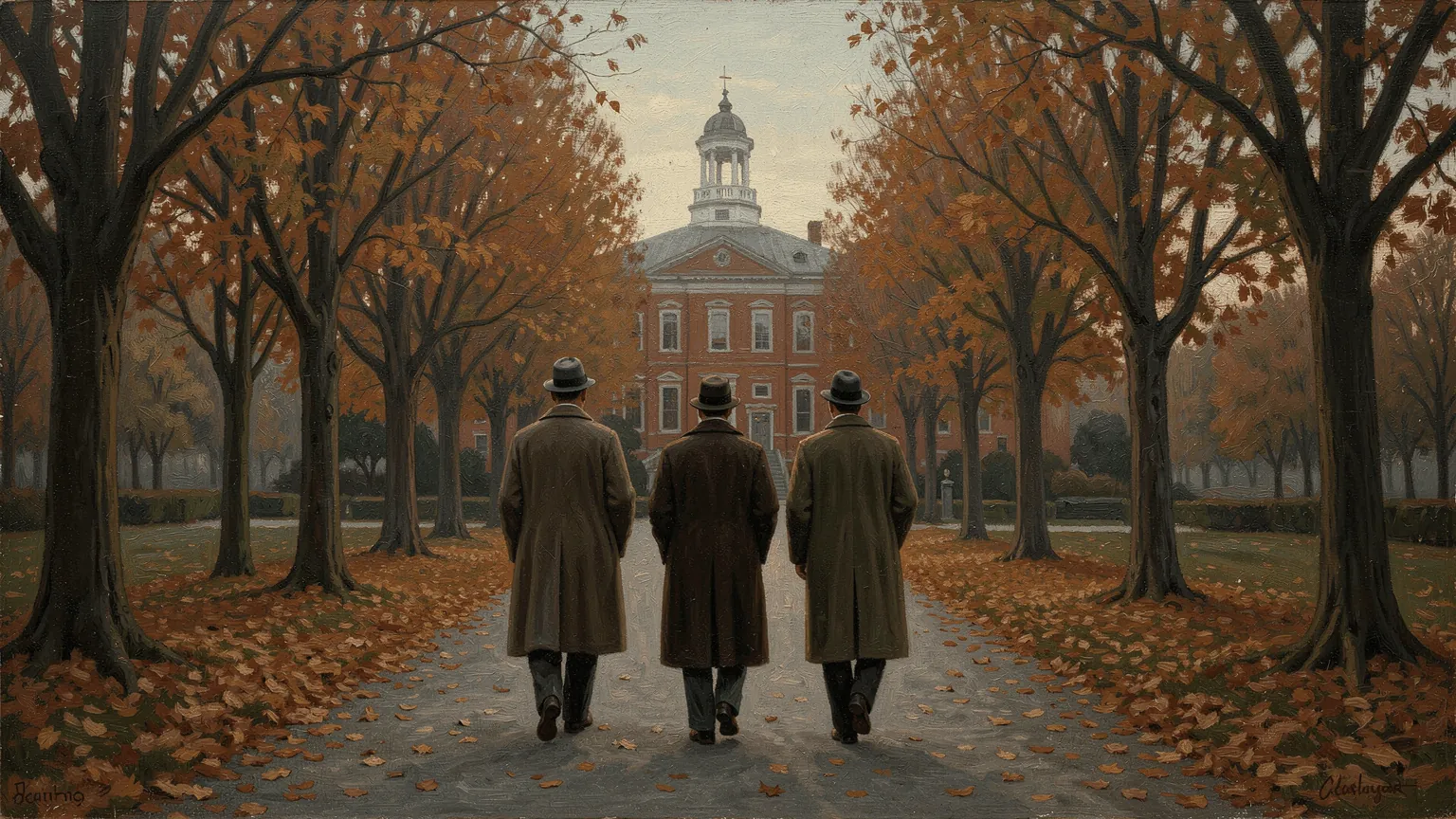
Jim Holt’s collection When Einstein Walked with Gödel: Excursions to the Edge of Thought opens with a friendship that should not have worked. In the 1940s and early 1950s, at the Institute for Advanced Study in Princeton, the most famous scientist in the world and its most reclusive logician walked home together most afternoons, talking in German. Einstein, by then, said he went to his office “just to have the privilege of walking home with Gödel.”
Nobody wrote down what they said on those walks. But on one question both of them wrote, in the same book, in the same year, and the question was never closed. This post is about that question, and about a third man who worked down the same corridor and is not part of the story as it is usually told.
A Universe That Turns
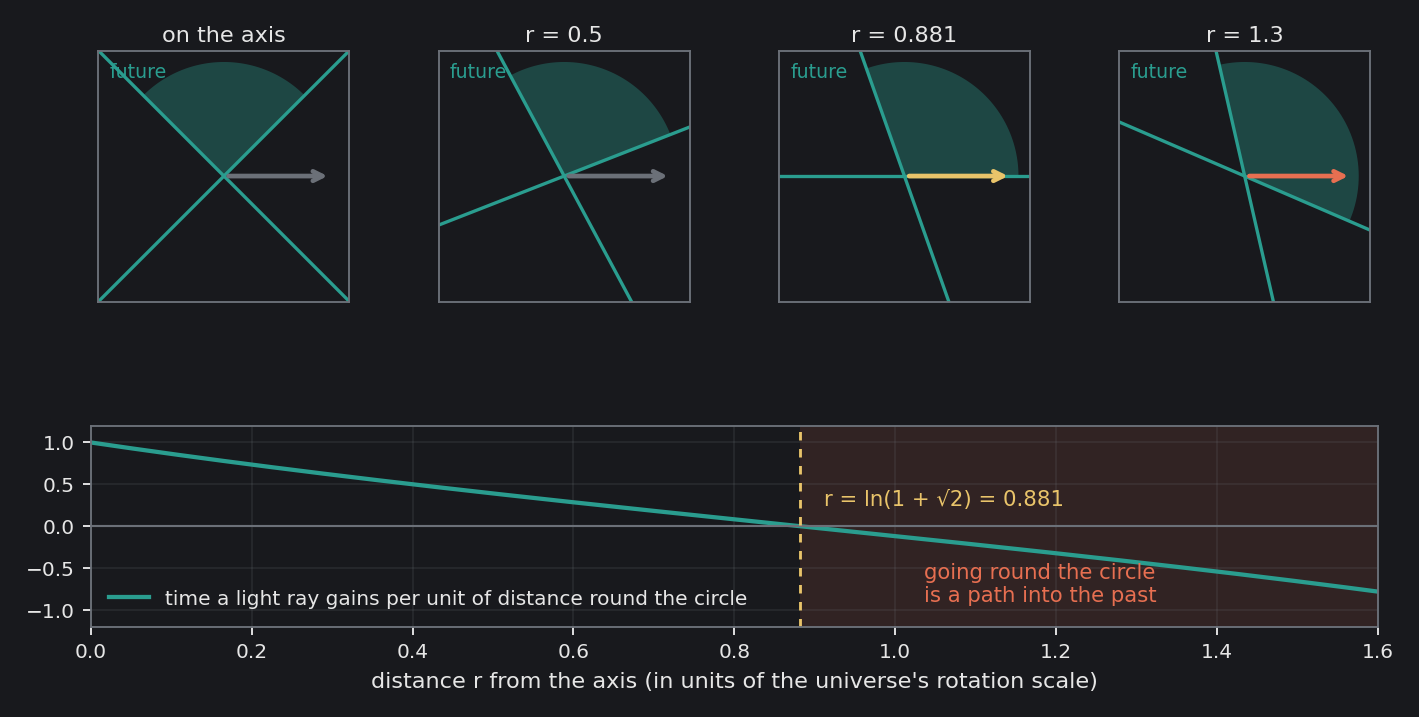
In 1949, for Einstein’s seventieth birthday, Gödel gave him a universe. It was a new solution of Einstein’s own equations of gravity, in which all the matter in the cosmos turns slowly about every point. In that universe the cones along which light travels, which mark out the possible futures of every event, tip over as you move away from the axis of rotation. Beyond a certain distance, $r = \ln(1+\sqrt{2}) \approx 0.881$ in the natural units of the rotation, they have tipped so far that a circle around the axis is a path a traveller can follow, always moving into their own future, and still arrive back at the moment they left.
Gödel put it plainly: “by making a round trip on a rocket ship in a sufficiently wide curve, it is possible in these worlds to travel into any region of the past, present, and future, and back again, exactly as it is possible in other worlds to travel to distant parts of space.” He even priced the ticket: for a voyage lasting $t$ years by the traveller’s clock, fuel weighing about $10^{22}/t^2$ times the ship.
The physics was a birthday present. The philosophy, in an essay Gödel wrote for the same volume, was an attack. The passing of time, he argued, means that “reality consists of an infinity of layers of ‘now’ which come into existence successively.” Special relativity had already broken that picture: “Each observer has his own set of ‘nows’, and none of these various systems of layers can claim the prerogative of representing the objective lapse of time.” One could still hope that the matter of the real, curved universe picks out one privileged set of layers, a cosmic time. In Gödel’s universe the matter picks out none: rotation makes it impossible to slice that spacetime into a single stack of moments. And since his universe obeys the same laws as ours, a passing of time that exists only because of how the matter happens to be arranged is, he concluded, no objective passing at all. Time’s lapse belongs, as Kant had said, to the way we see, not to what there is.
Einstein’s reply, in the same volume, praised the essay and did not answer it. “Kurt Gödel’s essay constitutes, in my opinion, an important contribution to the general theory of relativity, especially to the analysis of the concept of time. The problem here involved disturbed me already at the time of the building up of the general theory of relativity, without my having succeeded in clarifying it.”
He went this far. For two events close together, “before” is a physical fact, because a signal can be sent from the earlier to the later and not back, and “the sending of a signal is, in the sense of thermodynamics, an irreversible process, a process which is connected with the growth of entropy.” For events far apart, in a universe where time-like paths close on themselves, the distinction “earlier–later” is lost. And he ended with a sentence he never came back to: “It will be interesting to weigh whether these are not to be excluded on physical grounds.”
That is the unsettled matter. Gödel said that the passing of time is not real. Einstein said that it is physical nearby, lost far away, and possibly rescued by physics he did not name. The walks went on for six more years, and neither of them published another word on it.
The Man Down the Corridor
At the same Institute, from 1933 until 1951, worked Hermann Weyl, the one person who had written about every part of that disagreement.
- Relativity. His Space, Time, Matter of 1918 was the book from which a generation learned Einstein’s theory, and his 1918 attempt at a unified field theory was sunk by a single objection from Einstein, about clocks.
- Cosmic time. In 1923 he stated the assumption that gives an expanding universe a single clock: the paths of the galaxies never cross, spreading from a common past. Cosmologists still call it the Weyl principle. It is the reason “the age of the universe” means anything.
- Mathematics. Against Gödel’s belief that mathematical objects exist whole and timeless, Weyl had sided for years with the view that mathematics is built by the mind, step by step, and had doubted that the continuum of real numbers exists as a finished thing.
- Time and consciousness. From Edmund Husserl he had taken a philosophy of how time is lived, and in 1949 he put it into the English edition of his Philosophy of Mathematics and Natural Science in two sentences that bear directly on Gödel’s argument.
What follows is a walk that never happened. It is invented, but it keeps to what each of them thought and wrote. Lines in quotation marks are what they actually published; everything else is imagined.
An Imagined Walk, Autumn 1949
Princeton, late October. Einstein and Gödel leave Fuld Hall and turn down Olden Lane. Weyl catches them up at the gate.
Weyl: May I walk with you? I have been reading your birthday present, Gödel. Both halves of it: the universe and the essay.
Gödel: Then you know the conclusion. If the lapse of time were real, reality would be “an infinity of layers of ‘now’ which come into existence successively.” Relativity makes every such stack of layers depend on the observer. My universe shows that even the matter need not choose one. What is left is not a lapse. It is a way of looking.
Einstein: And I have told him that it disturbs me, and that I cannot answer it. Perhaps you can. You have always been braver with philosophy than I am.
Weyl: Your argument has two steps, Gödel, and I think they have different fates. The first says: in your universe there is no single stack of moments, because the matter rotates and no family of slices can cut across all its paths at once. That is true, and beautiful. The second says: therefore in ours the passing of time is unreal too, because a lapse that depends on how the matter happens to lie is no objective lapse. That second step is the one I want to walk around.
Gödel: Our universe has a stack of moments only by accident. The galaxies happen to fly apart and not to turn.
Weyl: By accident, yes. I assumed that accident myself, in 1923, before anyone had measured it: the galaxies’ paths never cross, and so they carry one common clock. Hubble found them flying apart six years later. I grant you completely that the cosmic “now” is a fact about our universe and not a law of every universe. But you have not yet told me what the lapse of time is. You have told me one picture of it: layers of “now” that come into being one after another. If that picture is the only one, your argument is finished. I do not think it is the only one.
Einstein: You have another picture?
Weyl: I have a sentence. I put it in my book this year. “The objective world simply is, it does not happen. Only to the gaze of my consciousness, crawling upward along the life line of my body, does a section of this world come to life as a fleeting image in space which continuously changes in time.”
Gödel: That is my conclusion, in better prose. The world does not happen. The happening is in us.
Weyl: The first half is your conclusion. The second half is not. Notice what does the crawling: not a layer of the whole universe, but a gaze along one life line. There is no stack in my sentence. The becoming happens along a path, not across a slice.
Einstein: But then it is subjective. Consciousness crawls. Physics does not.
Weyl: Let me take it out of consciousness and put it into your own words, Einstein. You wrote in your reply that for two events close together, “before” is physical, because “the sending of a signal is, in the sense of thermodynamics, an irreversible process”, bound up with the growth of entropy. Now: what is a memory?
Einstein: You will tell me.
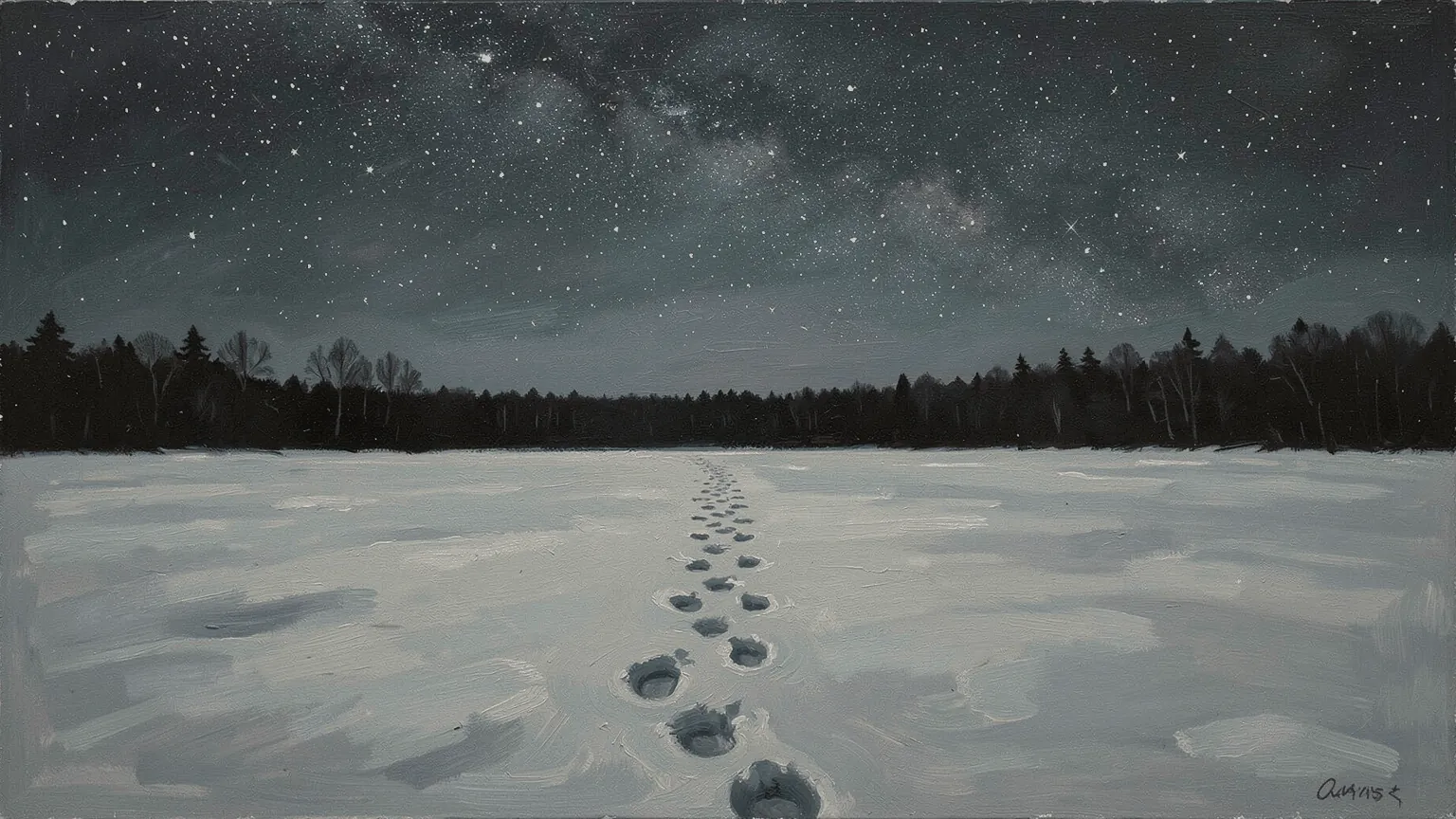
Weyl: A memory is a signal that a system sends to its own future. A footprint, a scratch in the wax, a trace in the brain: a record. And a record is made by exactly the kind of irreversible process you named. The footprint is later than the step. It is never earlier. So along every life line, in any universe where entropy grows, there is an order that is not a convention and does not depend on any observer’s slice: the order in which records accumulate. That order is local. It needs no universal “now”. It is present on every path, in your universe, Gödel, as much as in ours.
Gödel: Then take your traveller on my wide circle. He goes round, always into his own future, and arrives back at the moment he left. Where are his records then? He meets himself setting out.
Weyl: That is exactly where the question turns. Along a closed path, any quantity that only ever increases must come back to the value it started with. That is not physics, it is arithmetic: you cannot climb all the way round a circle. So one of two things happens on your loop. Either entropy stops growing somewhere along it, and records are unmade as he goes; or no one who keeps records can travel it at all.
Einstein: “Excluded on physical grounds.” I wrote that sentence and did not know which grounds I meant.
Weyl: These are yours: the same irreversibility you used to give “before” a meaning. Your equations of gravity allow Gödel’s loop. The law of entropy refuses to let a remembering traveller close it.
Gödel: Unless he forgets.
Weyl: Then think what “forgets” means. If his records are unmade as he goes, then when he arrives at the moment he left, nothing in him remembers the journey. He does not visit his past. He arrives at it as the man who was there before. The paradoxes vanish, and so does the time traveller. What your universe permits is a path that closes. What it cannot contain is a person who comes back.
Gödel: You have saved a direction. I did not deny that there are processes with a direction. I denied that existence itself changes, that there is a lapse in which things come to be.
Weyl: And here you and I have been on opposite sides for twenty years, over mathematics rather than physics. You think the continuum exists whole, every real number already there, found and not made. I once argued that a sequence nobody has yet chosen does not yet exist. Let me concede something to you tonight. The world is finished, the way you think the continuum is. All of spacetime simply is, and in it nothing comes into being. But inside what simply is, there are structures that are not symmetric: a record and the thing it records. The becoming is not a motion of the whole block. It is a relation within the block, between an event and its traces, running along each path.
Einstein: So the arrow is in the furniture, not in the house.
Weyl: Yes. And in our universe, because the galaxies behave as I assumed, all those little arrows line up into one great one, and we can speak of the age of the world. In Gödel’s universe they do not line up, and near the wide circles they cannot even be followed all the way round. Nothing about the arrow itself has changed. Only the luck of how they line up.
Einstein: Then let me say what I think we now agree, and you will each tell me where I am wrong. One: Gödel is right that there is no objective “now” spread across the universe. The layers of “now” are not in the laws; I have said as much since 1905, and his universe proves that even the matter need not supply them. Two: I was right that “before” is physical where one event can leave a trace in another, and that is enough to give every path its direction, in every universe where entropy grows. Three: Weyl is right that in ours the directions happen to agree, because the galaxies spread apart and do not turn, and that this is a fact and not a law. So the passing of time is neither unreal nor universal. It is real, it is local, and here, by a kind of luck, it is shared.
Gödel: And my loops?
Einstein: Your loops stand, as geometry. They are closed to anyone who remembers. That is the physical ground I asked for, and I had it in my own reply without seeing it.
Gödel: You have given me less than I asked for. My argument was that time is ideal, that its lapse belongs to our mode of perception.
Weyl: You keep the part that was always yours: the “now”. Nothing in four dimensions picks out this moment as present. The present is where the gaze is, crawling up the life line. That is ideal, if you like. But the crawling has a direction, and the direction is physical. You were right about the now and wrong about the lapse.
Gödel: Then we have divided time into three and each taken a piece.
Weyl: That is what a resolution usually looks like.
They reach Mercer Street. Einstein stops at his gate and laughs.
Einstein: Gödel, your ticket. Fuel of ten to the twenty-two over t squared times the ship. I think physics was protecting us from your universe before thermodynamics ever had to.
Gödel: The estimate was generous.
Weyl: In 1918, Einstein, you sank my theory with a clock. You said that if the rate of a clock depended on the path it had travelled, atoms from different histories would shine in different colours, and they do not. An atom cannot remember its path. Tonight I have argued the opposite: that every path is remembered, by what happens along it. Which of us was right?
Einstein: Both. The atom keeps no memory of its journey, and so its clock is honest. The world keeps a memory of every journey, and so its time has a direction. Goodnight, gentlemen.
Einstein turns in at his gate. Gödel walks on alone, into the dusk, and Weyl stands for a moment watching him go.
After the Walk
In March 1955, when his oldest friend Michele Besso died, Einstein wrote to Besso’s family: “People like us who believe in physics know that the distinction between past, present and future is only a stubbornly persistent illusion.” It is the first clause of the walk’s conclusion, in his own hand: the global “now” is not in the physics. He died that April. Weyl died in Zürich that December. Gödel lived until 1978.
The physics has not closed the question either, but it has moved in the direction the walk took. Whether nature forbids Gödel’s loops is still open; in 1992 Stephen Hawking proposed a chronology protection conjecture, that quantum effects destroy any time machine before it can form. Measurements of the cosmic microwave background find no sign of the overall rotation Gödel’s universe needs, and the galaxies do spread apart as Weyl assumed, which is why the phrase “the universe is 13.8 billion years old” means something. And the wall Weyl runs into on the walk is one that physicists studying loops in time keep meeting: in their models, what travels round a closed loop cannot keep gaining entropy. It stays constant, or it has to fall somewhere on the way.
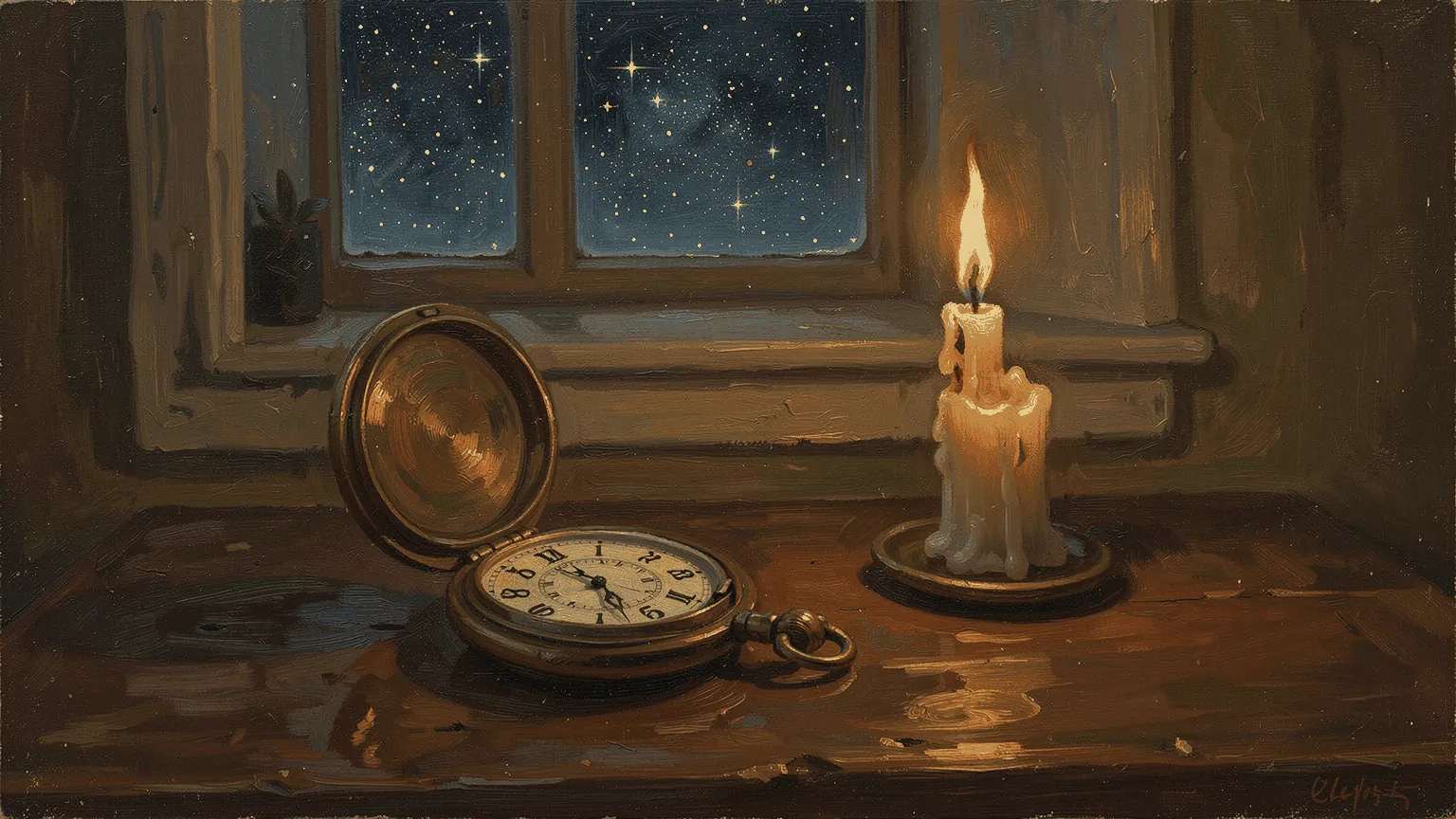
A watch can be wound back. A candle cannot. Einstein’s reply already held the difference: the direction of time is in the burning, not in the dial. Gödel was right that there is no single dial for the whole universe. What the three of them never managed to say together, and what this walk lets them say, is that there never needed to be one. Time passes the way a candle burns: here, in one direction, for everything that is burning.
Sources
- J. Holt, When Einstein Walked with Gödel: Excursions to the Edge of Thought (2018).
- K. Gödel, “An example of a new type of cosmological solutions of Einstein’s field equations of gravitation”, Reviews of Modern Physics 21 (1949) 447–450.
- K. Gödel, “A remark about the relationship between relativity theory and idealistic philosophy”, in P. A. Schilpp (ed.), Albert Einstein: Philosopher-Scientist (1949).
- A. Einstein, “Reply to criticisms”, in P. A. Schilpp (ed.), Albert Einstein: Philosopher-Scientist (1949).
- H. Weyl, Philosophy of Mathematics and Natural Science (English edition, 1949).
- S. W. Hawking, “Chronology protection conjecture”, Physical Review D 46 (1992) 603–611.
- “Closed timelike curves and the second law of thermodynamics”, Physical Review A 99 (2019) 022304.
The light cones in figure 2 are computed from Gödel’s metric by the script archived with this post. The walk is invented; the quotations in it are not.
Interested in applying these ideas to your work? Get in touch.