
When to Shoot
A Man Who Planned to Miss
On the morning of 11 July 1804, at Weehawken, New Jersey, Alexander Hamilton faced Aaron Burr with a loaded pistol. The night before, he had written down what he intended to do. He was, he said, strongly opposed to duelling, and he had “resolved… to reserve and throw away my first fire.”
The accounts of what happened next differ. Hamilton’s shot went high, into the branches above Burr’s head, whether by intention or by reflex. Burr’s did not. Hamilton died the next day.
He was not the only one to die of the question. Évariste Galois was shot on 30 May 1832, at twenty, having spent the night before writing out his mathematics in a letter to a friend; it took the world another fourteen years to publish it. Alexander Pushkin died of a duelling wound in 1837. For two centuries men settled their quarrels this way, and none of them had a theory of the one thing that decided it: when to pull the trigger.
A Question for an Afternoon
The theory arrived by accident, at the RAND Corporation in Santa Monica in the late 1940s, where a young mathematician named David Blackwell was working on the games the Cold War was interested in. Years later he described how it started:
“One day some of us were talking and this question arose: If two people were advancing on each other and each one has a gun with one bullet, when should you shoot? If you miss, you’re required to continue advancing. That’s what gives it dramatic interest. If you fire too early your accuracy is less and there’s a greater chance of missing. It took us about a day to develop the theory of that duel.”
Fire When the Chances Add to One
Set it up. The duellists start far apart and walk towards each other; call the time $t$, from $0$ when they are out of range to $1$ when they are at point blank. A shot fired at time $t$ hits with probability $p_1(t)$ for the first duellist and $p_2(t)$ for the second, rising from $0$ to $1$ as they close. A hit wins, being hit loses, and in the version Blackwell solved first, the noisy duel, each hears the other fire.
That last detail is everything. If you fire and miss, your opponent knows you are now unarmed, so he simply keeps walking and fires at point blank, where he cannot miss. A shot at time $t$ is therefore a gamble with only two outcomes: you win with probability $p_1(t)$ and you die with probability $1 – p_1(t)$. It is worth firing first as soon as that gamble beats letting the other man take his, and the algebra of that comparison collapses to a single line:
Fire at the moment your two chances of hitting add up to one. Before it, a miss costs you too much; after it, you are letting him shoot first. And notice what the rule does not say. It does not tell the better shot to wait for a surer shot, or the worse shot to fire early in desperation. Both of them fire at the same instant. Skill changes who wins, never when.
With equal skill the moment is exactly halfway, where each has a one-in-two chance: the duel is a coin toss, whoever fires. Make one duellist better, say the first hits with probability $t$ and the second with only $t^2$, and the firing moment moves to $t^{*} = 0.618$, the reciprocal of the golden ratio. From there the better shot wins 61.8% of the time, whichever of them actually pulls the trigger: if he fires, he hits 61.8% of the time; if his opponent fires first, the opponent misses 61.8% of the time and is walked up to.
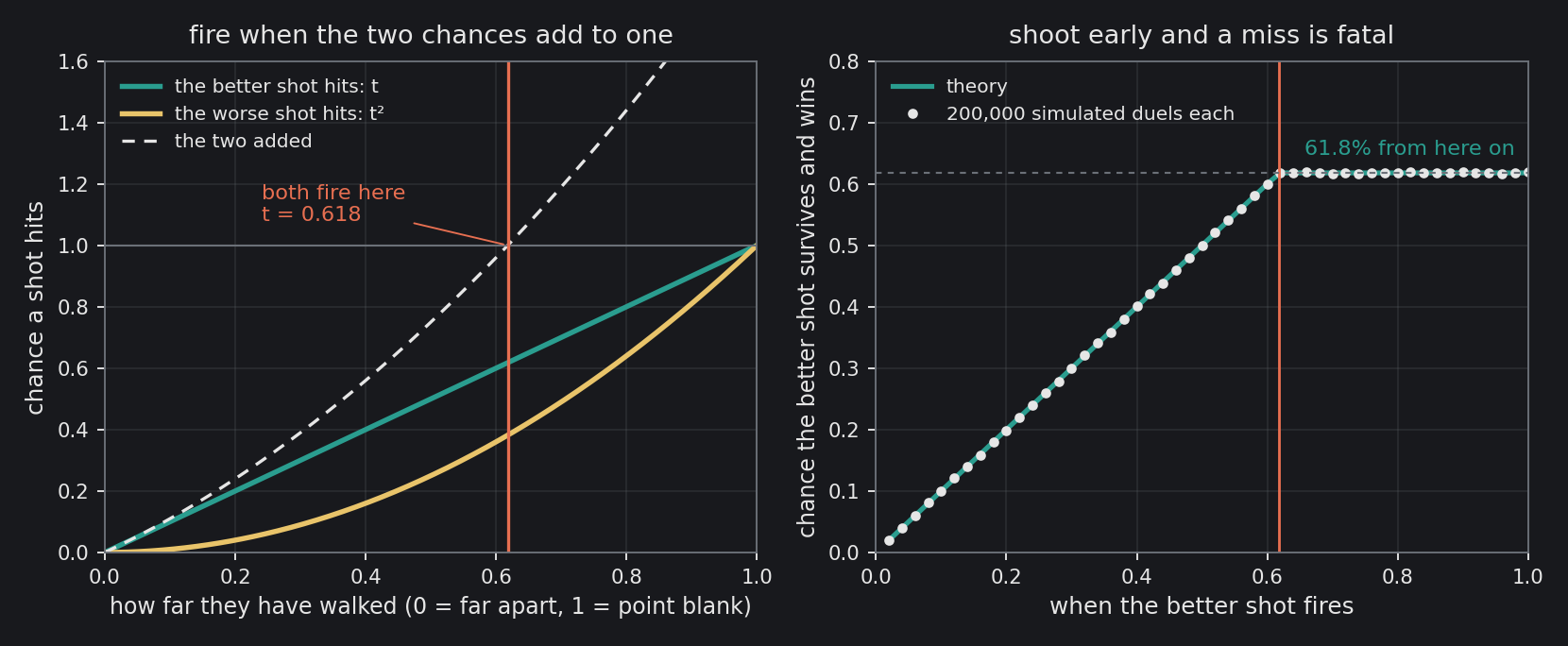
The right-hand panel shows the cost of impatience. Firing at 0.3 instead of 0.618, the better shot wins only 30% of the time: less than the worse shot does by waiting correctly.
The Silent Pistol
Blackwell was not finished. “Then I got the idea of making each gun silent. With the guns silent, if you fire, the other fellow doesn’t know, unless he’s been hit. He doesn’t know whether you fired and missed or whether you still have the bullet. That turned out to be a very interesting problem mathematically.”
It is interesting because the noisy answer stops working. A silent duellist who always fires at the same moment is predictable: his opponent fires a fraction of a second before, every time. There is no safe moment, and the only defence against being predicted is not to know yourself when you will fire. Each duellist must draw his firing time at random. For two duellists of equal skill, $p(t) = t$, the right randomness has an exact form:
Never fire in the first third of the approach. After that, fire at a random moment drawn from this curve, which piles its weight near the one-third mark and thins out towards point blank. On average the silent duellist fires exactly halfway, the same moment as the noisy one, but not reliably: in 62.5% of duels he fires earlier than halfway, and in the rest later.
The strange property of this strategy is what makes it right. Against an opponent who randomizes this way, every firing moment from one-third onwards is exactly as good as every other: each gives an even contest, worth precisely zero. There is nothing to exploit. Fire earlier than one-third and you lose on average: fire a fifth of the way in, and your expected score falls to −0.2.
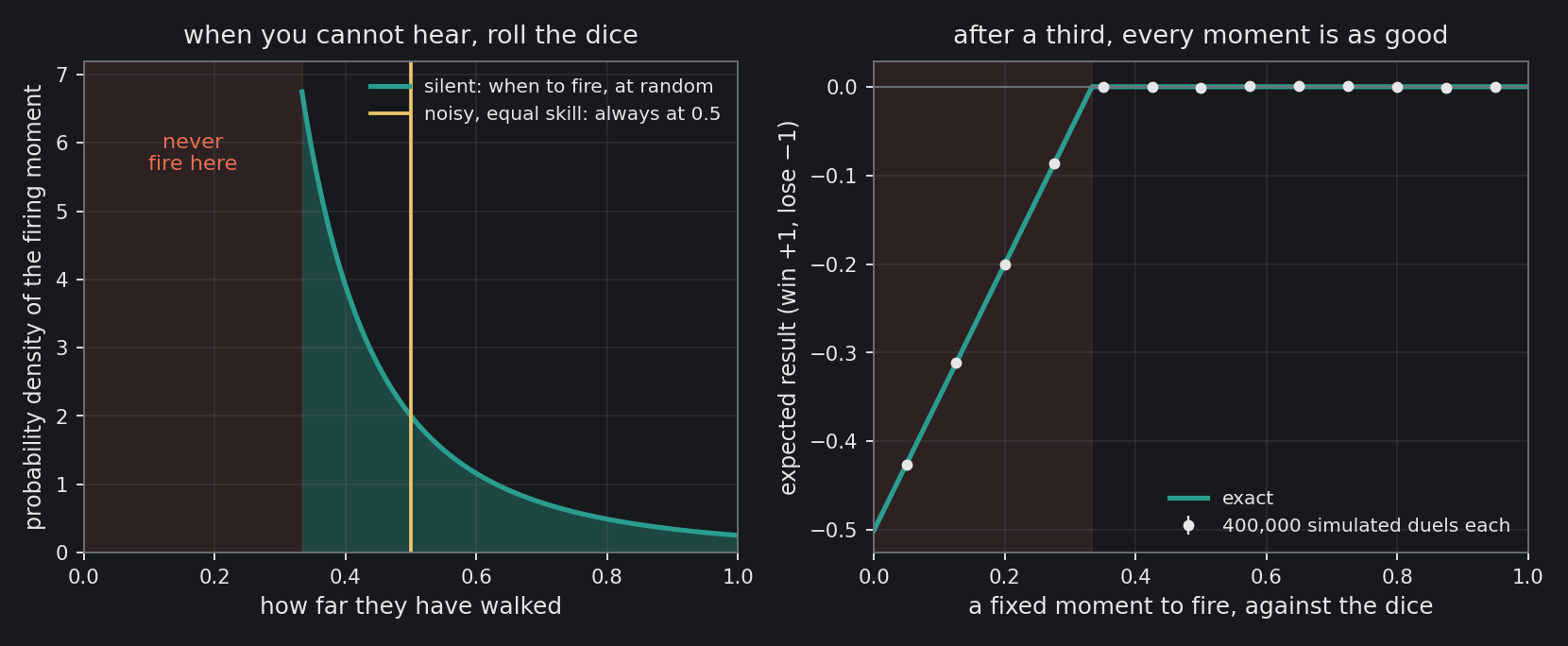
Algorithm — A Silent Duel, Simulated
input:  t, the moment you have decided to fire (0 = far apart, 1 = point blank)

repeat 400,000 times:
    s  <- 1 / sqrt(9 - 8 U),  U uniform on [0,1]
                                # the opponent's random moment: this
                                # draws from 1/(4 s^3) on [1/3, 1]
    if t < s:                   # you fire first
        you hit with probability t          -> you win
        else he fires at s, hits with p(s)  -> you lose
        else both missed                    -> a draw
    else:                       # he fires first
        he hits with probability s          -> you lose
        else you fire at t, hit with p(t)   -> you win
        else both missed                    -> a draw
    score +1 for a win, -1 for a loss, 0 for a draw

return the average score

  For every t from 1/3 to 1 the average is zero, to within the
  simulation's noise. Below 1/3 it is negative: at t = 0.2, -0.2.
Duels Without Pistols
In 1969 the Soviet mathematician Eugene Dynkin posed the general, random version of the question, now called a Dynkin game: two players each choose when to stop a random process, and what each receives depends on who stops first. The accuracy curves become random, the payoffs become whatever the game is about, and the question stays the one Blackwell asked on that afternoon at RAND.
Games of timing like this turn out to describe a great deal that has nothing to do with pistols. When a company should launch a product its rival is also preparing. When a union should end a strike, or a management concede one. When to walk away from a standoff that is costing both sides. In every one of them the logic is the duel’s: act too soon and you waste your one shot; wait too long and the other side acts first.
Draw Second
There is one more duel, the one in the Westerns, where the hero always lets the villain draw first and still wins. Niels Bohr, the physicist, thought this was not a film convention but a law of nature: a man who reacts to a movement is faster than a man who decides to make one. He is said to have tested it with toy pistols against his colleague George Gamow, always drawing second, and winning every time.
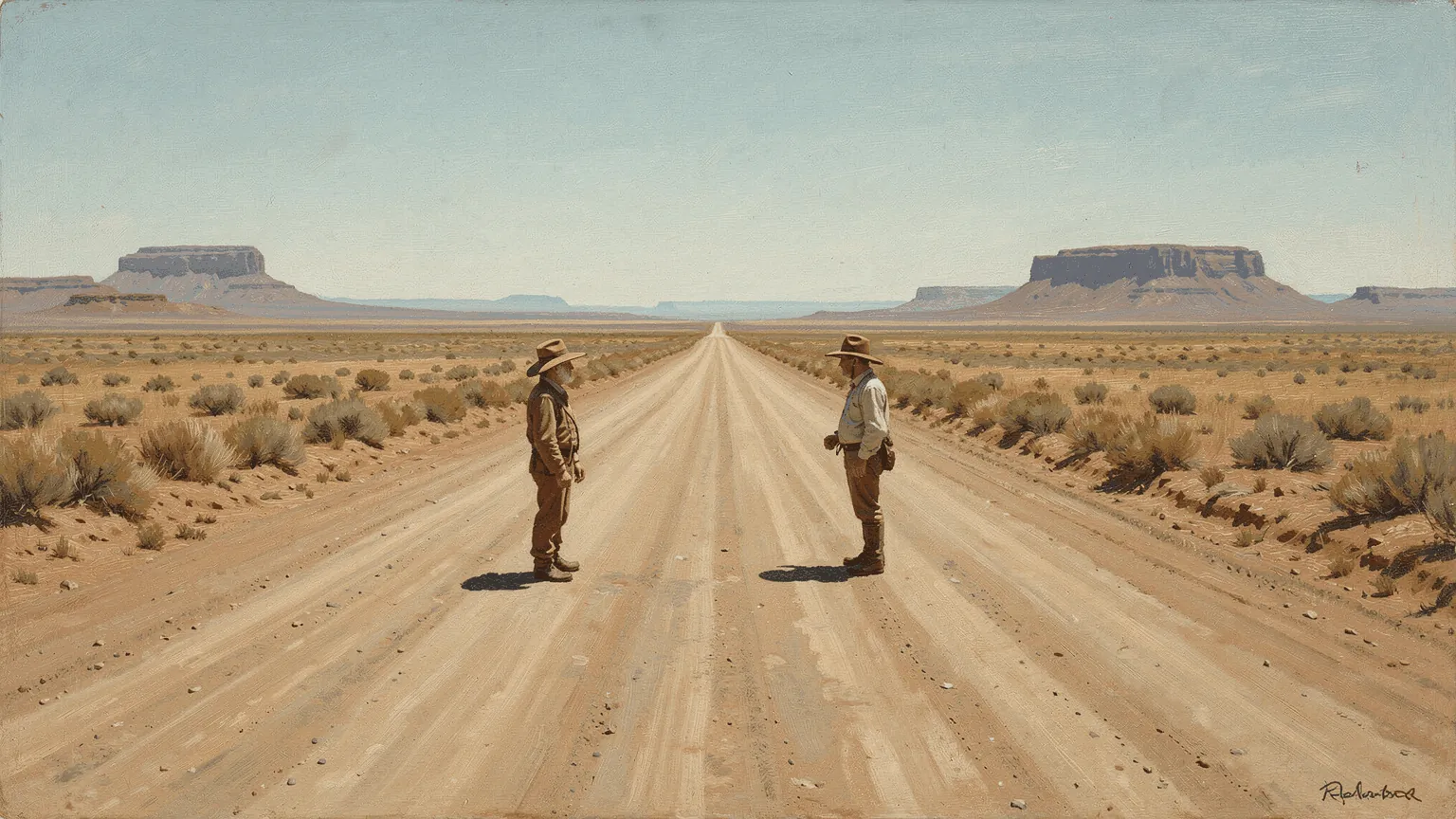
In 2010 a team of neuroscientists finally tested Bohr’s law in the laboratory, and he was half right. A movement made in reaction really is faster, by about 21 milliseconds. But it takes about 200 milliseconds to react in the first place, and that swamps the advantage entirely. The gunslinger who draws first wins. As for Bohr’s victories over Gamow, the lead researcher had a simpler explanation: Bohr was a crack shot.
The mathematics and the laboratory agree on the same lesson. Waiting is a strategy only when the other side’s first move costs them something. In Blackwell’s duel it does, because a miss is fatal and your opponent must spend his only bullet to try. In the gunfight on Main Street it does not, and the man who moves first lives. And Hamilton, who planned to throw away his first fire, had chosen the one strategy the mathematics says can only lose: to shoot first and miss on purpose, which hands the other man all the time in the world.
Sources
- D. Blackwell’s recollection in D. J. Albers and G. L. Alexanderson, Mathematical People (1985), p. 25.
- D. Blackwell, “The Noisy Duel, One Bullet Each, Arbitrary Non-Monotone Accuracy”, RAND RM-131 (1949).
- E. B. Dynkin, “Game variant of a problem on optimal stopping” (1969).
- A. E. Welchman et al., “The quick and the dead: when reaction beats intention”, Proceedings of the Royal Society B 277 (2010) 1667–1674.
Every number here is computed by the script archived with this post.
Interested in applying these ideas to your work? Get in touch.