
The Needle That Knew Too Much
A Machine in Massa
In the November–December 1901 issue of a journal for Italian mathematics teachers, the Periodico di Matematica per l’Insegnamento Secondario, a contributor named Mario Lazzarini described a machine. A drum 17 centimetres across turned on a horizontal axis. Two ridges inside it carried a little stick, 2.5 centimetres long, up to the top and dropped it onto a grid of parallel wires. When the stick landed across a wire, the grid dipped, a stylus at the other end of its shaft lifted off a moving strip of telegraph paper, and the line it was drawing broke. All the experimenter had to do was count the breaks.
With the wires 3 centimetres apart, Lazzarini reported 1,808 hits in 3,408 throws, and from them a value of π: 3.1415929. The first six decimal places are right. George Gamow retold the result in One Two Three… Infinity, and Edward Kasner and James Newman in Mathematics and the Imagination: “One could scarcely expect to find a better example of the inter-relatedness of all mathematics.”
It is far too good. An honest run of 3,408 throws misses π by about 0.05. One hit more, and Lazzarini’s machine would have said 3.1399; one hit fewer, 3.1433.
Buffon’s Floor
The game is older than the machine. In 1733 Georges-Louis Leclerc, Comte de Buffon, put a problem to the French Academy of Sciences, and in 1777 he printed it with its solution: throw a stick onto a floor of parallel boards, and let one player bet that it lands across a joint and the other that it does not. A needle of length $l$ dropped on lines $d$ apart, with $l \le d$, crosses a line with probability
The proof is one average. The needle crosses when its centre lies within $\tfrac{l}{2}\sin\theta$ of a line, where $\theta$ is its angle to the lines, and the average of $\sin\theta$ over all directions is $2/\pi$. Buffon wanted the length that makes the bet fair, which is $\pi/4$ of a board, a little over three quarters. In 1812 Laplace turned the formula round: throw the needle $N$ times, count $H$ crossings, and
Lazzarini’s stick and wires give $2l/d = 5/3$, so $p = 5/(3\pi) = 0.5305$: a little over half the throws cross a wire, and $\pi \approx \tfrac{5}{3}\,N/H$.
How Wrong an Honest Needle Is
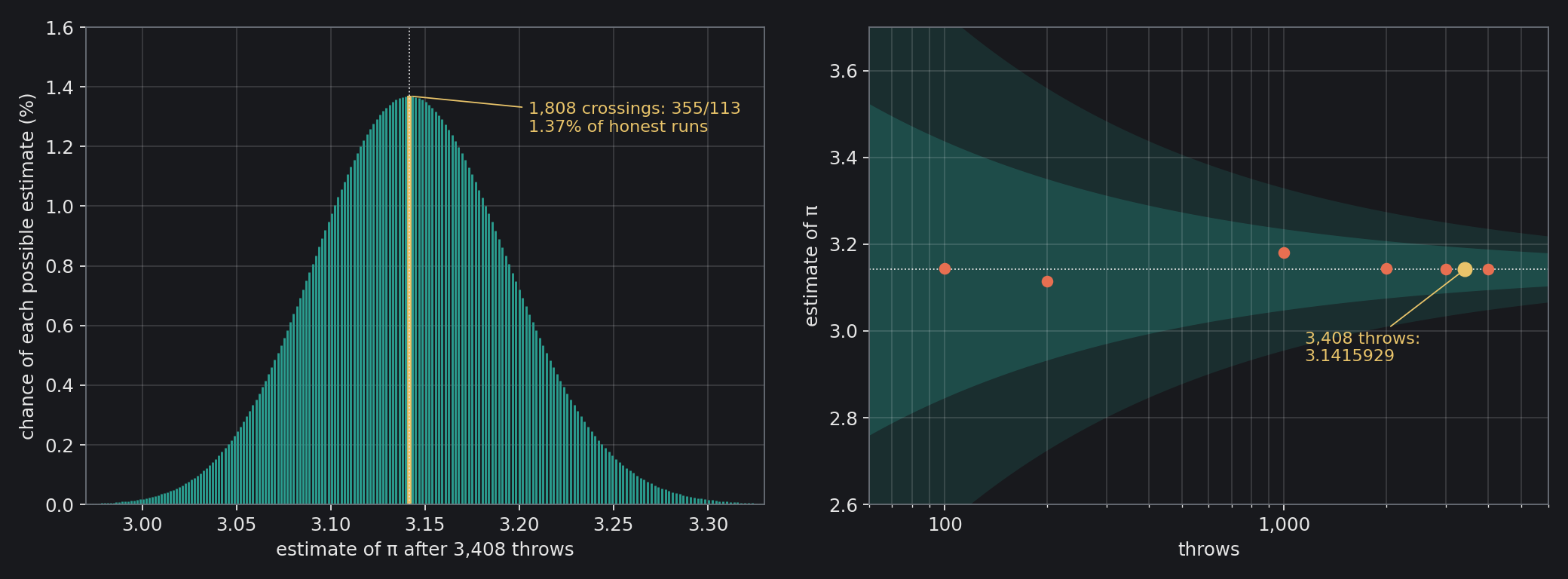
When the number of throws is fixed before the first one, the crossings follow the binomial distribution: 3,408 throws, each crossing with probability 0.5305. The likeliest count of all is 1,808 itself, because $3408 \times 5/(3\pi) = 1808.0002$. Yet even that count, the single likeliest outcome, comes up only 1.37% of the time. The count typically lands 29 crossings to either side of it, and the estimate of π 0.051 to either side. Only 15% of honest runs of that length get within 0.01 of π.
Lazzarini’s error was $355/113 – \pi = 2.7 \times 10^{-7}$, about 190,000 times smaller than the typical one. The error of an honest needle shrinks like one over the square root of the number of throws, so every extra correct decimal place costs a hundred times more throws. For $2.7 \times 10^{-7}$ to be the typical error takes about $1.2 \times 10^{14}$ throws: at one throw a second, 3.9 million years.
The Fraction in the Machine
Lazzarini’s answer is not just close to π. It is a famous fraction, $\tfrac{5}{3}\cdot\tfrac{3408}{1808} = \tfrac{355}{113}$, found by the Chinese mathematician Zu Chongzhi in the fifth century. No fraction with a denominator below 16,604 comes closer to π; the first that does is 52,163/16,604. And the machine produces 355/113 exactly when
Lazzarini’s run is the case $k = 16$: $3408 = 16 \times 213$ and $1808 = 16 \times 113$.
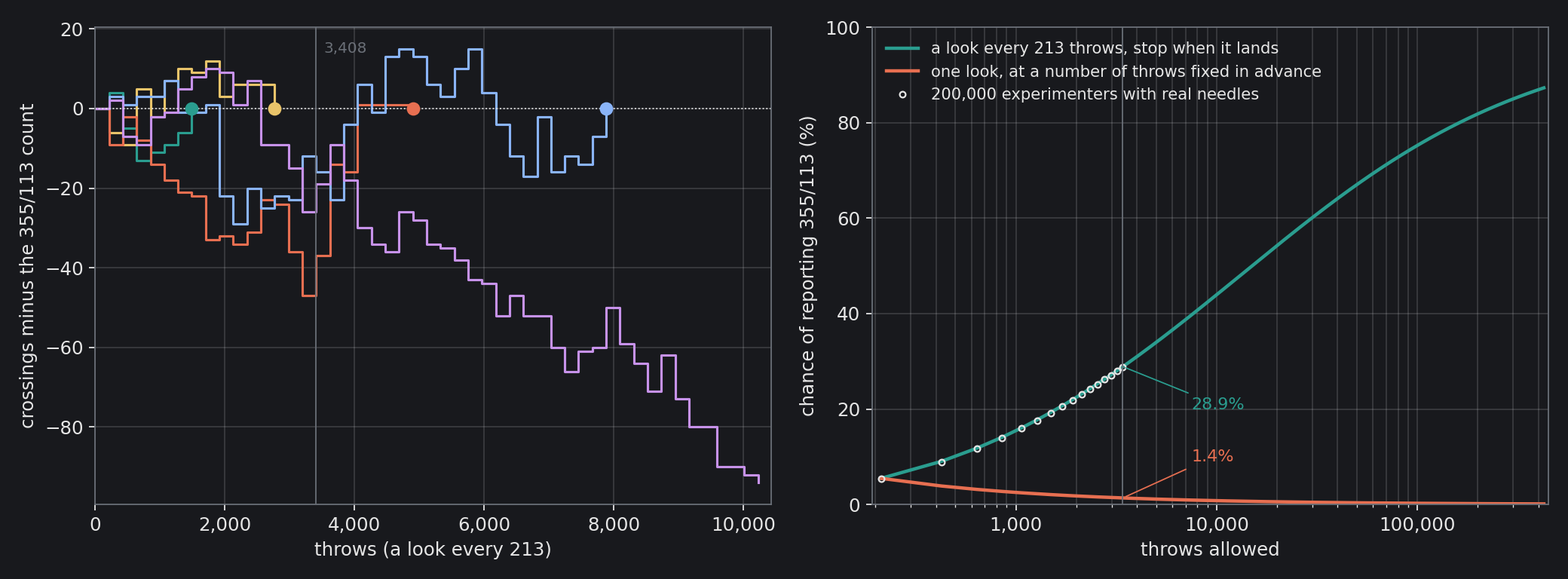
Now imagine an experimenter who writes down nothing false. Every throw is honest and every count is true. He only looks at the count after every 213 throws, and stops the first time it reads exactly 113 crossings for each 213. Then he reports.
His first look lands 5.5% of the time. By the 16th look, after 3,408 throws, he has landed 28.9% of the time: 21 times as often as the experimenter who fixed 3,408 throws in advance. And given time, he rarely fails. The gap between his count and the 355/113 count is a random walk in one dimension, moving about 7 crossings up or down between looks with almost no drift: the drunk man’s walk, and the drunk man comes home. Half of these experimenters land within 71 looks (15,123 throws), and 87% within 2,000 looks.
So the six decimal places measure the stopping rule, not π. It is the same theorem that makes a 90% win rate worthless: a rule that chooses when to stop can choose what the record says.
Algorithm — The Chance of Reporting 355/113 Under the Stopping Rule
input:  p = 5/(3π)          the chance one throw crosses a wire
        K = 16 looks, one every 213 throws
w[s] ← C(213, 113+s) p^(113+s) (1−p)^(100−s)
                     s = −113 … 100: crossings in 213 throws, minus 113
f[0] ← 1             f[g] = chance the count stands at 113k + g
                     and the experimenter is still throwing
repeat for k = 1 … K:
    f ← f ∗ w        one more stretch of 213 throws (a convolution)
    first[k] ← f[0]  the count reads exactly 113k: 355/113
    f[0] ← 0         ...and the experimenter stops
return first[1] + … + first[K]          28.87% for K = 16
To check it, I had 200,000 simulated experimenters throw real needles, with no π anywhere in the throw: each needle’s centre lands uniformly between two wires, and its direction comes from a random point in a circle. By the 16th look, 28.77% had landed, against 28.87% from the formula, and at every one of the 16 looks the two agreed to within 1.7 standard errors. Their counts after 3,408 throws averaged 1,808.03 crossings against 1,808.00, and 1.364% of them had exactly 1,808 against 1.369%.
Drop Your Own Needles
The board below throws needles onto Lazzarini’s floor under either rule. The honest rule stops at 3,408 throws. Lazzarini’s rule looks at the count every 213 throws and stops when it lands on 355/113, which often takes a while: turn up the speed. The button below the chart runs 10,000 experimenters at a time with the page’s own needles. I checked the board against Python. Over 10 million of its throws, 53.051% crossed a wire, against Buffon’s 53.052%. Of 100,000 experimenters run by its own code, 1.33% reported 355/113 under the honest rule and 28.82% under Lazzarini’s, against 1.37% and 28.87% exactly.
Too Good All the Way Down
Lazzarini printed a whole table, not one result. With the wires 3 centimetres apart, his estimates after 100, 200, 1,000, 2,000, 3,000, 3,408 and 4,000 throws were 3.144, 3.115, 3.180, 3.1446, 3.142, 3.1415929 and 3.1416. Every row is closer to π than an honest needle has any right to be. The row at 3,408 stands out twice: it is the only one that is not a round number, and the only one given to seven decimal places.
There is a standard test for a table like this. Take the crossings counted between one row and the next, which in an honest single run are independent; measure how far each stretch is from what Buffon predicts, in its own standard units; square, and add. Too large a total means the needle was unlucky or the counts were wrong. Too small a total means the counts were too good. If each table is one run, as it reads, an honest table lands as close to Buffon as this one, or closer, 3.5 times in 10,000. His other table, with the wires 2.6 centimetres apart, lands that close 5.7 times in 10,000, and the two together about 7 times in 10 million. Lee Badger reached the same verdict by another route in 1994: “the probability is less than 0.00003.”
The Same Test on Mendel’s Peas
That test has a famous victim. In 1936 Ronald Fisher applied it to the pea experiments Gregor Mendel had published in 1866, the founding experiments of genetics: round seeds and wrinkled, yellow and green, tall plants and short. Fisher combined them into one test with 84 degrees of freedom, and the total came to 41.6, far below the 84 an honest set of experiments would average. He printed the chance of a fit that bad or worse as 0.99993. Computed exactly, it is 0.99997: an honest repeat of Mendel’s whole programme would agree with his ratios this closely, or more closely, about 3 times in 100,000.
Fisher did not accuse Mendel himself. “Although no explanation can be expected to be satisfactory,” he wrote, “it remains a possibility among others that Mendel was deceived by some assistant who knew too well what was expected.” The case is still argued. In 2010 Ana Pires and João Branco wrote that there are “reasonable grounds to assume that a certain unconscious bias was systematically introduced in Mendel’s experimentation”.

A Joke for Teachers
Lee Badger set out the case against Lazzarini in 1994, and the editor of Nature, John Maddox, wrote: “The truth is that if Lazzarini’s result had been published in 1994 and not 1901, it would be called a barefaced fraud.”
In 2018 Hans van Maanen, the editor of the Dutch sceptics’ magazine Skepter, went back to the paper itself, and read it as something else. It appeared in a journal for schoolteachers, not mathematicians. It gives π to seven decimal places from counts of four digits. Its first arrangement of the wires, by its own account, gave 3.205 after 100 throws and then 3.483 after 500, so Lazzarini turned the grid a quarter turn and tried again. And a stick carried up by a ridge inside a turning drum rolls off the ridge after a quarter turn, long before the top, so that, in van Maanen’s words, “no stick will even hit the grid”. “Literally everything indicates a joke,” he concluded, one a teacher could take into class the week the pupils met Zu Chongzhi’s 355/113. Had Maddox read Lazzarini rather than Badger, “he would have gotten red-faced from laughter, not from indignation”.
Nothing more is known of Lazzarini: a few articles in the same journal, a chapter in a book on Fibonacci, and an address in Massa, in Tuscany. His needle never knew anything. He knew the answer before the first throw, and so, perhaps, did every teacher who read him.
Sources
- G.-L. Leclerc, Comte de Buffon, his memoir on the game of franc-carreau, reported in Histoire de l’Académie royale des sciences (1733) 43–45.
- G.-L. Leclerc, Comte de Buffon, “Essai d’arithmétique morale”, Histoire naturelle, générale et particulière, Supplément 4, Imprimerie royale, Paris, 1777, §XXIII.
- P.-S. Laplace, Théorie analytique des probabilités, Courcier, Paris, 1812, chapter V.
- G. Mendel, “Versuche über Pflanzen-Hybriden”, Verhandlungen des naturforschenden Vereines in Brünn 4 (1866) 3–47.
- M. Lazzarini, “Un’applicazione del calcolo della probabilità alla ricerca sperimentale di un valore approssimato di π”, Periodico di Matematica per l’Insegnamento Secondario 17 (1901) 140–143.
- R. A. Fisher, “Has Mendel’s work been rediscovered?”, Annals of Science 1 (1936) 115–137.
- E. Kasner and J. Newman, Mathematics and the Imagination, Simon and Schuster, New York, 1940.
- G. Gamow, One Two Three… Infinity, Viking, New York, 1947.
- L. Badger, “Lazzarini’s lucky approximation of π”, Mathematics Magazine 67 (1994) 83–91.
- J. Maddox, “False calculation of π by experiment”, Nature 370 (1994) 323.
- A. M. Pires and J. A. Branco, “A statistical model to explain the Mendel–Fisher controversy”, Statistical Science 25 (2010) 545–565.
- H. van Maanen, “Lazzarini’s little sticks”, Skepsis, 2022; first published in Dutch in Skepter 31 (2018) 8–12.
Every number in the text, the two charts and the board are computed by the scripts archived with this post: the binomial distribution, the stopping rule by dynamic programming, and 200,000 simulated experimenters with real needles, saved once; the board was checked against the same figures in a browser.
Interested in applying these ideas to your work? Get in touch.