
The Shock That Refuses to Break
The Tide That Runs Uphill
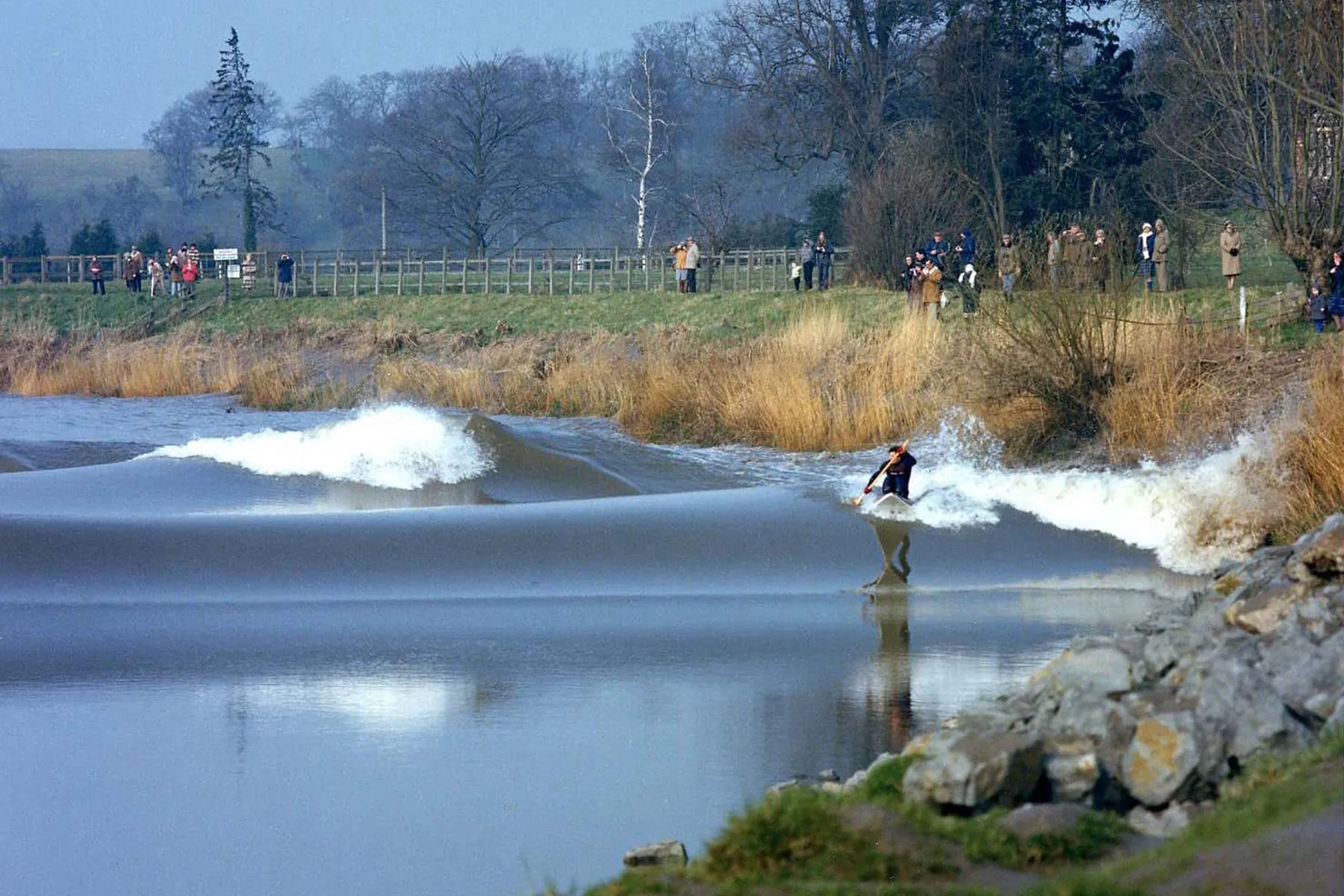
On the highest spring tides the River Severn runs backwards. The tide pouring into its estuary pushes a step of water up the river, “a wave or series of waves, as much as 2m in height”, in the words of Britain’s National Tidal and Sea Level Facility. It is at its most developed between Minsterworth and Gloucester, and surfers ride it.
Most tidal bores are gentler, and they do not arrive as a wall. On 10 September 2010 a team of engineers measuring the bore of the Garonne in south-west France watched it come up a channel 1.4 metres deep at 4.5 metres a second as a train of smooth waves, with a surfer riding just ahead of the first crest. That is the usual shape: “practically the very large majority of tidal bore occurrences have an undular shape”, writes the hydraulic engineer Hubert Chanson: a train of undulations that rivermen call whelps. The first wave is the biggest, and the ones behind it are smaller and smaller.
Why a train of waves, when a step of water should steepen into a wall? And why is the first wave the biggest? For a weak bore, the answer to the second question is a number: the first wave grows to twice the height of the step. Raise a river two metres deep by 20 centimetres, and within a few minutes its first wave stands 40 centimetres above the water ahead of it.
A Shock With Nowhere to Break
Long waves in shallow water travel at $\sqrt{gh}$, and deeper water carries them faster, so the back of a rising tide runs into its front. In the equations of shallow water alone, the slope steepens until it stands vertical: a shock. In a real river a shock is a breaking front, all foam and turbulence, and it costs energy. Lord Rayleigh worked out the bill in 1914. For a weak bore of height $\Delta$ on water of depth $h$, it burns
and Rayleigh added that “the impossibility of a gain of energy shows that the motions here contemplated cannot be reversed.”
But water is not only shallow. A wave shorter than a few depths travels more slowly than a long one, so water is dispersive, and Korteweg and de Vries wrote down the correction in 1895, in a paper about long waves in a canal:
Here $\eta$ is the height of the water above its resting level. The third term steepens the wave; the last one lets the short waves that the steepening makes fall behind. The equation also holds a gift. Measure heights in units of the step, $\eta = \Delta\,u$, and stretch distance and time by
and every weak bore becomes the same bore: a step from $u = 1$ behind to $u = 0$ ahead. The depth and the height only stretch the axes. For a step of 20 centimetres on two metres of water, one unit of $x$ is 5.16 metres and one unit of $\tau$ is 46.6 seconds.
The Fan of Waves
In 1974 two Soviet physicists, Alexander Gurevich and Lev Pitaevskii, solved exactly this problem, for shock waves in a plasma rather than a river. The step never becomes a wall. It unrolls into a fan of waves whose shape depends only on $x/\tau$. At the back, at $x/\tau = -6$, the waves are ripples of vanishing height, $\pi$ units long. At the front, at $x/\tau = 4$, the first wave is a solitary wave of height 2: twice the step. In between, every crest and every trough lies on an envelope made of elliptic integrals:
The fan never stops widening. It grows by 10 units of $x$ for every unit of $\tau$, and new waves are born at its back at 2.5465 per unit of $\tau$.
To check all of it, I solved the equation on a grid of 32,768 points with a spectral method, from a sharp step, for 80 units of $\tau$. The first wave reached 1.59 times the step by $\tau = 1$, 1.92 by $\tau = 5$ and 1.98 by $\tau = 20$, and it averaged 1.995 over the last 20 units. Every crest and trough sat on the envelope, typically within 0.003. The grid counted 204 crests at the end; the formula says 203.7. Only the front lags a little: over the last 20 units it moved at 3.99 instead of 4, the slow logarithmic delay that the theory predicts for the leading wave.
Algorithm — Solving the Korteweg–de Vries Step Problem
input:  N = 32,768 points on a periodic box of length L
        Δt = 0.0025, end time T = 80
x_j ← j L / N;  k ← the N Fourier wavenumbers
u ← ½[tanh((x − x_L)/20) − tanh(x − x_R)]
                      a plateau of 1; the bore starts at x_R
û ← FFT(u)
Λ ← i k³              the u_xxx term, solved exactly
                      (breaking bore: Λ ← i k³ − 4k²)
N(v̂) ← −3ik · FFT(IFFT(v̂)²)
                      the 6uu_x term; top third of k cut off
E ← e^(Δt Λ);  E½ ← e^(Δt Λ/2)
Q, f₁, f₂, f₃ ← the ETDRK4 weights, each a mean over 64
                points on a circle round Δt Λ, kept complex
repeat T/Δt times:    fourth-order exponential Runge–Kutta
    a ← E½ û + Q N(û)
    b ← E½ û + Q N(a)
    c ← E½ a + Q (2N(b) − N(û))
    û ← E û + f₁ N(û) + 2 f₂ (N(a) + N(b)) + f₃ N(c)
return u ← IFFT(û)
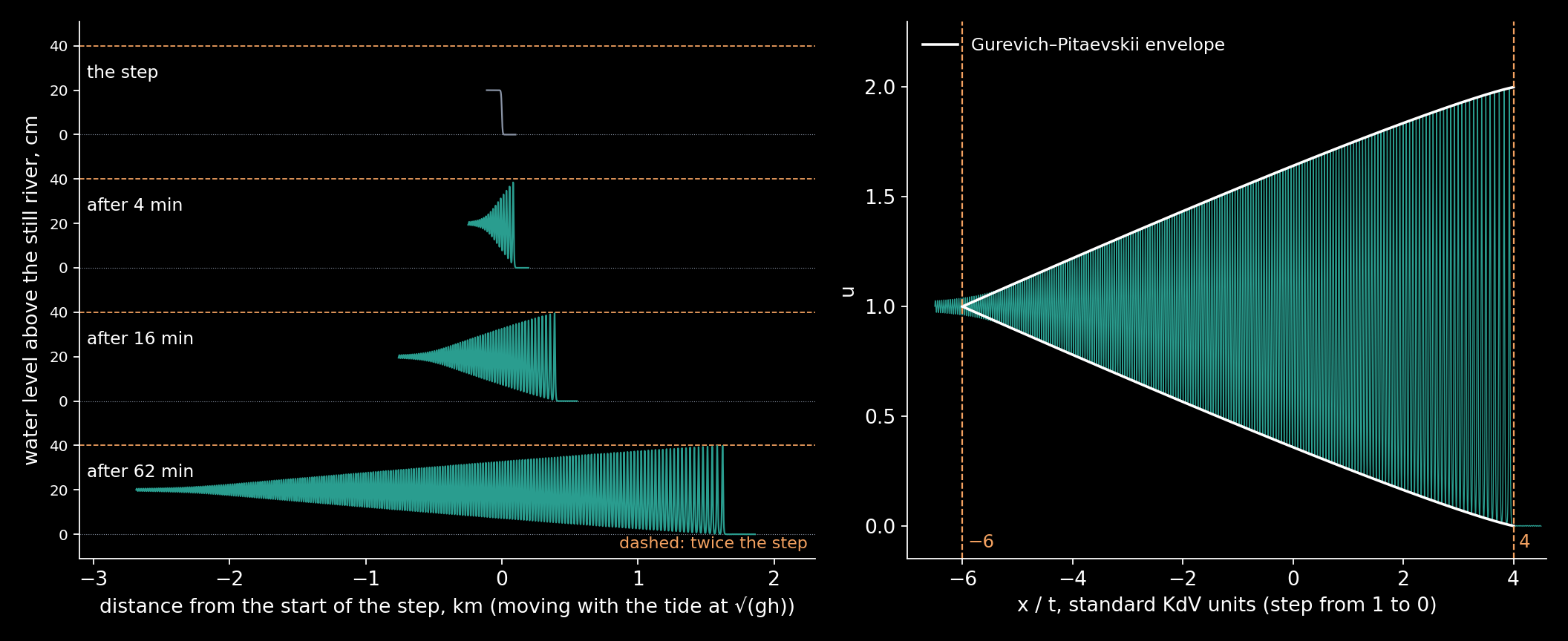
In the river with the 20-centimetre step, the numbers become these. The first wave grows to 40 centimetres, and comes within 4% of that height after about 3.7 minutes and 971 metres. It runs at 4.87 metres a second, while long waves run at 4.43. The train grows by 1.11 metres every second: after ten minutes it is 664 metres long and holds 33 waves, with a new one born every 18 seconds. At its back the waves are 16 metres long and pass every 3.5 seconds.
Where the Energy Goes
Here is the puzzle. Rayleigh’s bore must burn energy, and the Korteweg–de Vries equation has no friction in it; nothing in it can burn anything. It keeps $\int u^2\,dx$ exactly, and for long waves that is the energy of the water, $\rho g\int \eta^2\,dX$ per metre of width. So who pays Rayleigh’s bill?
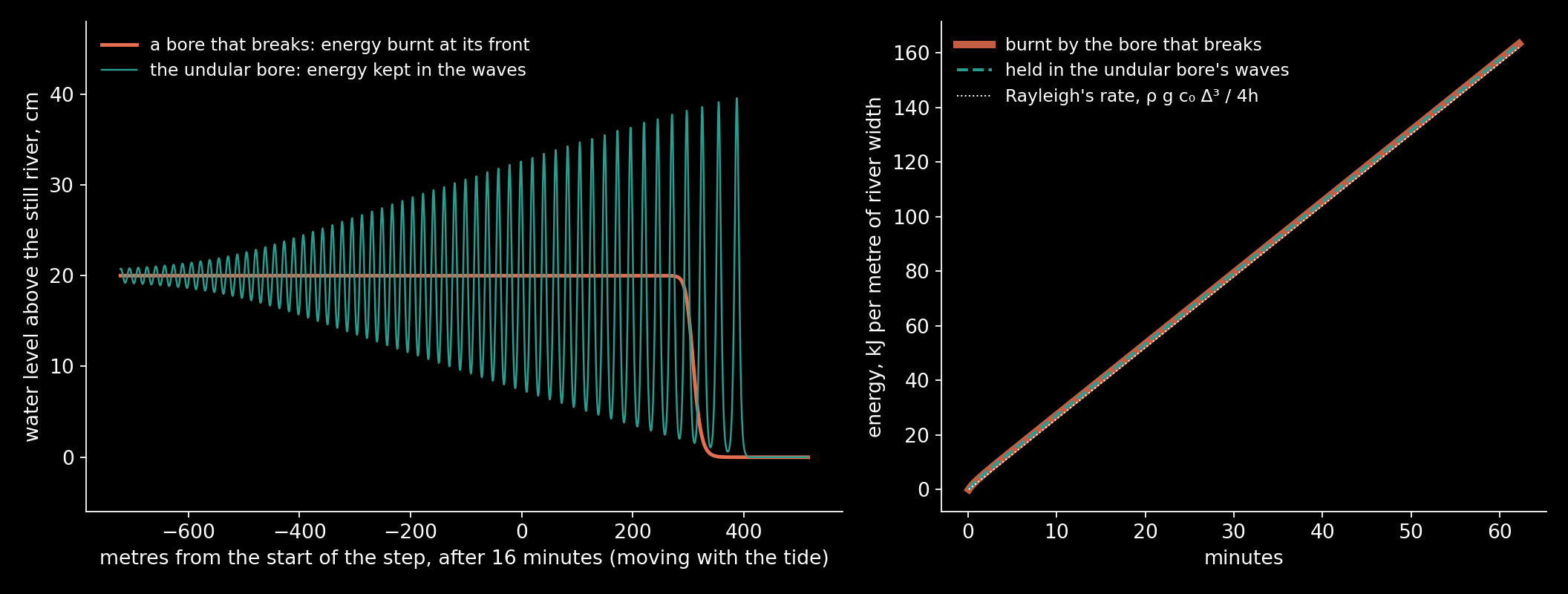
To see it, I gave the same equation a viscous term, strong enough to keep the bore a single smooth step: a bore that breaks, in a model. Both bores take in $\int u^2$ through the water behind them at the same rate, 4 units for every unit of $\tau$. The breaking bore keeps 3.0000 of them and burns 1.0000 at its front, which is Rayleigh’s loss: in these units it is the step cubed. The undular bore keeps 3.9997. The difference is in the waves.
So the wave train is the burnt energy, unburnt. A bore that cannot break stores what a breaking bore would destroy, at exactly the same rate, and that is why the train has to keep growing: there is nowhere else for the energy to go. The idea is old. Benjamin and Lighthill proposed in 1954 that an undular bore keeps to the same rules of mass and momentum as a breaking one, with the energy that seems to be lost carried away by the waves it makes. The computation makes the accounting exact.
In the two-metre river a breaking bore of 20 centimetres would burn 43.5 watts for every metre of the river’s width. After an hour the undular train holds 156 kilojoules per metre of width, every joule of which a breaking bore would have turned into heat.
How Far Before It Doubles
The first wave needs room to grow. It comes within 4% of twice the step after 4.7 units of $\tau$, and because $a$ and $b$ depend on $\Delta/h$, so does the distance the bore must run first: $28.2\,h\,(2h/3\Delta)^{3/2}$. For a bore a quarter of the depth that is 123 depths of water; for a tenth of the depth, 485; for a twentieth, 1,373. A weak bore needs a long river.
In 1935 Favre published the bores he had made in a flume 75.58 metres long, on water between 0.1075 and 0.205 metres deep: 369 to 703 depths. By the formula, only bores higher than 8% to 12% of the depth had room to bring their first wave close to twice the step. Favre’s records, read again in 2021 by Bjørnestad and colleagues, agree: the height of the first wave “increases with increasing bore strength, up to a maximum of 2.06 times” the step, at 0.281 of the depth. Above that the bores broke: “the bore is undular if the change in surface elevation of the wave is less than 0·28 of the original depth of water”, as Peregrine summed it up in 1966.
The theory is for weak bores: small steps, long waves, one direction of travel. A real river has a current, sloping banks and friction on its bed, and friction wears the waves down. A real tide also rises over minutes rather than at a sharp step, and for a gradual rise the first wave keeps growing slowly instead of settling at twice the step. The board below is the weak bore itself.
The board does not solve anything; it stretches the one solution to the depth and the step you choose. To check the stretching, I solved the equation a second time, directly in metres and seconds and from the same starting step, with no rescaling at all, for two rivers the post never uses: one a metre deep with a 15-centimetre step, and one five metres deep with a 25-centimetre step. After 6 and 52 minutes the board’s first wave stood at 29.66 and 49.10 centimetres, against 29.74 and 49.37 from the direct solution, in the same place to within 1.2 metres, and along the whole train the two surfaces differed by less than a millimetre in the median.
The Same Shock in the Sky
Over the Gulf of Carpentaria in northern Australia, early on spring mornings from September to about mid-November, a cloud rolls in from the sea that is, in the words of the meteorologist Roger Smith, “typically 1 or 2 km in width, 1 km deep, and may be 100 km or more long”. It is the Morning Glory, and in 1981 Smith and his colleagues showed what it is: an undular bore, travelling on a stable layer of air near the ground instead of on a river.
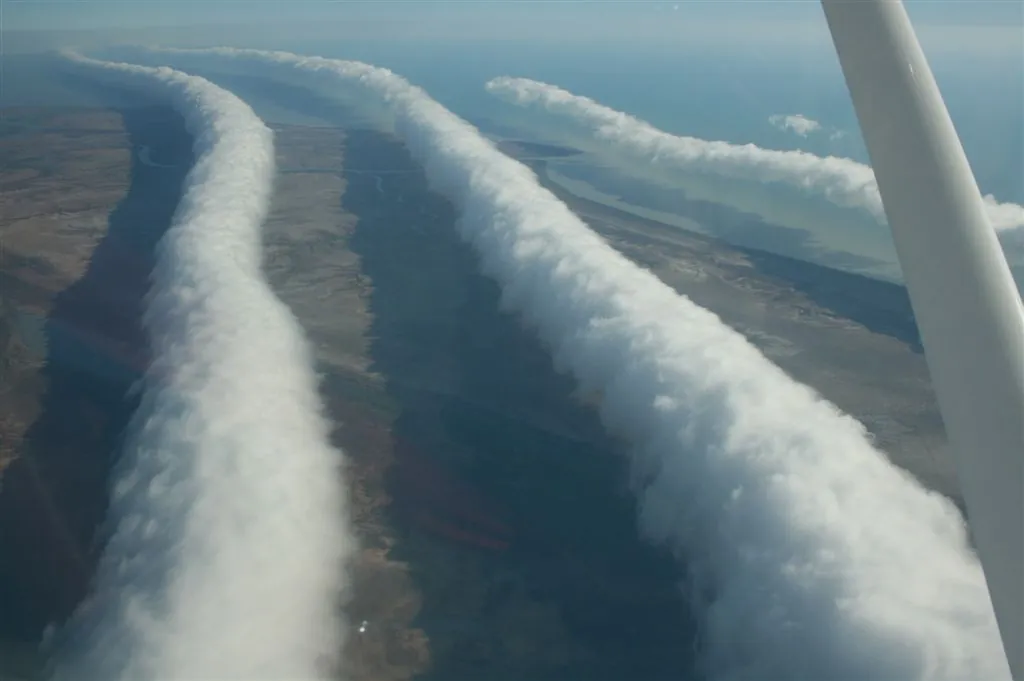
In 1989 two pilots, Russell White and Rob Thompson, flew a motor glider to Burketown to look for it. They caught it from the runway as it rolled overhead, climbed to its front edge and switched off the engine. The cloud carried them, as the river carries the surfer: on the first wave of a shock that cannot break.
Sources
- D. J. Korteweg and G. de Vries, “On the change of form of long waves advancing in a rectangular canal, and on a new type of long stationary waves”, Philosophical Magazine (5) 39 (1895) 422–443.
- Lord Rayleigh, “On the theory of long waves and bores”, Proceedings of the Royal Society of London A 90 (1914) 324–328.
- H. Favre, Étude théorique et expérimentale des ondes de translation dans les canaux découverts, Dunod, Paris, 1935.
- T. B. Benjamin and M. J. Lighthill, “On cnoidal waves and bores”, Proceedings of the Royal Society of London A 224 (1954) 448–460.
- D. H. Peregrine, “Calculations of the development of an undular bore”, Journal of Fluid Mechanics 25 (1966) 321–330.
- A. V. Gurevich and L. P. Pitaevskii, “Nonstationary structure of a collisionless shock wave”, Soviet Physics JETP 38 (1974) 291–297.
- R. H. Clarke, R. K. Smith and D. G. Reid, “The Morning Glory of the Gulf of Carpentaria: an atmospheric undular bore”, Monthly Weather Review 109 (1981) 1726–1750.
- G. A. El, R. H. J. Grimshaw and A. M. Kamchatnov, “Analytic model for a weakly dissipative shallow-water undular bore”, Chaos 15 (2005) 037102.
- G. A. El, R. H. J. Grimshaw and A. M. Kamchatnov, “Evolution of solitary waves and undular bores in shallow-water flows over a gradual slope with bottom friction”, Journal of Fluid Mechanics 585 (2007) 213–244.
- H. Chanson, “Current knowledge in tidal bores and their environmental, ecological and cultural impacts”, Environmental Fluid Mechanics 11 (2011) 77–98.
- H. Chanson, D. Reungoat, B. Simon and P. Lubin, “High-frequency turbulence and suspended sediment concentration measurements in the Garonne River tidal bore”, Estuarine, Coastal and Shelf Science 95 (2011) 298–306.
- G. A. El and M. A. Hoefer, “Dispersive shock waves and modulation theory”, Physica D 333 (2016) 11–65.
- M. Bjørnestad, H. Kalisch, M. Abid, C. Kharif and M. Brun, “Wave breaking in undular bores with shear flows”, Water Waves 3 (2021) 473–490.
- National Tidal and Sea Level Facility, “Tidal river bores”, ntslf.org.
- R. K. Smith, “The Morning Glory and related phenomena”, Meteorological Institute, University of Munich.
- ABC Science, “Soaring the glory”, 7 August 2003.
Every number in the text, the two charts and the board are computed by the script archived with this post: the Korteweg–de Vries equation solved once from a sharp step, with and without a viscous term, and checked against the Gurevich–Pitaevskii solution; the board was checked against a second, direct solution in metres and seconds.
Interested in applying these ideas to your work? Get in touch.