
The Body That Is Always Falling
Falling, Very Slowly
Stand still for a photograph. Feet together, arms by your sides, perfectly still. You are not still. You are an upside-down pendulum about ninety centimetres tall, balanced on two hinges at your ankles, and you are falling the whole time.
Left alone, a body that leans even slightly keeps leaning: gravity pulls harder the further it goes. For an ordinary adult the arithmetic is unforgiving. Any lean doubles about every 0.22 seconds. Half a millimetre becomes a centimetre in a second, and a fall in two.
The obvious answer is that your ankles are stiff, like a spring that holds you up. In 2002 Ian Loram and Martin Lakie measured that stiffness directly in people standing quietly, and found that it is not enough. The ankle’s intrinsic mechanical stiffness came to about 91% of the torque gravity exerts to topple you. A spring that supplies 91% of what you need does not hold you up. It only slows the fall. The rest has to come from your nervous system, which has to notice the lean and push back against it, and it notices late.
The Equation of Standing
Call the lean at the ankles $\theta$. Gravity pushes it further, in proportion to how far it has already gone. The muscles push it back, in proportion to the lean and to how fast it is changing, but only the lean the brain saw $\tau$ seconds ago. And the body is never quiet: breathing, the heartbeat and muscle tremor kick it at random. Put together:
This is the Langevin equation of a particle with mass: inertia, friction, a force from a potential, and random kicks. Two things make it strange. The potential is upside down: standing is the top of a hill, not the bottom of a valley, so without the muscles the body runs away from upright instead of settling into it. And the restoring force and the friction both arrive $\tau$ seconds late, because everything the brain does arrives late.
The numbers belong to an ordinary adult: $m = 70$ kg, a centre of mass $h = 0.9$ m above the ankles, and a moment of inertia $I = 65$ kg m², which make $a = 9.51$ per second squared. $P$ is how hard the muscles push back against the lean, and it has to beat gravity, $P > a$. $D$ is how hard they resist its speed. $\sigma\,\xi(t)$ is white noise, set so that the body sways about four millimetres, as a real one does.
The Limit
Without the delay, any $P$ larger than $a$ and any positive $D$ would hold you up forever. With it, they might not. Try a slight lean of the form $e^{\lambda t}$ and the equation becomes a condition on the growth rate $\lambda$:
You stay up if every solution $\lambda$ has a negative real part. The mathematician Gábor Stépán worked out what that demands of the delay, and the answer is a single inequality. No choice of $P$ and $D$ can hold an upside-down pendulum once
This is not about strength. A stronger push-back does not help, and neither does more damping. If the brain sees the lean too late, every correction arrives when the body has already moved on, and the corrections themselves drive it over. Your own reflex loop, from sensing a lean to the muscles acting on it, takes roughly a tenth to a fifth of a second: two to four times inside the limit.
Here is the equation running live. Drag the reflex delay and watch the map of settings that hold you up shrink, then tap the map to choose a setting and see what happens.
The Window That Closes
The map shrinks fast. At a delay of a tenth of a second almost any sensible setting holds you. At three tenths, only a narrow band does. Near the limit, the only settings that survive push back barely harder than gravity pulls, between one part in a thousand and a few per cent more, with the damping judged exactly. Past 0.46 seconds nothing is left.
Inside the window, the delay shows up as sway. Drive the same body with the same random kicks, give it the best setting for each delay, and watch how far it wanders:
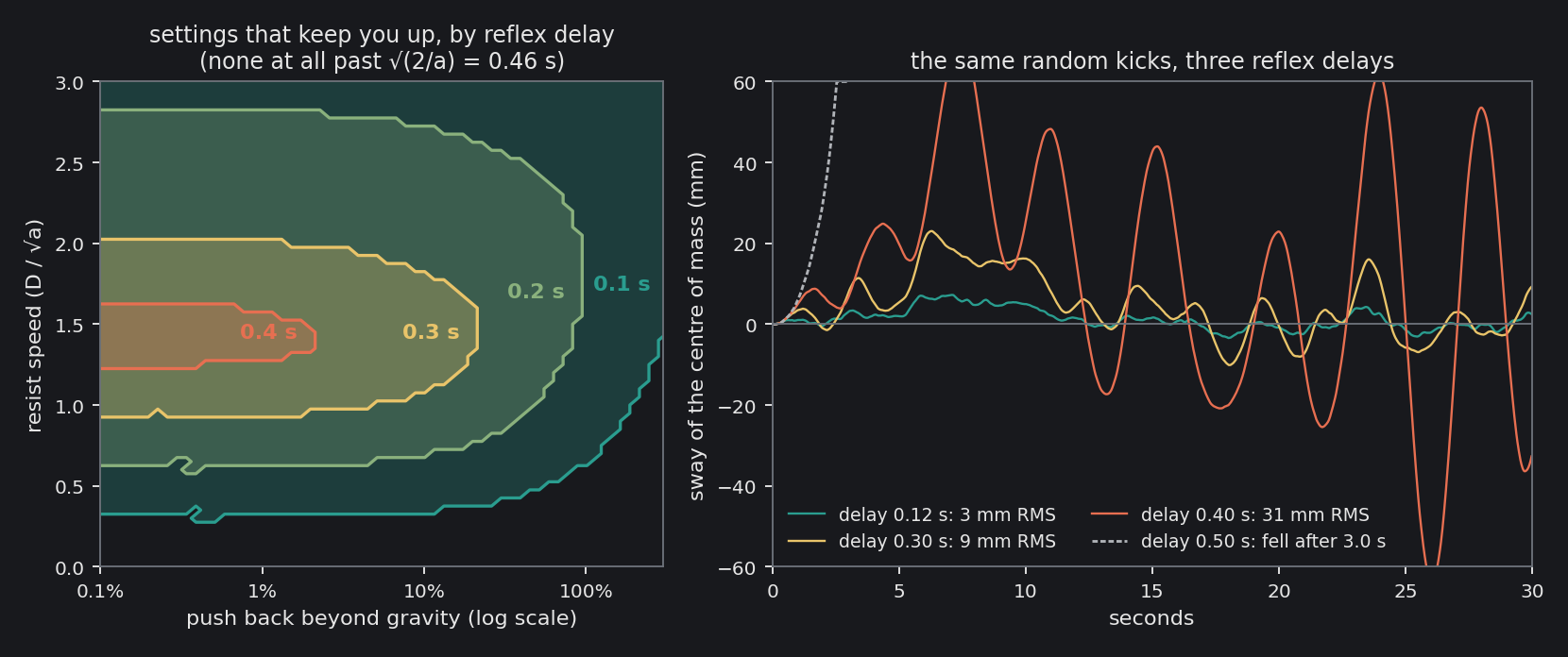
Three millimetres at a delay of 0.12 seconds, nine at 0.30, thirty-one at 0.40. Nothing about the muscles or the noise changed; only the lateness did.
Caught, Not Held
If the ankles do not hold you and the brain is always late, how does anyone stand? The measurements suggest that the brain does not steer smoothly at all. When Loram and Lakie had people balance a heavy pendulum with their ankle muscles, the control came in small discrete bursts: the body is allowed to fall a little, then thrown back with a short push and caught, again and again. Models of quiet standing built on that idea, in which the controller switches off near upright and lets the body drift, reproduce features of real sway that smooth control misses.
The drift shows in the record. In 1993 James Collins and Carlo De Luca tracked the point under the feet where the body’s weight lands, and found that over about the first second it wanders like a random walk, drifting away as if nobody were steering; over longer times it is pulled back, as if someone were. A second of falling, then a correction. Neurologists have used a crude version of the same test since the 19th century: ask a patient to stand with feet together and close their eyes, and watch the sway grow, because one of the brain’s sources of information about the lean has just been taken away.

The Pencil You Cannot Balance
You can feel the limit yourself. Balance a stick upright on a fingertip and you are controlling the same upside-down pendulum, this time watching it with your eyes, which puts the loop delay near a quarter of a second. For a uniform stick of length $L$, gravity’s rate becomes $a = 3g/2L$, and Stépán’s inequality turns into a minimum length:
A broom is easy. A ruler is hard. A pencil is out of reach for anyone whose eyes and hands work at human speed: a shorter stick falls faster, and below forty centimetres or so it falls faster than you can see it falling.
The Margin
Every part of that loop slows with age: sensing, the nerve signals, deciding, the muscles. The window of settings that keeps you up narrows as it does, and the sway widens inside it. In the United States, about one in four people over 65 falls each year, and falls are the leading cause of injury at that age. The equation does not say why any particular person falls. It says why the margin shrinks.

So the next time you stand still for a photograph, it is worth knowing what you are doing. You are not resting. You are falling towards the camera, or away from it, and being caught, again and again, by a brain that sees you a fifth of a second late and has learned to aim where you will be.
Sources
- I. D. Loram and M. Lakie, “Direct measurement of human ankle stiffness during quiet standing: the intrinsic mechanical stiffness is insufficient for stability”, Journal of Physiology 545 (2002) 1041–1053.
- I. D. Loram and M. Lakie, “Human balancing of an inverted pendulum: position control by small, ballistic-like, throw and catch movements”, Journal of Physiology 540 (2002) 1111–1124.
- J. J. Collins and C. J. De Luca, “Open-loop and closed-loop control of posture: a random-walk analysis of center-of-pressure trajectories”, Experimental Brain Research 95 (1993) 308–318.
- G. Stépán, “Delay effects in the human sensory system during balancing”, Philosophical Transactions of the Royal Society A 367 (2009) 1195–1212.
- Y. Asai et al., “A model of postural control in quiet standing: robust compensation of delay-induced instability using intermittent activation of feedback control”, PLoS ONE 4 (2009) e6169.
- “Intermittent feedback-control strategy for stabilizing inverted pendulum on manually controlled cart as analogy to human stick balancing”, Frontiers in Computational Neuroscience 10 (2016) 34, for the 0.23 s delay.
- US Centers for Disease Control and Prevention, Older Adult Falls data.
Every number in the text is computed by the scripts archived with this post, from a map of settings solved once and saved.
Interested in applying these ideas to your work? Get in touch.