
The Urn That Decides Once
One Red Ball, One Black Ball, and Eternity
Another wonderful thing from George Pólya. The last post was his as well — the drunk man who always finds his way home and the drunk bird who mostly does not. This one is an urn with two balls in it, and it is stranger than the bird.
There is an urn on the table with two balls in it, one red and one black.
Reach in without looking and take one out. Look at its colour, put it back, and put a second ball of that same colour in with it. Now there are three. Do it again. And again, forever.
Whatever colour you draw becomes slightly more likely next time. That is the entire mechanism — no strategy, no memory beyond the counts, no outside influence. Success feeds on success, in the smallest possible way.
Eggenberger and Pólya wrote it down in 1923, and not as a curiosity: they meant it as a model of contagion, where one case of an illness makes the next case likelier. It has since turned out to be the skeleton of a great many other things, and none of them behave the way you would guess.
After a very long time, what fraction of the urn is red?
The instinct is to say a half, because the two colours are symmetric and nothing favours either. The instinct is wrong, and it is wrong in a way that takes some time to recover from.
There Is No Typical Outcome
Start with the easy half. The share of red settles. It does not oscillate forever, it does not drift — it converges to some fixed value and stays there. That is not obvious from the setup, and the reason is exact: the share of red is a martingale, so its average never moves at all, and a bounded martingale must converge.
You can watch that happen in the numbers. Across forty thousand urns, the average share of red after one draw is 0.4997, and after four thousand draws it is 0.4997. The spread, meanwhile, grows from 0.167 to 0.288 — and then stops growing. The urn is not going anywhere. It is making up its mind, and then holding.
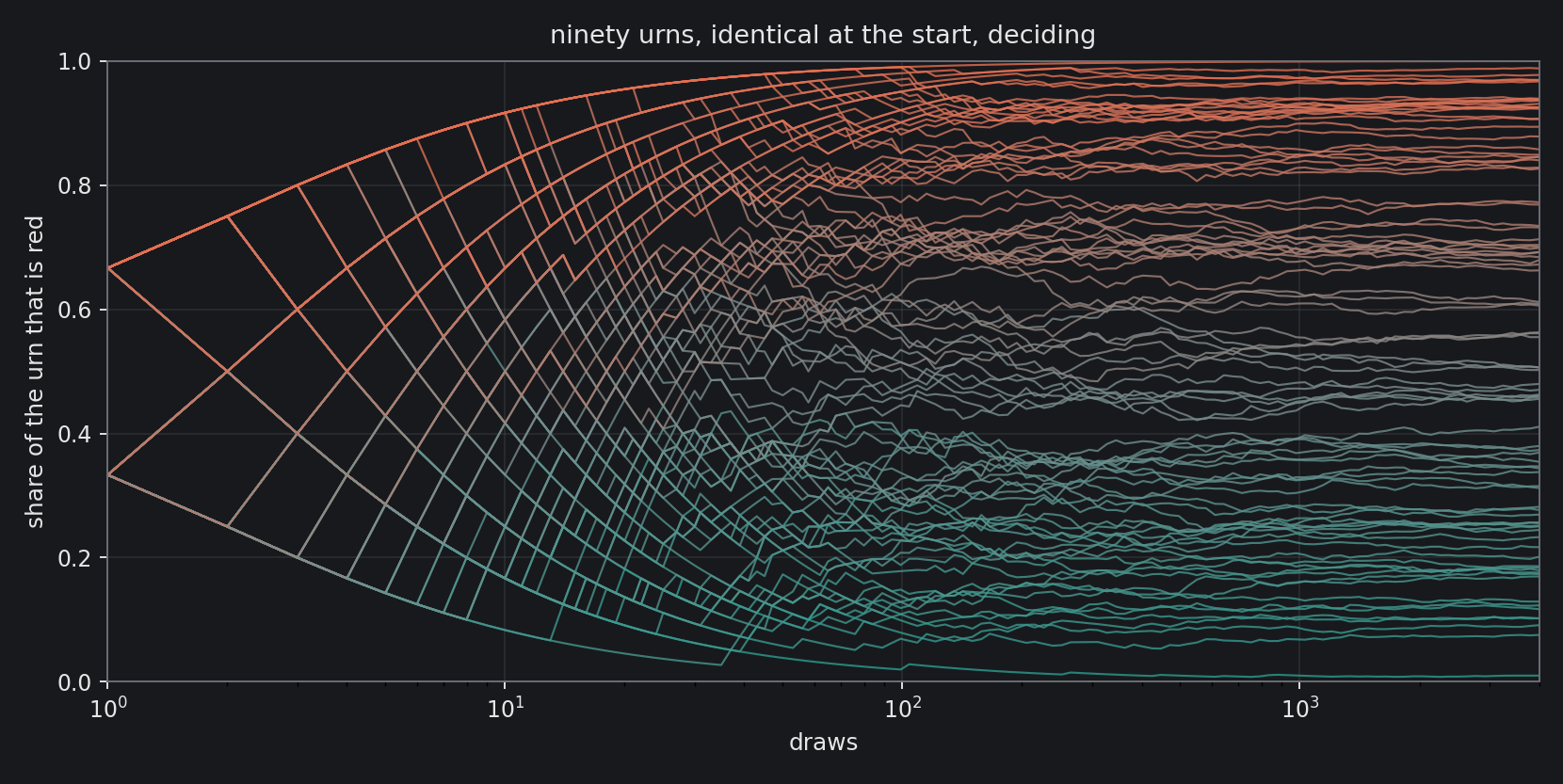
So each urn converges. To what?
Here is the fact that does the damage. Start with one red and one black, run a hundred draws, and count the reds. The answer is uniform on $\{0, 1, \dots, 100\}$. Exactly fifty reds has probability $1/101$. Exactly zero reds — never drawing red at all, a hundred times running — also has probability $1/101$. Every single count is equally likely, to twelve decimal places, and that is not a simulation result, it is the chain summed exactly.
Push it to the limit and the same thing holds. The long-run share of red is Uniform on $(0,1)$. Not concentrated near a half. Not concentrated anywhere. An urn that ends up 3% red is exactly as likely as one that ends up 50% red.
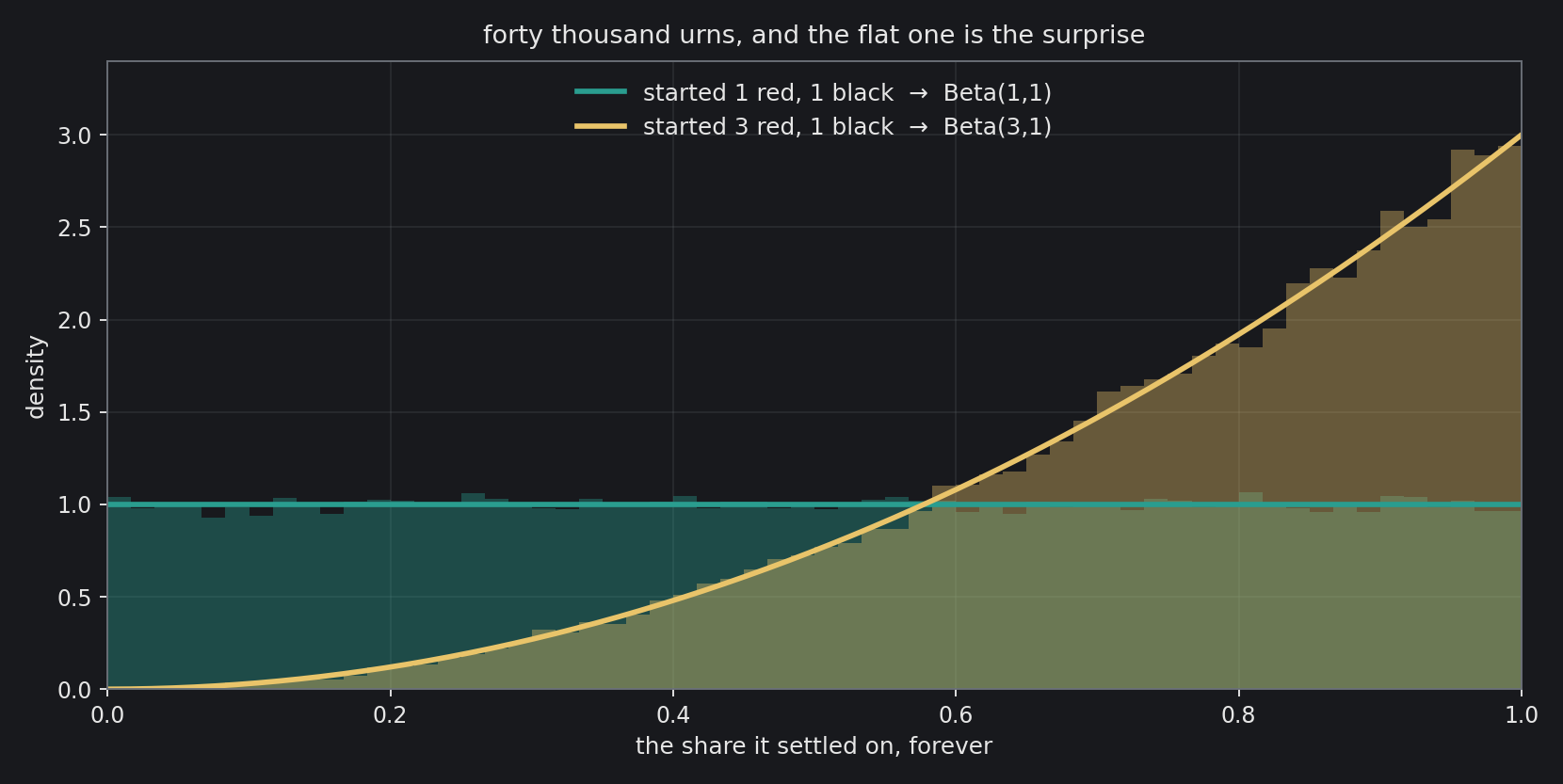
In general, starting with $r$ red and $b$ black and adding $c$ at a time, the limiting share is
and $\mathrm{Beta}(1,1)$ is the uniform distribution, which is why the plain urn behaves so strangely. Simulated, the one-and-one urn lands at mean $0.4997$ against the predicted $0.5$ and standard deviation $0.2881$ against $0.2887$, with a largest gap to the Beta CDF of $0.0026$.
The Urn Has No Memory. It Has a Secret.
Now the part that reorganises everything.
The urn looks like it has momentum. Each draw tilts the next; early luck compounds; the process visibly feeds on itself. That is the story we just told, and it is the story the picture tells.
It is not what is happening.
Notice first that the order does not matter. The probability of drawing red, red, black is $1/12$. Red, black, red is $1/12$. Black, red, red is $1/12$. Every ordering of the same counts has exactly the same probability — for three draws, for five, for any number. The sequence is exchangeable.
And in 1931 de Finetti proved that exchangeability has only one possible cause. Any infinite exchangeable sequence of zeros and ones is a mixture of independent coin flips: there exists a random variable $V$, unique, such that conditional on $V$ the draws are i.i.d. with $\mathbb{P}(\text{red}) = V$.
with $k$ the number of reds among those $n$ draws, and $\mu$ — the law of $V$ — determined uniquely by the sequence.
Apply that here. The urn is exactly the following, indistinguishable in every observable way:
Before the first draw, a coin of unknown bias $V$ is chosen once, at random, uniformly. Then that same coin is flipped forever.
There is no reinforcement. There is no momentum. There is no rich-getting-richer mechanism at all. There is one fixed, hidden number chosen at the beginning, and everything that looks like the urn responding to its own history is you, finding out what the number was. The counts in the urn are not accumulating advantage. They are accumulating evidence.
This is also Bayes’ theorem made out of pottery. Start with a uniform prior on a coin’s bias, observe $k$ heads in $n$ flips, and the posterior is $\mathrm{Beta}(1+k, 1+n-k)$ — whose two parameters are precisely the number of red and black balls now in the urn. The urn is not modelling a Bayesian. The urn is the posterior, sitting on a table, in balls.
The Rich Get Richer, and Nobody Wins
Now put an economy in it. Two firms, two technologies, two standards; each sale makes the next sale slightly more likely. This is the simplest preferential attachment model there is, and the phrase everybody reaches for is the rich get richer.
Which is true, and which does not mean what people think it means.
The first draw is worth an enormous amount. Draw red first and the expected final share of red jumps from $1/2$ to $2/3$. The ten-thousandth draw is worth essentially nothing. The outcome is decided early, by noise, and the rest of eternity is spent ratifying it.
But there is no monopoly. The limit is strictly between zero and one, almost surely. The market share freezes at an accident, and both firms live with it forever. A world with this kind of feedback does not tend toward one winner — it tends toward an arbitrary, permanent, and entirely unjustified split.
Change One Exponent
So when does feedback produce a monopoly?
Make the reinforcement nonlinear. Draw red with probability
where $R$ and $B$ are the current counts. At $\alpha = 1$ this is Pólya’s urn exactly. And the behaviour either side of one is not a matter of degree — it is three different worlds:
Below one, the urn equalises. Every urn converges to exactly fifty-fifty. Simulated, the spread of the limit shrinks steadily with the horizon — $0.124$ after three hundred draws, $0.0345$ after thirty thousand, heading to nothing. Sublinear feedback is a competitive market that keeps correcting itself.
At one, the urn freezes. The spread does not shrink. It sits at $0.287$ after three hundred draws and $0.287$ after thirty thousand. The decision was made early and nothing later can touch it.
Above one, one colour takes everything. Winner-take-all, almost surely. The loser is eventually never drawn again at all.
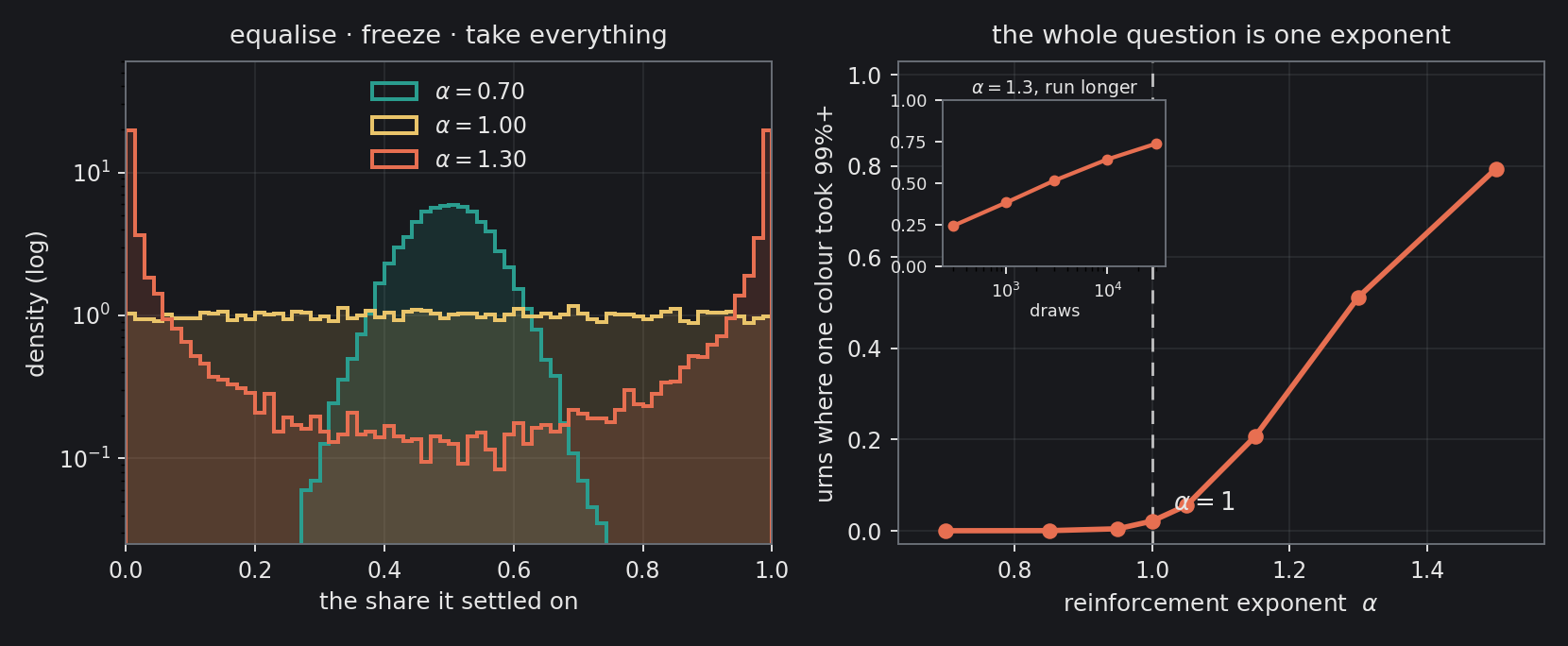
The threshold is exactly $\alpha = 1$, and that is the whole point of this post. The rich get richer is not a claim about outcomes. It is compatible with a permanent stable duopoly, with a market that grinds itself back to equal shares, and with total monopoly — and which one you get is decided not by whether there is feedback, but by whether the feedback is sublinear, linear, or superlinear. The phrase is missing its only load-bearing parameter.
What Is Checked, and Against What
Three methods, deliberately sharing no code, because a check that runs down the same path as the thing it checks can only ever agree with it.
The exact answer comes from summing the urn’s own Markov chain forward — no combinatorics, no Beta function, nothing that could smuggle in the conclusion. That is what establishes the uniform count to twelve decimals, and what shows the three-red-one-black urn is emphatically not flat.
The simulation adds balls to urns and knows nothing about any of it. It reproduces $\mathrm{Beta}(1,1)$ and $\mathrm{Beta}(3,1)$ to within $0.0026$ and $0.0045$ of their CDFs, and it independently reproduces the martingale property that the exact solver was never asked about.
The nonlinear urn has no closed form in play at all, which makes one number worth pausing on: at $\alpha = 1$ the “one colour took 99%” counter reads $2.08\%$, and the exact Beta$(1,1)$ mass outside $[0.01, 0.99]$ is $2\%$. The monopoly detector is calibrated by a case where there is no monopoly, only a uniform distribution with tails.
Algorithm — The Urn, Three Ways
input:  r, b (starting balls), c (how many are added), alpha

# ---- 1. exact, by summing the chain forward -----------------
after m draws the urn holds r + c*k red and b + c*(m-k) black,
so k alone is the state and the whole thing is 1-dimensional:

  p[0] <- 1
  for m = 0 .. n-1:
      q[k]      <- (r + c*k) / (r + b + c*m)  for k = 0..m
      p'[k]     <- p[k] * (1 - q[k])
      p'[k+1]   <- p'[k+1] + p[k] * q[k]
      p <- p'
  return p          # P(exactly k reds), exact, no randomness

  For r = b = c = 1 every entry equals 1/(n+1). Check that
  before believing anything else in this file.

# ---- 2. simulate, sharing nothing with the above ------------
hold M urns as two arrays R and B and step them together:
  p   <- R^alpha / (R^alpha + B^alpha)
  hit <- uniform(M) < p
  R   <- R + c*hit ;  B <- B + c*(not hit)
report the distribution of R/(R+B)

  Do NOT sample the limit from a Beta and call it a check. That
  is the answer wearing a disguise. Add the balls.

# ---- 3. the horizon is not eternity -------------------------
for alpha > 1 the theorem says ONE COLOUR TAKES EVERYTHING,
almost surely. A run of length T will not show that; it shows
a fraction that climbs with T. So report the climb, not a
single number, and say which one the theorem is about.

return the exact law, the simulated law, and the climb
What the Urn Is Really For
The urn is the skeleton inside a lot of things. Preferential attachment in growing networks is a Pólya urn with many colours. So is the Chinese restaurant process, and through it a good deal of Bayesian nonparametrics. So is the Dirichlet process. Wherever a model has to represent an unknown proportion that experience gradually reveals, this urn is somewhere underneath it, usually wearing a different name.
But the thing worth carrying out of it is smaller and stranger than any of that.
An outcome can be entirely produced by chance and entirely permanent at the same time. The urn does not tend toward anything. It does not seek a level, punish an imbalance, or remember a reason. It makes one decision, very early, for no reason at all — and then spends the rest of eternity confirming it, in a way that looks from the outside exactly like a law.
Interested in applying these ideas to your work? Get in touch.