The Rumour That Never Reaches Everyone
News Over the Garden Wall
News travels over a garden wall. The baker’s daughter is engaged; the schoolmaster is leaving; the mayor was seen at the station with a suitcase. Whoever hears it wants to tell it, and the pleasure lasts exactly as long as the face in front of you is new. The moment you tell someone who says I know, I heard it this morning, the fun is over, and you stop.
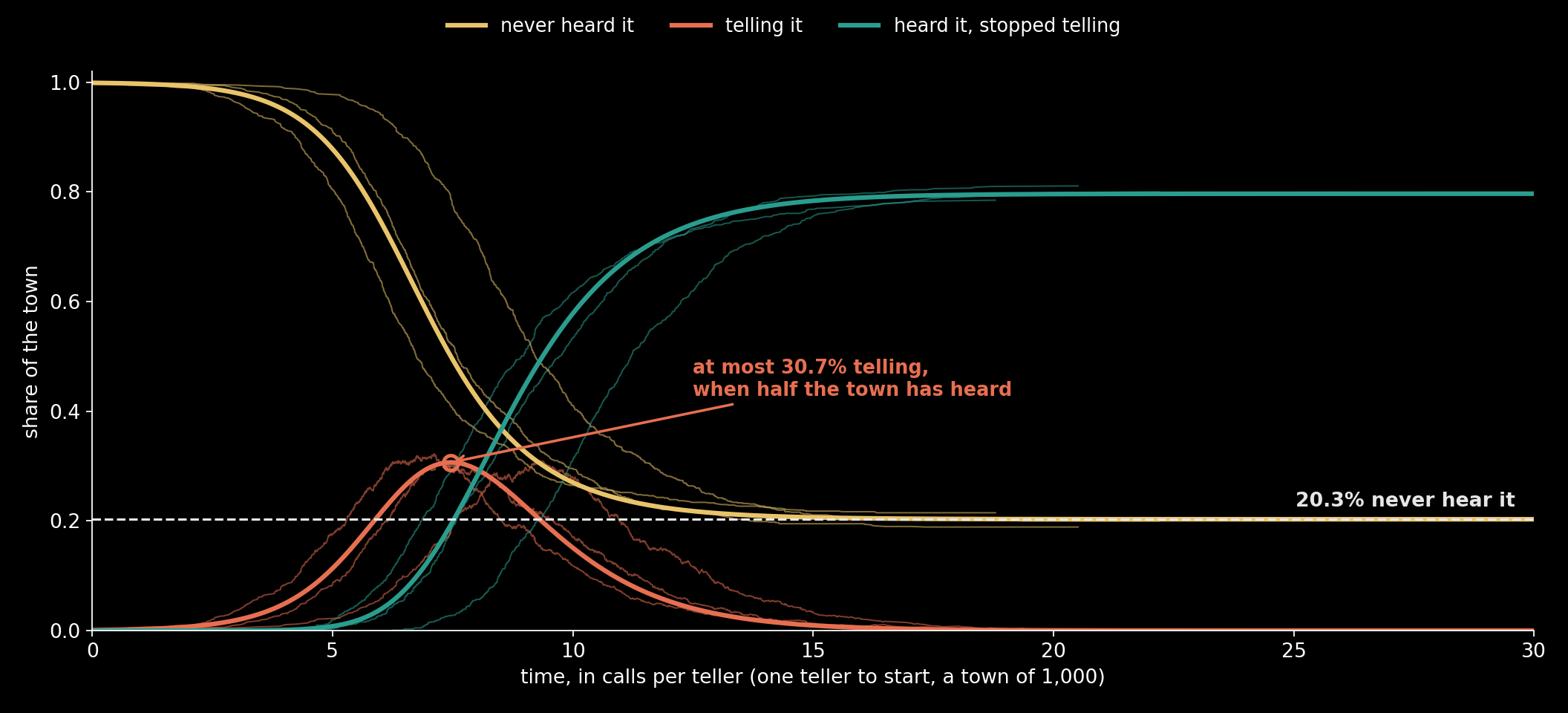
Suppose everyone in town follows that one rule and nobody is shy. Every teller makes new tellers, so the news ought to reach everybody. It does not. When the last teller falls silent, about one person in five has never heard it: 20.3%, in a village of a thousand or a city of a million, whether people talk once a day or once a minute. Nobody is hiding and nobody is left out on purpose. The rule stops itself.

Three Kinds of People
Mathematicians split the town the way the story does, under the names the field has used ever since: ignorants, who have not heard; spreaders, who are telling it; and stiflers, who heard it and have stopped. In 1964 D. J. Daley and D. G. Kendall wrote a single page in Nature, “Epidemics and Rumours”, and worked the idea out in full the next year in “Stochastic Rumours”. In their version people meet in pairs: a spreader who meets an ignorant makes a second spreader, two spreaders who meet both fall silent, and a spreader who meets a stifler stops.
In 1973 Daniel Maki and Maynard Thompson, in their book Mathematical Models and Applications, gave the simpler rule this post is about. A spreader calls one person, chosen at random. If that person has not heard, they become a spreader too. If they already knew, spreader or stifler, the caller is disappointed and stops for good.
One in Five, on a Napkin
Let $x$ be the share of the town that has not heard and $y$ the share telling, and let every teller make one call per unit of time. A call reaches someone new with chance $x$: one more teller, one fewer ignorant. It reaches someone who knew with chance $1-x$: one fewer teller. Divide one rate by the other and the clock drops out:
The rumour dies when nobody is left telling, $y = 0$, and the share who never heard it, $\theta$, is the root below 1 of the last line; $W_0$ is Lambert’s function, the inverse of $w e^{w}$. One person in five.
The same curve says when the town is busiest. The tellers peak where $dy/dx = 0$, at $x = \tfrac12$, and there $y = 1 – \ln 2 = 0.307$: at no moment are more than three people in ten telling it, and the crowd of tellers is largest exactly when half the town has heard.
Because the clock dropped out, speed cannot change the answer. In a town of 1,000 that starts with one teller, the last teller falls silent after 20.0 units of time. Let everyone talk three times as fast and the end comes at 6.7, three times sooner, with exactly the same 20.3% left out. Speed changes when the rumour ends, never whom it reached.
Maki and Thompson’s own treatment was not rigorous. Aidan Sudbury made it so in 1985: for their model, he showed, “the proportion of the population never hearing the rumour converges in probability to 0.203 as the population size tends to ∞”.
The Epidemic Twin
Write the same bookkeeping for a disease. Let $s$ be the share never infected, $i$ the share sick, $\beta$ the rate at which the sick infect and $\gamma$ the rate at which they recover:
This is the final size of an epidemic in the model W. O. Kermack and A. G. McKendrick published in 1927, a paper written to settle whether an epidemic ends only when nobody is left to catch it, “or whether the interplay of the various factors of infectivity, recovery and mortality, may result in termination, whilst many susceptible individuals are still present”. Halve the tellers and the rumour’s equation is the epidemic’s, with $R_0 = 2$.
In a disease, $R_0$ is set by the germ and by how people live, and it decides how many are spared. In the rumour nothing about the people enters at all. The stopping rule alone pins $R_0$ at exactly 2, and with it the 20.3%.
A Thousand Towns
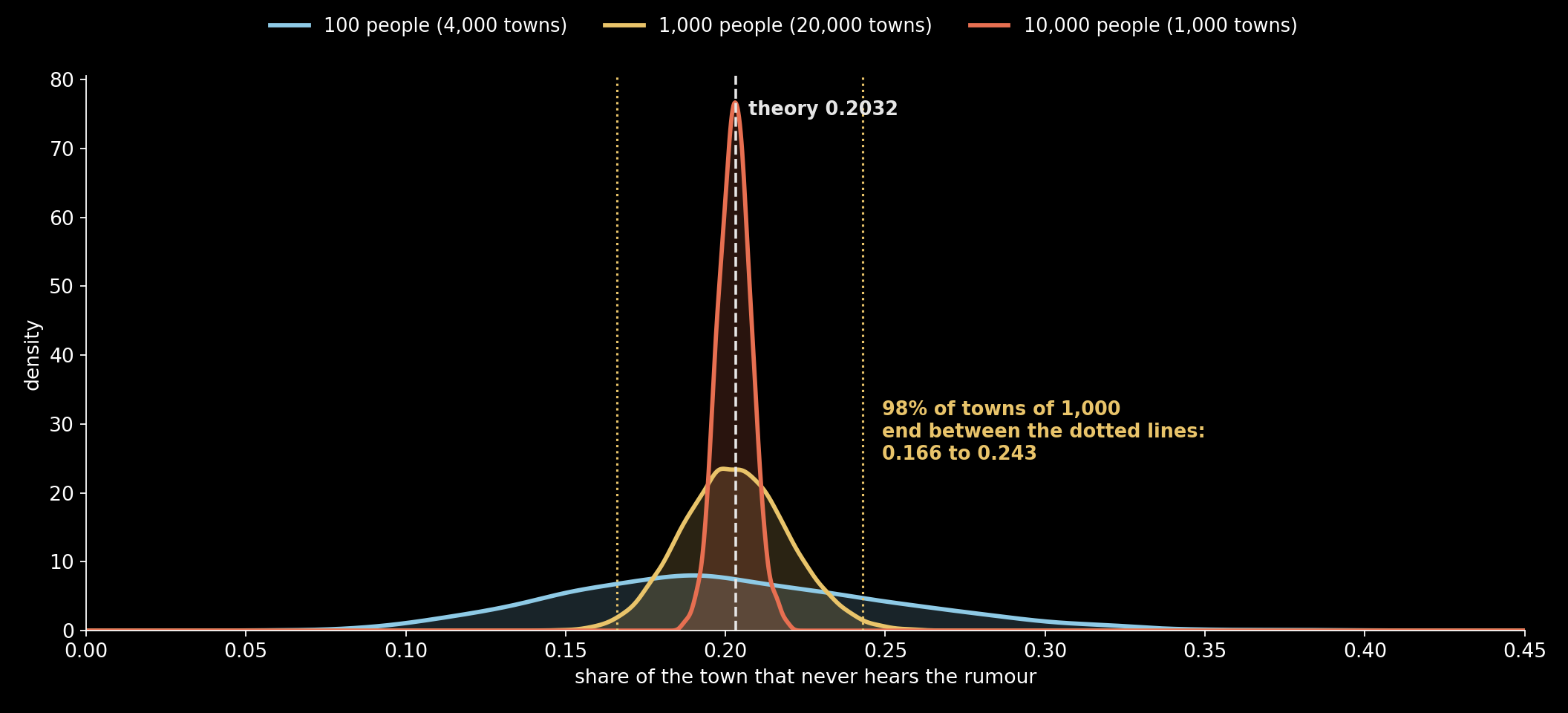
A formula for an endless town is a promise about a real one only if real towns keep it. So I ran the rule itself: one teller, a town of $N$, random calls until the last teller stops, in 4,000 towns of 100 and of 1,000 people and 1,000 towns of 10,000. On average 20.04%, 20.31% and 20.29% never heard it, against the formula’s 20.32%. The spread from town to town, as a standard deviation, was 5.2, 1.7 and 0.5 percentage points: each tenfold bigger town cut it by a factor of 3.1 and then 3.2, close to the square root of ten.
At 1,000 people, 98% of 20,000 towns ended with between 16.6% and 24.3% unaware, and only three towns in a thousand left more than a quarter of their people in the dark. Daley and Kendall’s paired version gives the same equation: there $x$ falls at rate $2xy$ and $y$ moves at $2y(2x-1)$, so $dy/dx$ is again $-2 + 1/x$. In 300 simulated towns of 1,000, their rule left 20.49% unaware.
Algorithm — A Rumour in a Town of N People
input:  N people, one teller to start
        k = how many who already knew a teller puts up with

ignorants i ← N − 1
lives L ← k                       # the strikes all tellers have left, added up
while L > 0:
    a teller calls someone else, chosen at random
    with chance i / (N − 1):  they had not heard     i ← i − 1,  L ← L + k
    otherwise:                they already knew      L ← L − 1
share never told ← i / N

theory, for a large town:  θ = exp(−(k + 1)(1 − θ)), the root below 1, by bisection

on a network, a teller calls a random FRIEND instead:
    pick a teller v at random and a friend w of v at random
    if w had not heard:  w becomes a teller
    else:                v stops
    repeat until nobody is telling
But Did You Hear…?
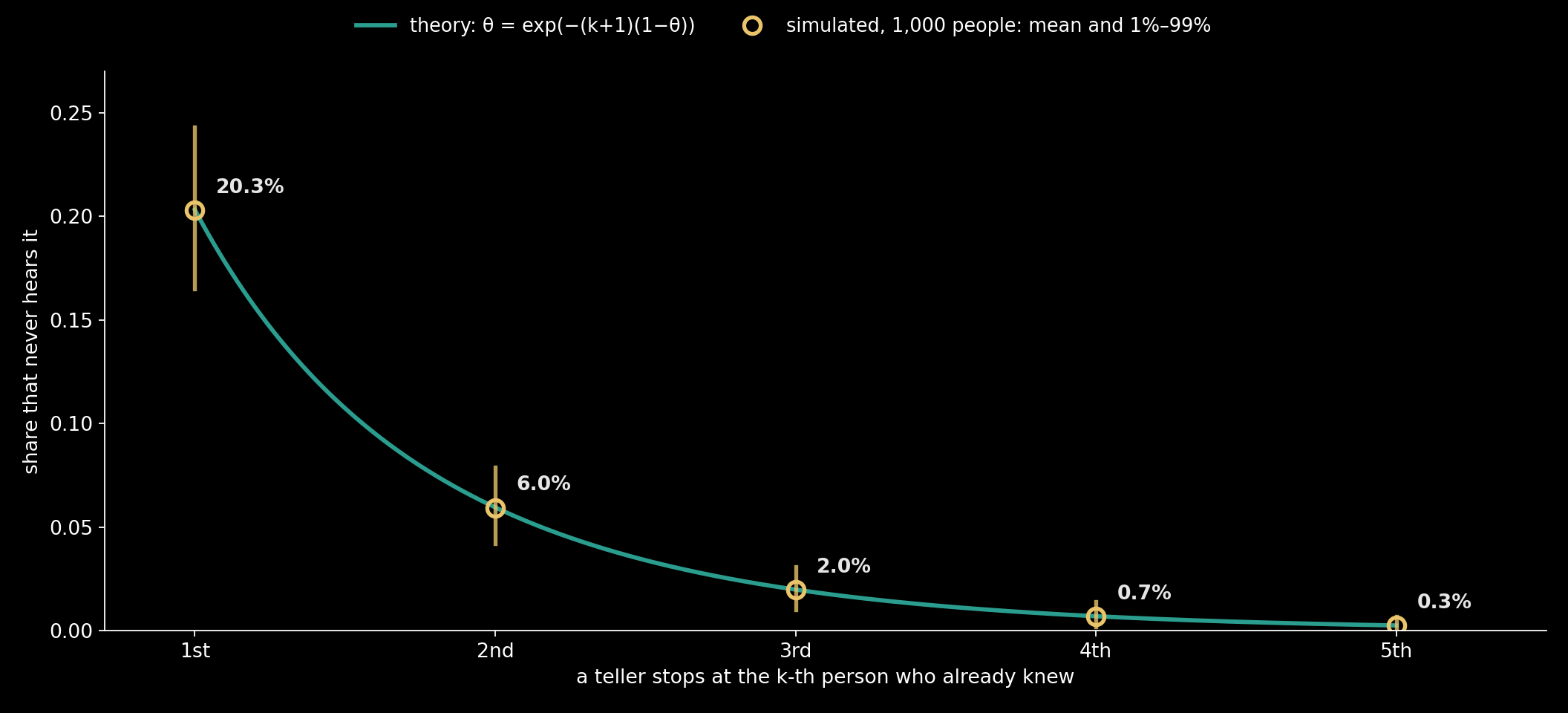
Not everyone gives up at the first I know. Let a teller keep going until the $k$-th person who already knew. The bookkeeping that solves it is short. Give each new teller $k$ lives and count $\ell$, the lives left in the whole town per person. A call to someone new adds a teller and $k$ lives; a call to someone who knew costs one life:
Who makes each call does not matter, only how many lives are left, so the count of ignorants and lives is a chain of its own: the share it ends with is exactly that of the full model, and the formula is its limit for a large town. With $k = 1$ it is Maki and Thompson’s rule again.
A second but did you hear cuts the unaware from 20.3% to 6.0%, a third to 2.0%, then 0.7% and 0.3%. Each extra strike divides them by 3.4, 3.0, 2.8 and 2.8, a factor that settles towards $e \approx 2.72$ for the very stubborn. Simulated towns of 1,000 agree: 5.93%, 1.98%, 0.70% and 0.25%.
Real Towns Have Friends
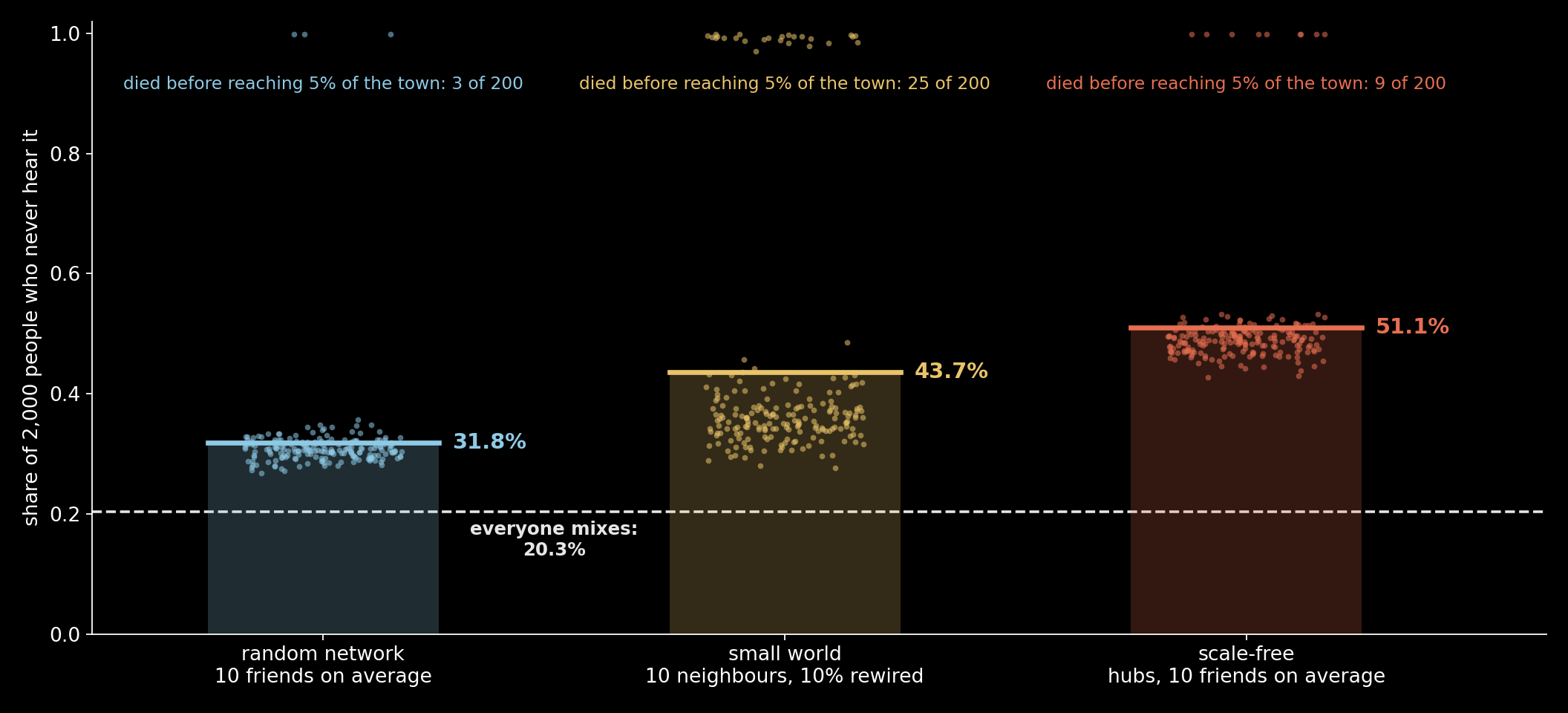
Nobody calls a stranger with gossip. People tell their friends, so I gave the town of 2,000 a network and let each teller call a random friend instead, 200 rumours on each of three. A random network, 10,000 friendships drawn at random, ten friends each on average: 31.8% never heard it. A small world in the sense of Duncan Watts and Steven Strogatz (1998), everyone linked to their ten nearest neighbours on a ring with a tenth of the links rewired at random: 43.7%. A scale-free network in the sense of Albert-László Barabási and Réka Albert (1999), where each newcomer befriends five people and prefers the well connected, so that six hubs gather more than a hundred friends each, the largest 143: 51.1%. On a plain ring with no rewiring at all, the rumour never leaves its street: 98.6% never hear it.
Why worse? A friend list is short, and the teller’s own past is on it. In the random network, 20.3% of all the stops were a teller calling back the very friend who had told him, and 16.7% a call to someone he had told himself: more than a third of the disappointments came from calls that a town where everyone mixes almost never makes, one chance in 1,999 each. In the small world, where about half the pairs of anyone’s friends are friends themselves, a further 32.5% of the stops were calls to someone who had heard it from a mutual friend. Networks also kill rumours early: 3, 25 and 9 of the 200 died before reaching even 5% of the town, which is why the small world’s typical rumour leaves 36.1% unaware while its average is 43.7%.
Yamir Moreno, Maziar Nekovee and Amalio Pacheco found the same direction in 2004 by another route, solving equations for each class of connectedness rather than drawing a network, with six friends on average: 59.2% of a scale-free population ever learns the rumour, against 79.7% from the formula for a population where everyone is alike. Those left out are the poorly connected; in their words, “hubs effectively learn the rumor”.
Word of Mouth Stops Itself
The rule that ends a rumour is the rule that makes it worth telling: you talk because the face is new, and you stop when it is not. In a town where everyone mixes, that leaves a fifth unaware; in a town of friends, a third to a half. Talking faster changes the date and nothing else. If something has to reach everyone, a recall, a boil-water notice, a change of plan, word of mouth is the wrong tool, because it is built to stop. Stubbornness helps, each extra round of but did you hear cutting the unaware about threefold, and a broadcast, which does not care who already knew, helps most of all.
Sources
- D. J. Daley and D. G. Kendall, “Epidemics and Rumours”, Nature 204 (1964) 1118.
- D. J. Daley and D. G. Kendall, “Stochastic Rumours”, IMA Journal of Applied Mathematics 1 (1965) 42–55.
- D. P. Maki and M. Thompson, Mathematical Models and Applications, with Emphasis on the Social, Life, and Management Sciences, Prentice-Hall, Englewood Cliffs, N.J. (1973).
- A. Sudbury, “The proportion of the population never hearing a rumour”, Journal of Applied Probability 22 (1985) 443–446.
- W. O. Kermack and A. G. McKendrick, “A contribution to the mathematical theory of epidemics”, Proceedings of the Royal Society of London, Series A 115 (1927) 700–721.
- D. J. Watts and S. H. Strogatz, “Collective dynamics of ‘small-world’ networks”, Nature 393 (1998) 440–442.
- A.-L. Barabási and R. Albert, “Emergence of Scaling in Random Networks”, Science 286 (1999) 509–512.
- Y. Moreno, M. Nekovee and A. F. Pacheco, “Dynamics of rumor spreading in complex networks”, Physical Review E 69 (2004) 066130.
Every number in the text and the charts is computed by the script archived with this post, from simulations solved once (seed 20261022) and checked against the formulas.
Interested in applying these ideas to your work? Get in touch.